AQA · GCSE · Combined Science
Course version: 8464 · Version from Sept 2018
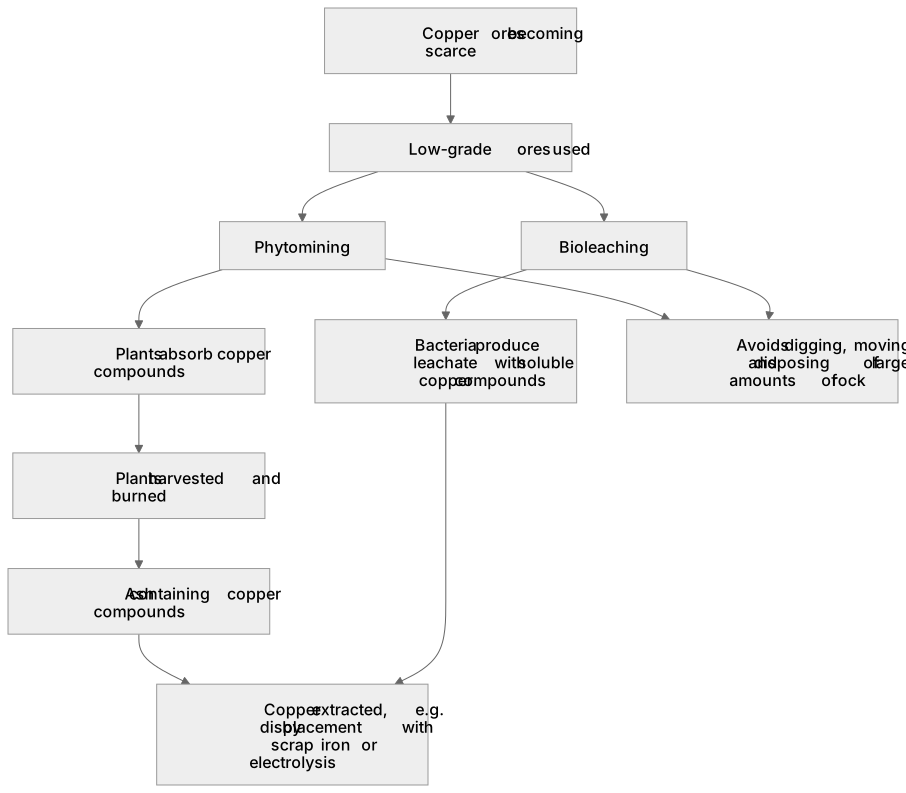
Alternative methods of extracting metals (HT only): Copper ores are becoming scarce and new ways of extracting copper from low-grade ores include phytomining, and bioleaching. These methods avoid traditional mining methods of digging, moving and disposing of large amounts of rock.
Copper is a finite resource; high-grade ores are depleting, making low-grade ores increasingly important.
- 3 key terms
Study notes
From the checked teaching notes for this specification point.
The idea
Copper is a finite resource; high-grade ores are depleting, making low-grade ores increasingly important. Traditional mining digs, moves and disposes of huge volumes of rock, which is energy-intensive and damages landscapes. Phytomining and bioleaching are alternative biological methods (assessed at Higher Tier only) extracting copper from low-grade ores without large-scale digging. Phytomining grows plants that absorb copper compounds; harvesting and burning them produces ash rich in copper compounds. Bioleaching uses bacteria to convert insoluble copper compounds into soluble ones. Both produce a leachate or ash from which copper is obtained, e.g., by displacement with scrap iron or electrolysis.
What earns the marks
- Copper ores are finite and high-grade ores are becoming scarce, so low-grade ores must be used.
- Traditional mining involves digging, moving and disposing of large amounts of rock, which is costly and environmentally damaging.
- Phytomining uses plants to absorb metal compounds from the soil; the plants are harvested and burned to produce ash containing metal compounds.
- Bioleaching uses bacteria to produce a solution (leachate) containing soluble copper compounds from insoluble copper compounds in low-grade ore.
- Copper can be extracted from the ash or leachate, for example by displacement using scrap iron or by electrolysis.
Common mistakes and how to put them right
Thinking phytomining involves burning plants to release copper metal directly.
Put it right: Burning produces ash containing copper compounds, and further processing is needed to obtain copper.
Confusing bioleaching with phytomining.
Put it right: Bioleaching uses bacteria to produce a copper-containing leachate, while phytomining uses plants and ash.
Stating that these methods avoid all environmental impact.
Put it right: They reduce digging, moving and disposal of rock but still require energy, land and processing, so some impact remains.
Believing low-grade ores contain no copper.
Put it right: They contain small amounts of copper compounds, which can still be extracted economically by these methods.
Exam tips
- Link scarcity of copper ores to the need for alternative methods when explaining why phytomining and bioleaching are used.
- Contrast traditional mining with the alternatives by naming the specific avoided processes: digging, moving and disposing of large amounts of rock.
- Use precise terms such as low-grade ore, leachate, ash and displacement, and avoid vague phrases like 'environmentally friendly' without explanation.
- Remember that phytomining and bioleaching are Higher Tier only topics.
Try the lesson
The start of the Alternative methods of extracting metals (HT only): Copper ores are becoming scarce and new ways of extracting copper from low-grade ores include phytomining, and bioleaching. These methods avoid traditional mining methods of digging, moving and disposing of large amounts of rock. lesson, made from checked teaching notes for this specification point.
Have a go first
Why are alternative methods like phytomining and bioleaching increasingly used to extract copper from low-grade ores?
Listen
Copper is a finite resource; high-grade ores are depleting, making low-grade ores increasingly important. Traditional mining digs, moves and disposes of huge volumes of rock, which is energy-intensive and damages landscapes. Phytomining and bioleaching are alternative biological methods (assessed at Higher Tier only) extracting copper from low-grade ores without large-scale digging. Phytomining grows plants that absorb copper compounds; harvesting and burning them produces ash rich in copper compounds. Bioleaching uses bacteria to convert insoluble copper compounds into soluble ones. Both produce a leachate or ash from which copper is obtained, e.g., by displacement with scrap iron or electrolysis. A strong answer earns marks for these points. Copper ores are finite and high-grade ores are becoming scarce, so low-grade ores must be used. Traditional mining involves digging, moving and disposing of large amounts of rock, which is costly and environmentally damaging. Phytomining uses plants to absorb metal compounds from the soil; the plants are harvested and burned to produce ash containing metal compounds. Bioleaching uses bacteria to produce a solution (leachate) containing soluble copper compounds from insoluble copper compounds in low-grade ore. A common slip: Thinking phytomining involves burning plants to release copper metal directly. Instead, burning produces ash containing copper compounds, and further processing is needed to obtain copper. Exam tip: Link scarcity of copper ores to the need for alternative methods when explaining why phytomining and bioleaching are used.
See it
Key words
Say what each word means before you turn the card.
Phytomining
Try answering aloud or in your head before turning the card.
Bioleaching
Try answering aloud or in your head before turning the card.
Leachate
Try answering aloud or in your head before turning the card.
See every definition
- Phytomining
- Growing plants that absorb copper compounds, then harvesting and burning them to produce ash rich in copper compounds.
- Bioleaching
- Using bacteria to convert insoluble copper compounds into soluble ones, producing a leachate from which copper is obtained.
- Leachate
- The solution containing soluble copper compounds produced by bacteria from insoluble copper compounds in low-grade ore.
Label the diagram
Some boxes have lost their names. Pick the right name for each number.
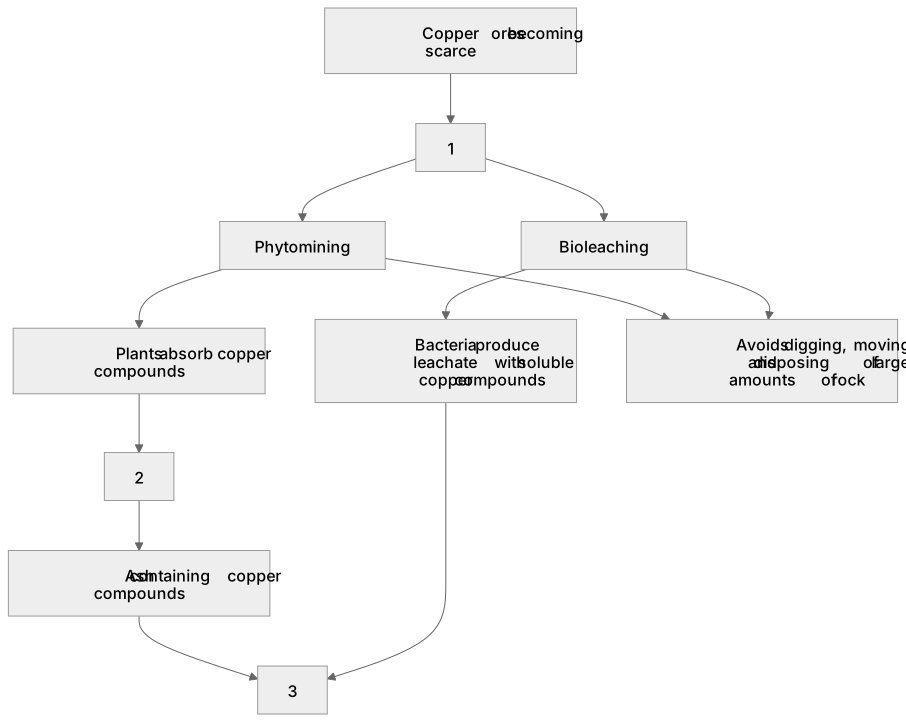
1Box 1
2Box 2
3Box 3
There is more to this lesson
The full lesson goes on to check your understanding and help you earn the marks. Create a free account to carry on, with your progress saved.
A week of Premium from your first lesson · Then the free plan continues · No card, no charge
Test your understanding of Alternative methods of extracting metals (HT only): Copper ores are becoming scarce and new ways of extracting copper from low-grade ores include phytomining, and bioleaching. These methods avoid traditional mining methods of digging, moving and disposing of large amounts of rock.
Active recall beats re-reading. Take an instant quiz now to test what you’ve learned and lock it into long-term memory.
A week of Premium from your first lesson · Then the free plan continues · No card, no charge