AQA · GCSE · Combined Science
Course version: 8464 · Version from Sept 2018
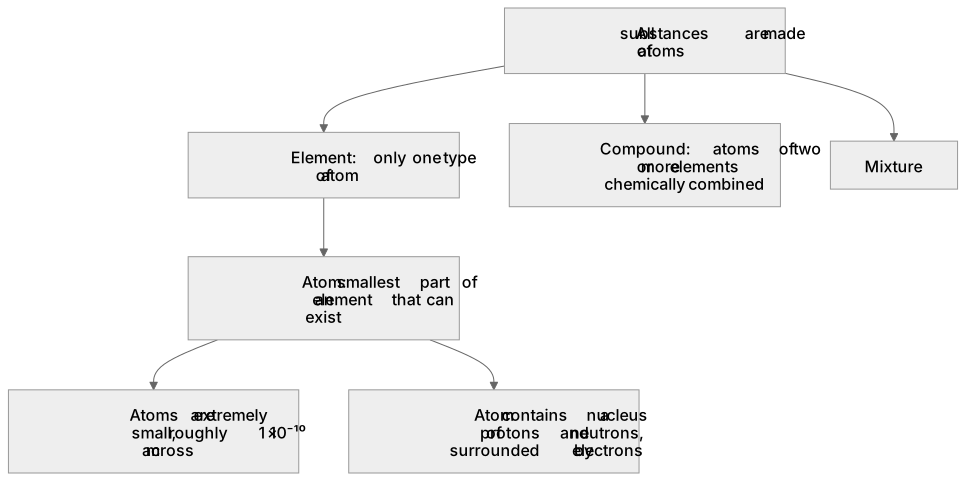
Atoms, elements and compounds: All substances are made of atoms. An atom is the smallest part of an element that can exist.
This statement establishes the particle model that underpins all of chemistry.
- 4 key terms
Study notes
From the checked teaching notes for this specification point.
The idea
This statement establishes the particle model that underpins all of chemistry. Every substance, whether an element, a compound or a mixture, is built from atoms, so the properties of a material come from the atoms it contains and how they are arranged. An element contains only one type of atom, and that single atom is the smallest piece of the element that can exist. For example, a piece of copper is made of countless copper atoms; if you kept dividing it, you would eventually reach one copper atom, and splitting that atom would give particles that are no longer copper. Atoms are extremely small, roughly 1 × 10⁻¹⁰ m across, so they cannot be seen with a school light microscope. They are not indivisible, however: each atom has a nucleus containing protons and neutrons, surrounded by electrons.
What earns the marks
- States that all substances are made of atoms, including elements, compounds and mixtures.
- Defines an atom as the smallest part of an element that can exist.
- Recognises that an element contains only one type of atom.
- Explains that atoms are the building blocks of all materials and are too small to see with a light microscope.
- Uses the idea that atoms themselves contain smaller particles, such as protons, neutrons and electrons, so they are not indivisible.
Common mistakes and how to put them right
Saying an atom is the smallest particle that exists.
Put it right by specifying the smallest part of an element, because atoms contain protons, neutrons and electrons.
Confusing atoms with molecules.
Put it right by noting that a molecule is two or more atoms bonded together, whereas an atom is a single particle of an element.
Thinking compounds contain only one type of atom.
Put it right by stating that a compound contains atoms of two or more elements chemically combined.
Exam tips
- Use the exact phrase 'smallest part of an element' when defining an atom, because vague wording such as 'smallest thing' loses credit.
- Link the definition to a named element, for example copper or oxygen, to show the idea applies to a real substance.
- If asked why atoms cannot be seen, refer to their very small size, roughly 1 × 10⁻¹⁰ m, rather than saying they are invisible.
Try the lesson
The start of the Atoms, elements and compounds: All substances are made of atoms. An atom is the smallest part of an element that can exist. lesson, made from checked teaching notes for this specification point.
Have a go first
Which statement about atoms is correct?
See it
Key words
Say what each word means before you turn the card.
Atom
Try answering aloud or in your head before turning the card.
Element
Try answering aloud or in your head before turning the card.
Particle model of matter
Try answering aloud or in your head before turning the card.
Structure of the atom
Try answering aloud or in your head before turning the card.
See every definition
- Atom
- The smallest part of an element that can exist.
- Element
- A substance that contains only one type of atom.
- Particle model of matter
- The model that all substances are made of atoms, including elements, compounds and mixtures.
- Structure of the atom
- Each atom has a nucleus containing protons and neutrons, surrounded by electrons.
Label the diagram
Some boxes have lost their names. Pick the right name for each number.
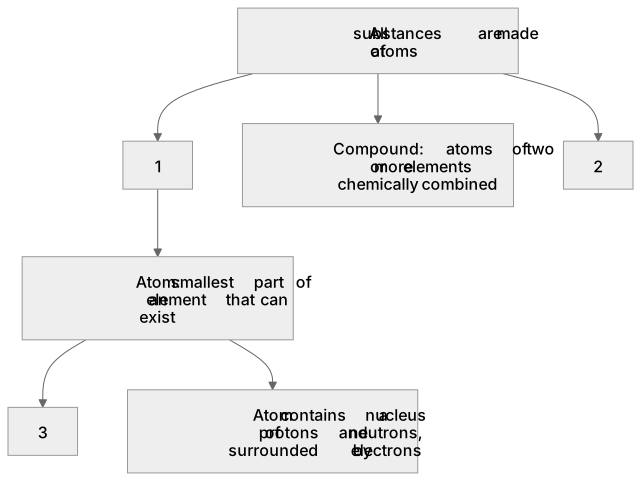
1Box 1
2Box 2
3Box 3
There is more to this lesson
The full lesson goes on to check your understanding and help you earn the marks. Create a free account to carry on, with your progress saved.
A week of Premium from your first lesson · Then the free plan continues · No card, no charge
Test your understanding of Atoms, elements and compounds: All substances are made of atoms. An atom is the smallest part of an element that can exist.
Active recall beats re-reading. Take an instant quiz now to test what you’ve learned and lock it into long-term memory.
A week of Premium from your first lesson · Then the free plan continues · No card, no charge