AQA · GCSE · Combined Science
Course version: 8464 · Version from Sept 2018
Atoms, elements and compounds: Atoms of each element are represented by a chemical symbol, eg O represents an atom of oxygen, Na represents an atom of sodium.
Chemists use chemical symbols as a universal shorthand for elements.
- 2 key terms
Study notes
From the checked teaching notes for this specification point.
The idea
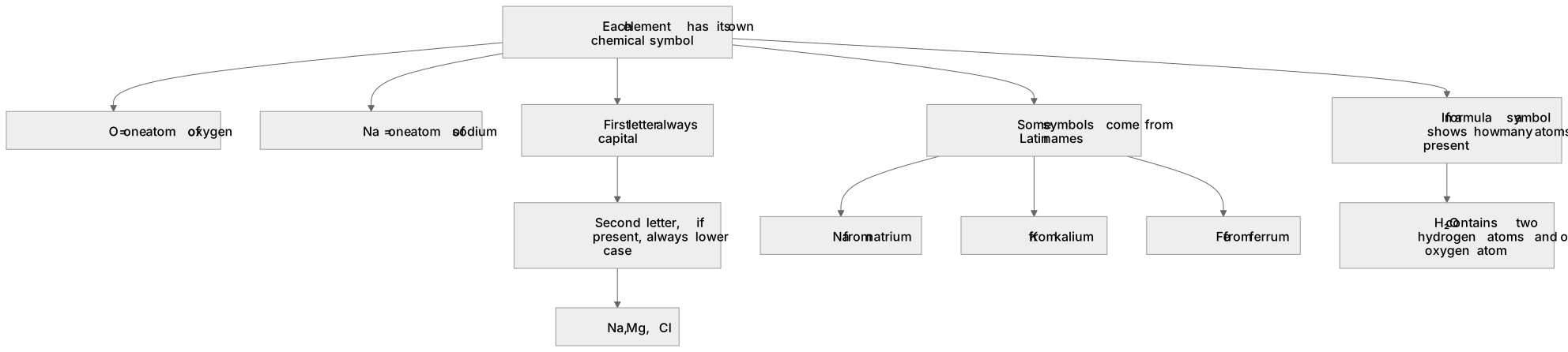
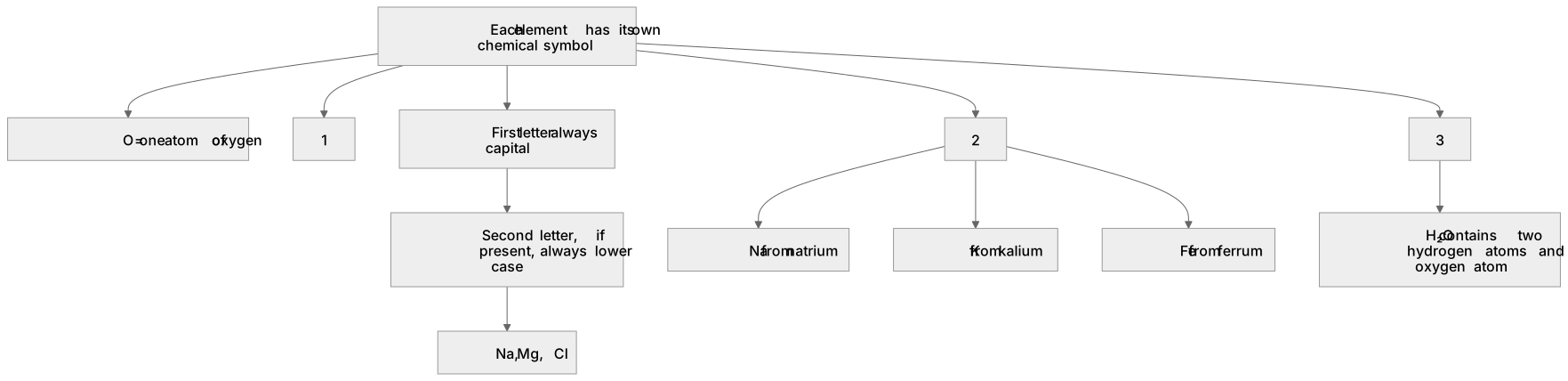
Chemists use chemical symbols as a universal shorthand for elements. Each element has its own symbol, so O means one atom of oxygen and Na means one atom of sodium. Symbols are one or two letters: the first letter is always a capital, and a second letter, if present, is always lower case, as in Na, Mg and Cl. Many symbols come from the English name, but some come from the Latin name, which is why sodium is Na (from natrium), potassium is K (from kalium) and iron is Fe (from ferrum). A symbol can represent one atom of the element, and in a formula it shows how many atoms of that element are present, for example H₂O contains two hydrogen atoms and one oxygen atom. Learning symbols allows scientists worldwide to read and write formulae consistently.
What earns the marks
- States that each element has its own chemical symbol.
- Interprets a symbol such as O or Na as representing one atom of that element.
- Applies the capital-then-lower-case rule when writing symbols, for example Na and Cl.
- Recognises that some symbols come from Latin names, such as Na for sodium and Fe for iron.
- Uses symbols within a formula to show the number of atoms of each element present.
Common mistakes and how to put them right
Writing both letters as capitals, such as NA.
Put it right: Correct this to Na, because only the first letter is a capital.
Treating a symbol as a word abbreviation only.
Put it right by noting that Na represents one atom of sodium, not the word 'sodium'.
Reading H₂O as one hydrogen atom.
Put it right by using the subscript to show two hydrogen atoms and one oxygen atom.
Exam tips
- Learn the symbols for common elements, including those with Latin origins such as Na, K and Fe, because they are frequently used in formulae.
- When naming an element from its symbol, check the capital and lower-case letters carefully before answering.
- Practise counting atoms in formulae such as CO₂ and CaCO₃ so you can link symbols to numbers of atoms.
Try the lesson
The start of the Atoms, elements and compounds: Atoms of each element are represented by a chemical symbol, eg O represents an atom of oxygen, Na represents an atom of sodium. lesson, made from checked teaching notes for this specification point.
Have a go first
The chemical symbol for sodium is Na and the chemical symbol for chlorine is Cl. Which statement correctly describes what these symbols represent?
See it
Key words
Say what each word means before you turn the card.
Chemical symbol
Try answering aloud or in your head before turning the card.
Formula
Try answering aloud or in your head before turning the card.
See every definition
- Chemical symbol
- A representation of an atom of each element, such as O for an atom of oxygen or Na for an atom of sodium.
- Formula
- Shows how many atoms of each element are present, for example H₂O contains two hydrogen atoms and one oxygen atom.
Label the diagram
Some boxes have lost their names. Pick the right name for each number.
1Box 1
2Box 2
3Box 3
There is more to this lesson
The full lesson goes on to check your understanding and help you earn the marks. Create a free account to carry on, with your progress saved.
A week of Premium from your first lesson · Then the free plan continues · No card, no charge
Test your understanding of Atoms, elements and compounds: Atoms of each element are represented by a chemical symbol, eg O represents an atom of oxygen, Na represents an atom of sodium.
Active recall beats re-reading. Take an instant quiz now to test what you’ve learned and lock it into long-term memory.
A week of Premium from your first lesson · Then the free plan continues · No card, no charge