AQA · GCSE · Combined Science
Course version: 8464 · Version from Sept 2018
Atoms, elements and compounds: Chemical reactions can be represented by word equations or equations using symbols and formulae.
A chemical reaction rearranges atoms; the products contain the same atoms as the reactants, only joined differently.
- 4 key terms
Study notes
From the checked teaching notes for this specification point.
The idea
A chemical reaction rearranges atoms; the products contain the same atoms as the reactants, only joined differently. A word equation names reactants and products, for example methane + oxygen → carbon dioxide + water. A symbol equation replaces names with formulae, for example CH₄ + 2O₂ → CO₂ + 2H₂O, and must be balanced so every element has equal atom counts on both sides. State symbols (s), (l), (g) and (aq) may be added. To write one, identify reactants and products, write correct formulae using valencies, then adjust coefficients only, never subscripts, until each element balances. Check by counting atoms of each element on both sides.
What earns the marks
- Word equations name reactants and products and use an arrow, for example sodium + chlorine → sodium chloride.
- Symbol equations use correct chemical formulae, for example H₂O not HO or H₂O₂, and correct state symbols where required.
- Balancing is achieved by changing coefficients in front of formulae, never by altering subscripts within a formula.
- Atom counts for each element must be equal on both sides, demonstrating conservation of mass.
- A balanced equation can be checked element by element, including polyatomic ions treated as units where unchanged.
Common mistakes and how to put them right
Changing a subscript to balance, such as writing H₂O as H₂O₂.
Put it right: Adjust only the large coefficient, for example 2H₂O.
Forgetting that diatomic elements exist as pairs, writing O instead of O₂.
Put it right: Use H₂, N₂, O₂, F₂, Cl₂, Br₂ and I₂ when these elements appear alone.
Miscounting atoms in formulae containing brackets or multiple groups, for example Ca(OH)₂.
Put it right: Multiply every atom inside the bracket by the subscript outside.
Omitting state symbols when the question asks for them.
Put it right: Add (s), (l), (g) or (aq) after each formula as appropriate.
Exam tips
- Underline each element in turn and tally atoms on both sides before finalising your answer.
- If a question gives a word equation, convert names to formulae carefully, using the periodic table and common ion charges.
- Show balancing by writing coefficients clearly; do not erase working that shows your method.
- For 6-mark equation questions, balance first, then add state symbols, then recheck every element.
Try the lesson
The start of the Atoms, elements and compounds: Chemical reactions can be represented by word equations or equations using symbols and formulae. lesson, made from checked teaching notes for this specification point.
Have a go first
Which word equation correctly represents the reaction between magnesium and oxygen to form magnesium oxide?
See it
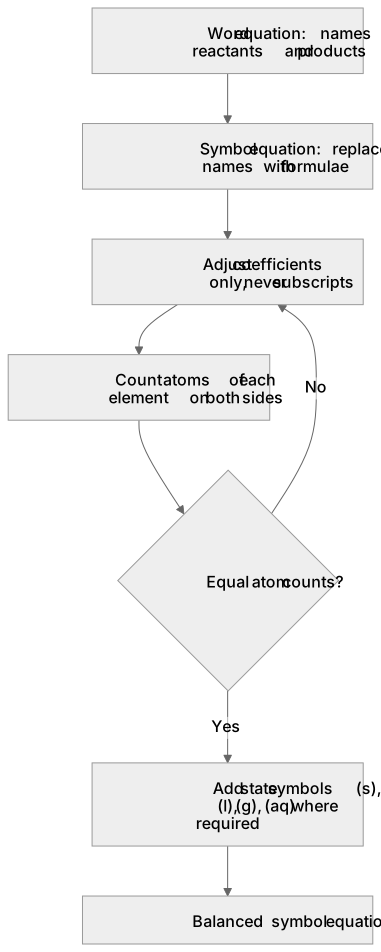
Key words
Say what each word means before you turn the card.
Word equation
Try answering aloud or in your head before turning the card.
Symbol equation
Try answering aloud or in your head before turning the card.
Balancing
Try answering aloud or in your head before turning the card.
State symbols
Try answering aloud or in your head before turning the card.
See every definition
- Word equation
- Names reactants and products and uses an arrow, for example methane + oxygen → carbon dioxide + water.
- Symbol equation
- Replaces names with formulae, for example CH₄ + 2O₂ → CO₂ + 2H₂O, and must be balanced so every element has equal atom counts on both sides.
- Balancing
- Achieved by changing coefficients in front of formulae, never by altering subscripts within a formula, until each element balances.
- State symbols
- (s), (l), (g) and (aq) may be added after each formula as appropriate.
Label the diagram
Some boxes have lost their names. Pick the right name for each number.
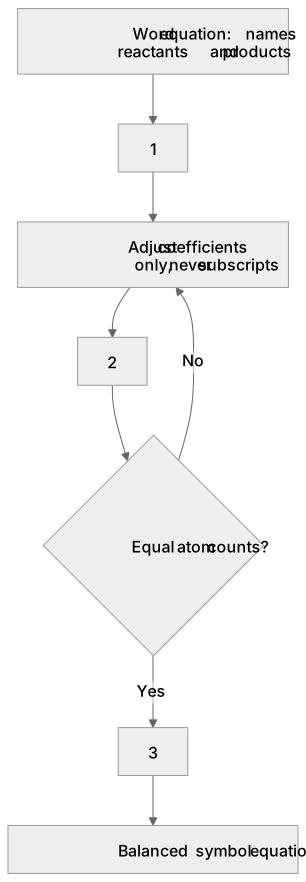
1Box 1
2Box 2
3Box 3
There is more to this lesson
The full lesson goes on to check your understanding and help you earn the marks. Create a free account to carry on, with your progress saved.
A week of Premium from your first lesson · Then the free plan continues · No card, no charge
Test your understanding of Atoms, elements and compounds: Chemical reactions can be represented by word equations or equations using symbols and formulae.
Active recall beats re-reading. Take an instant quiz now to test what you’ve learned and lock it into long-term memory.
A week of Premium from your first lesson · Then the free plan continues · No card, no charge