AQA · GCSE · Combined Science
Course version: 8464 · Version from Sept 2018
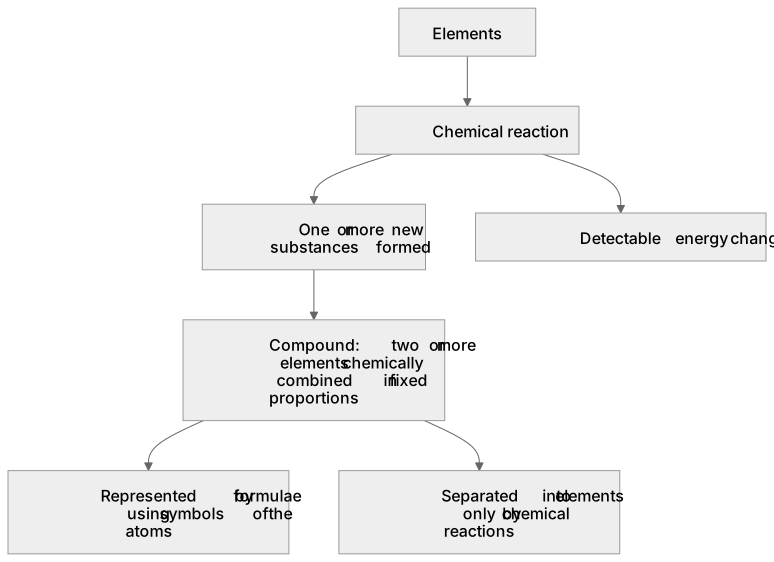
Atoms, elements and compounds: Compounds are formed from elements by chemical reactions. Chemical reactions always involve the formation of one or more new substances, and often involve a detectable energy change. Compounds contain two or more elements chemically combined in fixed proportions and can be represented by formulae using the symbols of the atoms from which they were formed. Compounds can only be separated into elements by chemical reactions.
A compound forms when two or more elements react chemically, producing one or more new substances with different properties from the starting elements.
- 4 key terms
Study notes
From the checked teaching notes for this specification point.
The idea
A compound forms when two or more elements react chemically, producing one or more new substances with different properties from the starting elements. For example, iron and sulfur react to form iron sulfide, which is not magnetic like iron. Chemical reactions often release or absorb energy, seen as temperature, light or sound changes. Compounds have fixed proportions of elements, shown by formulae such as H₂O or CO₂, where the subscripts give the atom ratio. Unlike mixtures, compounds cannot be separated by physical methods like filtration or distillation; they require chemical reactions such as electrolysis or heating with a reducing agent.
What earns the marks
- State that compounds are formed when elements react chemically.
- Explain that chemical reactions produce one or more new substances and often involve a detectable energy change.
- Describe compounds as containing two or more elements chemically combined in fixed proportions.
- Interpret or write formulae such as H₂O and CO₂ to show the ratio of atoms in a compound.
- Explain that compounds can only be separated into elements by chemical reactions, not by physical separation techniques.
Common mistakes and how to put them right
Confusing compounds with mixtures.
Put it right by checking whether a chemical formula with fixed ratios is given.
Thinking energy change always means a temperature rise.
Put it right by stating 'detectable energy change' rather than only 'heat released'.
Believing compounds can be separated by distillation or filtration.
Put it right by stating that chemical reactions such as electrolysis are needed to break compounds into elements.
Exam tips
- When describing a reaction, name the new substance formed and state one observable energy change to cover both parts of the statement.
- Use the formula to count atoms: in CO₂ there is one carbon atom and two oxygen atoms, giving a fixed 1:2 ratio.
- If asked how to separate a compound, name a chemical method such as electrolysis or thermal decomposition, not a physical method.
Try the lesson
The start of the Atoms, elements and compounds: Compounds are formed from elements by chemical reactions. Chemical reactions always involve the formation of one or more new substances, and often involve a detectable energy change. Compounds contain two or more elements chemically combined in fixed proportions and can be represented by formulae using the symbols of the atoms from which they were formed. Compounds can only be separated into elements by chemical reactions. lesson, made from checked teaching notes for this specification point.
Have a go first
Which statement describes what happens when a compound is formed from elements?
See it
Key words
Say what each word means before you turn the card.
Chemical reactions
Try answering aloud or in your head before turning the card.
Compounds
Try answering aloud or in your head before turning the card.
Formulae
Try answering aloud or in your head before turning the card.
Separation of compounds
Try answering aloud or in your head before turning the card.
See every definition
- Chemical reactions
- Processes that always involve the formation of one or more new substances and often involve a detectable energy change.
- Compounds
- Substances containing two or more elements chemically combined in fixed proportions, which can be represented by formulae using the symbols of the atoms from which they were formed.
- Formulae
- Representations of compounds using the symbols of the atoms from which they were formed, showing the fixed proportions of the elements.
- Separation of compounds
- Compounds can only be separated into elements by chemical reactions, not by physical separation techniques.
Label the diagram
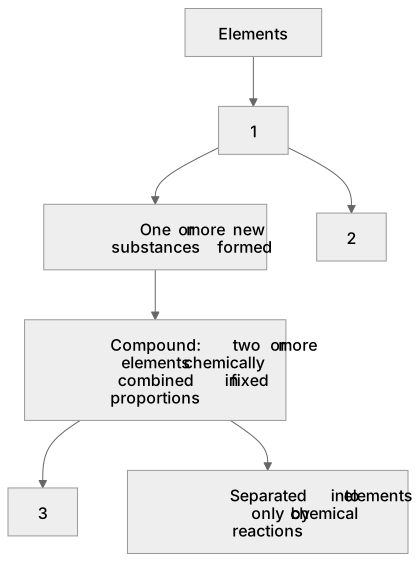
Some boxes have lost their names. Pick the right name for each number.
1Box 1
2Box 2
3Box 3
There is more to this lesson
The full lesson goes on to check your understanding and help you earn the marks. Create a free account to carry on, with your progress saved.
A week of Premium from your first lesson · Then the free plan continues · No card, no charge
Test your understanding of Atoms, elements and compounds: Compounds are formed from elements by chemical reactions. Chemical reactions always involve the formation of one or more new substances, and often involve a detectable energy change. Compounds contain two or more elements chemically combined in fixed proportions and can be represented by formulae using the symbols of the atoms from which they were formed. Compounds can only be separated into elements by chemical reactions.
Active recall beats re-reading. Take an instant quiz now to test what you’ve learned and lock it into long-term memory.
A week of Premium from your first lesson · Then the free plan continues · No card, no charge