AQA · GCSE · Combined Science
Course version: 8464 · Version from Sept 2018
Atoms, elements and compounds: (HT only) write balanced half equations and ionic equations where appropriate.
This skill requires representing electron transfer and solution reactions using balanced equations.
- 4 key terms
Study notes
From the checked teaching notes for this specification point.
The idea
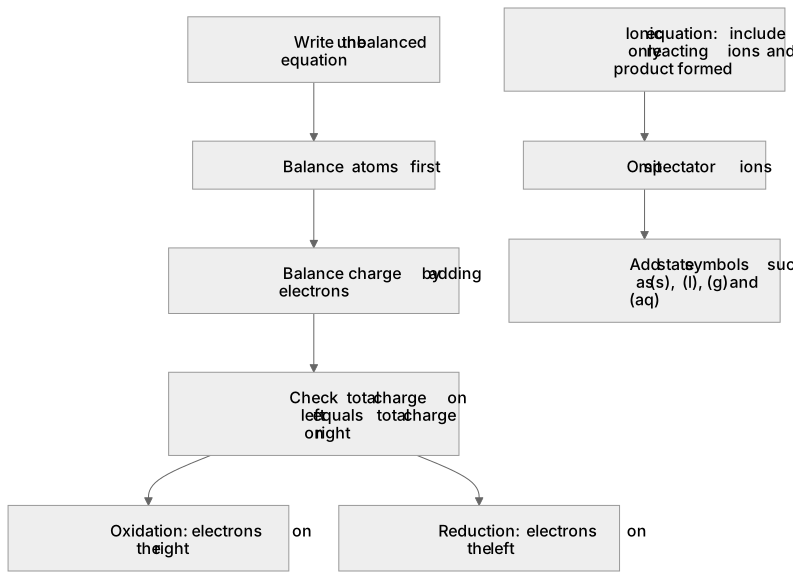
This skill requires representing electron transfer and solution reactions using balanced equations. A half equation shows one species losing or gaining electrons, such as Na → Na⁺ + e⁻. Balance atoms first, then balance the charge by adding electrons. An ionic equation shows only the reacting ions that undergo a change, omitting spectator ions. For example, in the reaction between silver nitrate and sodium chloride solutions, the ionic equation is Ag⁺(aq) + Cl⁻(aq) → AgCl(s). The sodium and nitrate ions are spectator ions. You must balance both atoms and charge in every equation. State symbols are often included to show the physical state. This is assessed by asking you to complete, construct or interpret these equations.
What earns the marks
- Half equations must balance atoms and charge; electrons are shown with the correct number and side.
- Ionic equations include only the reacting ions and the product formed; spectator ions are omitted.
- State symbols such as (s), (l), (g) and (aq) are used correctly where required.
- Coefficients are whole numbers in the simplest ratio; equations are balanced for both mass and charge.
- In oxidation half equations, electrons appear on the right; in reduction half equations, electrons appear on the left.
Common mistakes and how to put them right
Forgetting to balance charge.
Put it right: Add the electron to balance the 1⁺ charge on the right.
Including spectator ions in an ionic equation.
Put it right: Cancel ions that appear unchanged on both sides.
Unbalanced atoms in a half equation.
Put it right: Balance chlorine atoms first to give Cl₂ + 2e⁻ → 2Cl⁻.
Exam tips
- Check charge balance after balancing atoms: total charge on the left must equal total charge on the right.
- For ionic equations, identify the precipitate, gas or molecule formed, then include only the ions that form it.
Try the lesson
The start of the Atoms, elements and compounds: (HT only) write balanced half equations and ionic equations where appropriate. lesson, made from checked teaching notes for this specification point.
Have a go first
Sodium atoms form sodium ions, Na⁺. Which half equation correctly shows this change?
See it
Key words
Say what each word means before you turn the card.
Half equation
Try answering aloud or in your head before turning the card.
Ionic equation
Try answering aloud or in your head before turning the card.
Spectator ions
Try answering aloud or in your head before turning the card.
State symbols
Try answering aloud or in your head before turning the card.
See every definition
- Half equation
- Shows one species losing or gaining electrons, with atoms balanced first and then charge balanced by adding electrons.
- Ionic equation
- Shows only the reacting ions that undergo a change, omitting spectator ions.
- Spectator ions
- Ions that appear unchanged on both sides and are omitted from an ionic equation.
- State symbols
- Symbols such as (s), (l), (g) and (aq) often included to show the physical state.
Label the diagram
Some boxes have lost their names. Pick the right name for each number.
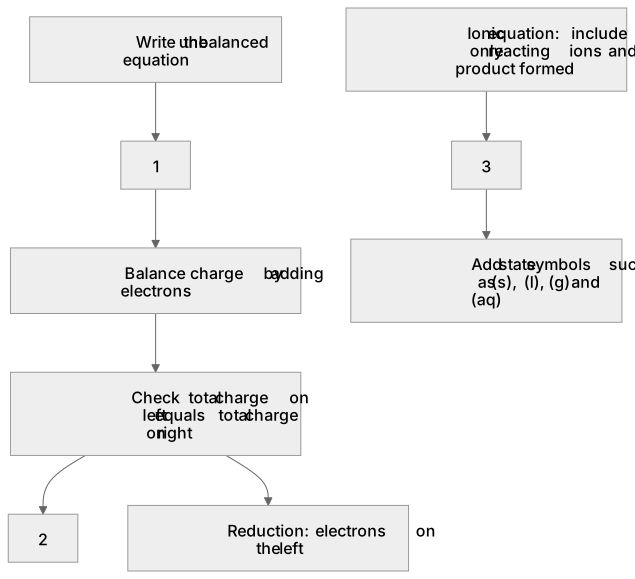
1Box 1
2Box 2
3Box 3
There is more to this lesson
The full lesson goes on to check your understanding and help you earn the marks. Create a free account to carry on, with your progress saved.
A week of Premium from your first lesson · Then the free plan continues · No card, no charge
Test your understanding of Atoms, elements and compounds: (HT only) write balanced half equations and ionic equations where appropriate.
Active recall beats re-reading. Take an instant quiz now to test what you’ve learned and lock it into long-term memory.
A week of Premium from your first lesson · Then the free plan continues · No card, no charge