AQA · GCSE · Combined Science
Course version: 8464 · Version from Sept 2018
Atoms, elements and compounds: Students will be supplied with a periodic table for the exam and should be able to:
In the exam, you receive a periodic table.
- 3 key terms
Study notes
From the checked teaching notes for this specification point.
The idea
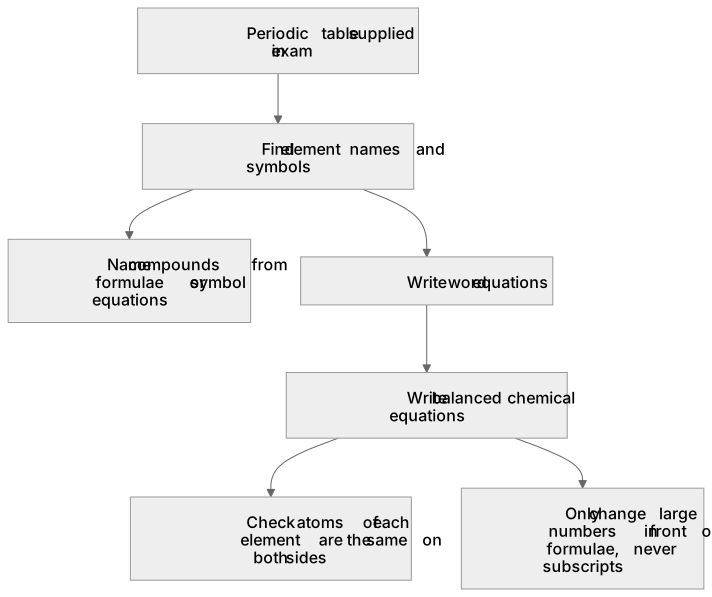
In the exam, you receive a periodic table. You must use it to find element names and symbols, particularly for the first 20 elements, Groups 1 and 7, and others in the specification. You should be able to name compounds from given formulae or symbol equations, such as naming NaCl as sodium chloride. Additionally, you must write word equations and balanced chemical equations for reactions. For example, writing the word equation 'hydrogen + oxygen → water' and the balanced symbol equation '2H₂ + O₂ → 2H₂O'. The periodic table helps identify elements to construct these equations accurately. Note that for main-group elements, the group number equals the outer-shell electrons, except for Group 0.
What earns the marks
- Use the periodic table to identify names and symbols of the first 20 elements, Group 1, Group 7, and other specified elements.
- Name compounds correctly when given their chemical formulae or symbol equations.
- Write accurate word equations for chemical reactions described in the specification.
- Write correct chemical formulae and construct balanced chemical equations for specified reactions.
Common mistakes and how to put them right
Misidentifying element symbols due to incorrect capitalisation.
Put it right: Ensure the first letter is uppercase and the second is lowercase (e.g., Co, not CO).
Failing to balance chemical equations correctly.
Put it right: Ensure the number of atoms of each element is the same on both sides of the equation.
Overgeneralising group number rules.
Put it right: While group number equals outer-shell electrons for Groups 1-7, Group 0 elements have full outer shells.
Exam tips
- Always check the periodic table for the correct spelling of element names and exact symbols.
- When writing balanced equations, only change the large numbers (coefficients) in front of formulae, never the small subscript numbers.
Try the lesson
The start of the Atoms, elements and compounds: Students will be supplied with a periodic table for the exam and should be able to: lesson, made from checked teaching notes for this specification point.
Have a go first
A student is given a periodic table in a GCSE Chemistry exam. Which piece of information about an element is shown in every box of that table?
See it
Key words
Say what each word means before you turn the card.
Chemical symbols and names
Try answering aloud or in your head before turning the card.
Naming compounds
Try answering aloud or in your head before turning the card.
Writing and balancing equations
Try answering aloud or in your head before turning the card.
See every definition
- Chemical symbols and names
- Use the periodic table to find element names and symbols, particularly for the first 20 elements, Groups 1 and 7, and others in the specification.
- Naming compounds
- Name compounds correctly when given their chemical formulae or symbol equations, such as naming NaCl as sodium chloride.
- Writing and balancing equations
- Write word equations and balanced chemical equations for reactions, ensuring the number of atoms of each element is the same on both sides.
Label the diagram
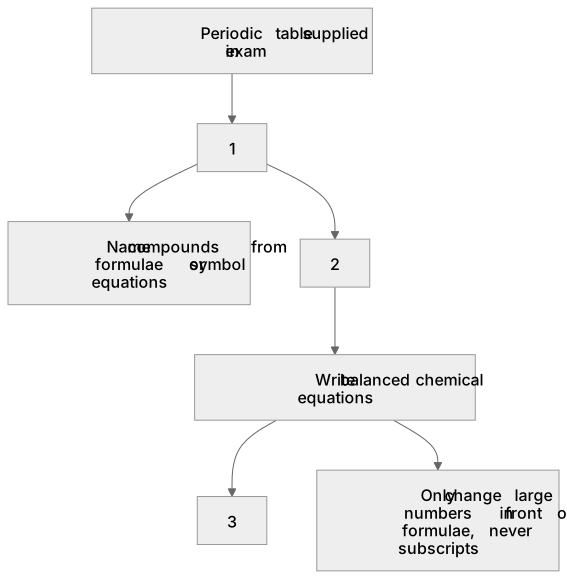
Some boxes have lost their names. Pick the right name for each number.
1Box 1
2Box 2
3Box 3
There is more to this lesson
The full lesson goes on to check your understanding and help you earn the marks. Create a free account to carry on, with your progress saved.
A week of Premium from your first lesson · Then the free plan continues · No card, no charge
Test your understanding of Atoms, elements and compounds: Students will be supplied with a periodic table for the exam and should be able to:
Active recall beats re-reading. Take an instant quiz now to test what you’ve learned and lock it into long-term memory.
A week of Premium from your first lesson · Then the free plan continues · No card, no charge