AQA · GCSE · Combined Science
Course version: 8464 · Version from Sept 2018
Biotic factors: availability of food
Food availability is a biotic factor: the amount of suitable food in a habitat that a population can actually obtain.
Study notes
From the checked teaching notes for this specification point.
The idea
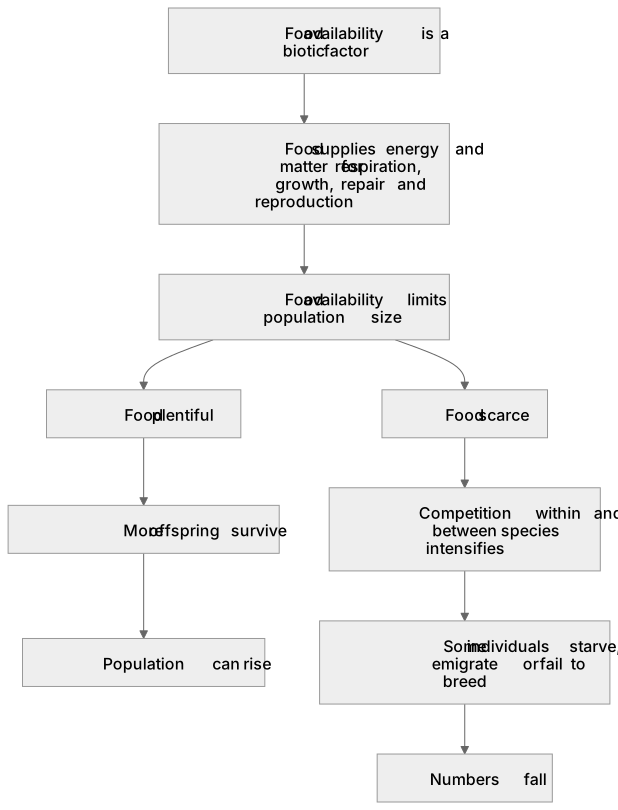
Food availability is a biotic factor: the amount of suitable food in a habitat that a population can actually obtain. It sets a limit on how many individuals an area can support, because every organism needs energy and matter from food for respiration, growth, repair and reproduction. If food is plentiful, more offspring survive and the population can rise; if food becomes scarce, competition within and between species intensifies, so some individuals starve, emigrate or fail to breed, and numbers fall. Availability changes with season, weather, disease and human activity. For example, oak trees produce mast years with many acorns, and grey squirrel numbers often rise afterwards. Ecologists sample populations and food supply to link the two.
What earns the marks
- States that food is a biotic factor because it comes from other living organisms, including plants, animals and decaying material.
- Explains that food supplies energy and matter for respiration, growth, repair and reproduction, so it limits population size.
- Describes how increased food availability can raise survival of offspring and allow population growth.
- Describes how reduced food availability causes starvation, emigration, reduced breeding or death, lowering population size.
- Uses the idea of competition: individuals compete for limited food, and only some obtain enough to survive and reproduce.
- Applies the factor to a named example, such as acorns affecting squirrel numbers or aphids affecting ladybird numbers.
- Recognises that food availability varies with season, weather, disease and human activities such as farming or deforestation.
Common mistakes and how to put them right
Treating food as an abiotic factor.
Put it right by stressing that food is produced by living organisms, so it is biotic.
Assuming more food always means unlimited population growth.
Put it right by noting that predators, disease, space and other factors also limit populations.
Confusing food availability with territory or shelter.
Put it right by defining food as material eaten for energy and matter, while shelter is a different resource.
Exam tips
- Name the factor as biotic and justify it by linking food to living organisms.
- Use a chain of reasoning: food changes → competition or survival changes → population changes.
- Give a named organism and a specific food source to make the answer concrete.
- Use comparative words such as more, fewer, increase and decrease to show the direction of change.
Try the lesson
The start of the Biotic factors: availability of food lesson, made from checked teaching notes for this specification point.
Have a go first
In a woodland, the number of slugs increases after a rainy summer because more young plants are growing. Which biotic factor has changed to allow the slug population to grow?
See it
Label the diagram
Some boxes have lost their names. Pick the right name for each number.
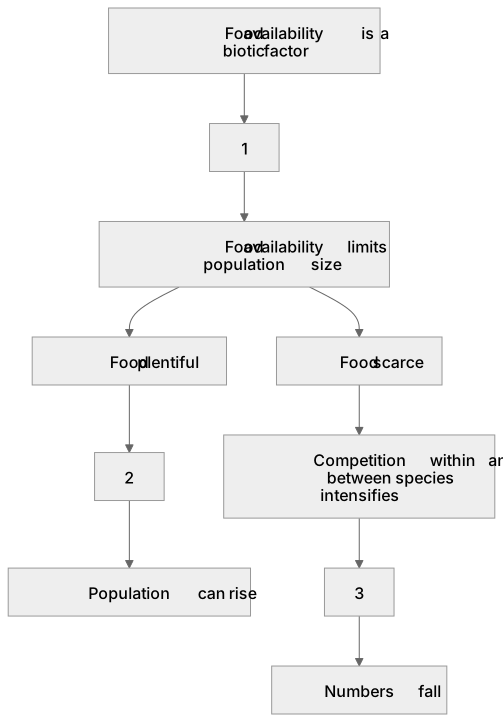
1Box 1
2Box 2
3Box 3
There is more to this lesson
The full lesson goes on to check your understanding and help you earn the marks. Create a free account to carry on, with your progress saved.
A week of Premium from your first lesson · Then the free plan continues · No card, no charge
Test your understanding of Biotic factors: availability of food
Active recall beats re-reading. Take an instant quiz now to test what you’ve learned and lock it into long-term memory.
A week of Premium from your first lesson · Then the free plan continues · No card, no charge