AQA · GCSE · Combined Science
Course version: 8464 · Version from Sept 2018
Biotic factors: new predators arriving
A new predator arriving is a biotic factor because it is a living organism that eats other organisms.
- 4 key terms
Study notes
From the checked teaching notes for this specification point.
The idea
A new predator arriving is a biotic factor because it is a living organism that eats other organisms. When a predator enters an ecosystem where prey have not evolved defences against it, it can quickly reduce prey numbers. The predator may be introduced accidentally, for example in ballast water, or deliberately for pest control. Its impact depends on how many predators arrive, how many prey they eat, whether the prey can hide, flee or reproduce fast enough, and whether other food is available. Prey numbers may fall, then predator numbers may fall as food becomes scarce, giving a cyclical relationship. The change can also affect other species, for example plants that the prey used to eat may grow more.
What earns the marks
- States that a new predator is a biotic factor because it is a living organism that feeds on other organisms.
- Explains that predation transfers energy from prey to predator and reduces the number of prey.
- Describes how prey without suitable defences may decline rapidly when a new predator arrives.
- Explains that predator numbers may later fall if prey become scarce, linking the two populations.
- Recognises that the effect depends on factors such as predator numbers, prey reproduction rate and availability of refuges.
- Describes indirect effects on other species, such as increased plant growth when herbivorous prey decline.
- Uses a named example, such as introduced rats eating native bird eggs or cane toads affecting native prey.
Common mistakes and how to put them right
Calling a predator abiotic.
Put it right by stating that a predator is a living organism, so it is biotic.
Assuming the predator always wipes out the prey.
Put it right by explaining that prey may survive in refuges, reproduce, or the predator may switch prey.
Ignoring indirect effects: correct this by considering how reduced prey numbers affect plants or other animals in the food web.
Exam tips
- Identify the predator as a biotic factor and name the prey species.
- Describe the short-term effect on prey numbers, then the longer-term effect on predator numbers.
- Use food web language such as producer, consumer, prey and predator accurately.
- Mention one indirect effect to show understanding of interdependence.
Try the lesson
The start of the Biotic factors: new predators arriving lesson, made from checked teaching notes for this specification point.
Have a go first
A new predator arrives in a habitat where rabbits live. What is the most likely effect on the rabbit population?
See it
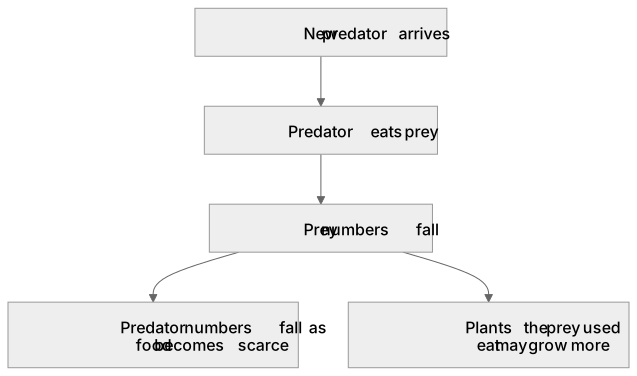
Key words
Say what each word means before you turn the card.
Predator–prey relationships
Try answering aloud or in your head before turning the card.
Interdependence and food webs
Try answering aloud or in your head before turning the card.
Effects of introduced species
Try answering aloud or in your head before turning the card.
Population cycles and limiting factors
Try answering aloud or in your head before turning the card.
See every definition
- Predator–prey relationships
- A relationship in which a predator eats other organisms, transferring energy from prey to predator and reducing the number of prey.
- Interdependence and food webs
- The way species affect each other, so that a change such as reduced prey numbers can affect other species, for example plants that the prey used to eat may grow more.
- Effects of introduced species
- A new predator entering an ecosystem where prey have not evolved defences against it can quickly reduce prey numbers, and its impact depends on how many predators arrive and how many prey they eat.
- Population cycles and limiting factors
- Prey numbers may fall, then predator numbers may fall as food becomes scarce, giving a cyclical relationship, with the effect depending on factors such as predator numbers, prey reproduction rate and availability of refuges.
Label the diagram
Some boxes have lost their names. Pick the right name for each number.
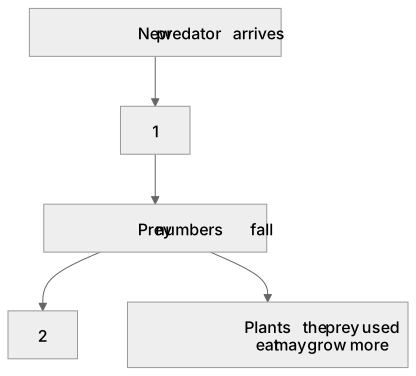
1Box 1
2Box 2
There is more to this lesson
The full lesson goes on to check your understanding and help you earn the marks. Create a free account to carry on, with your progress saved.
A week of Premium from your first lesson · Then the free plan continues · No card, no charge
Test your understanding of Biotic factors: new predators arriving
Active recall beats re-reading. Take an instant quiz now to test what you’ve learned and lock it into long-term memory.
A week of Premium from your first lesson · Then the free plan continues · No card, no charge