AQA · GCSE · Combined Science
Course version: 8464 · Version from Sept 2018
Biotic factors: one species outcompeting another so the numbers are no longer sufficient to breed.
Competition is a biotic factor because it involves living organisms using the same limited resources.
Study notes
From the checked teaching notes for this specification point.
The idea
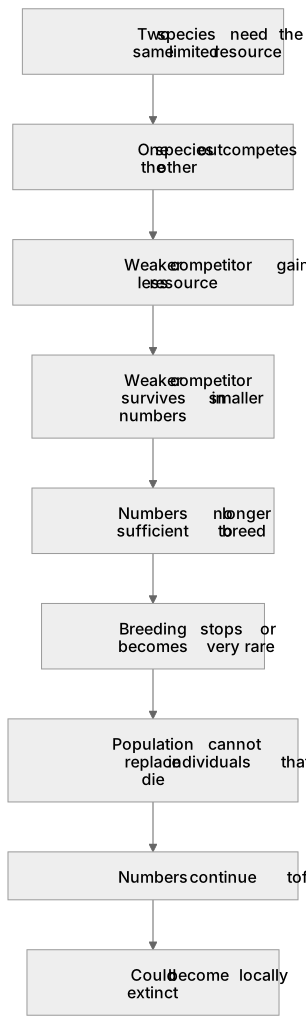
Competition is a biotic factor because it involves living organisms using the same limited resources. When one species outcompetes another, it uses resources such as food, water, light or space more successfully. The weaker competitor may survive in smaller numbers. If its population becomes too small, individuals may not meet often enough to find a mate within their own species, so breeding stops or becomes very rare. For example, if grey squirrels outcompete red squirrels for food and habitat, red squirrel numbers can fall until the remaining individuals are too scattered to breed successfully. The population may then decline further and could become locally extinct.
What earns the marks
- Competition occurs when organisms need the same limited resource, such as food, water, light or space.
- One species outcompetes another when it obtains the resource more successfully, so the weaker competitor gains less.
- A reduced population may have too few individuals to find mates within their own species, so breeding becomes unsuccessful or stops.
- If breeding stops, the population cannot replace individuals that die, so numbers continue to fall.
- Competition is a biotic factor because it depends on the presence and activity of other living organisms.
Common mistakes and how to put them right
Saying the weaker species dies immediately.
Put it right by explaining that numbers fall gradually and breeding may fail before all individuals die.
Treating competition as an abiotic factor.
Put it right by stating that competition involves living organisms and is therefore biotic.
Assuming the two species compete only for food.
Put it right by mentioning other resources such as water, light, shelter or territory.
Exam tips
- Name the resource being competed for and state which species obtains it more successfully.
- Explain the link between low numbers and failure to breed, rather than just writing that the species dies out.
- Use the phrase sufficient to breed when describing the point at which the population can no longer replace itself.
Try the lesson
The start of the Biotic factors: one species outcompeting another so the numbers are no longer sufficient to breed. lesson, made from checked teaching notes for this specification point.
Have a go first
In a pond, two species of water snail eat the same water weed. One snail species takes most of the weed. Over time, the other snail species struggles to survive, and its population falls so low that the remaining individuals cannot find mates. What is this an example of?
See it
Label the diagram
Some boxes have lost their names. Pick the right name for each number.
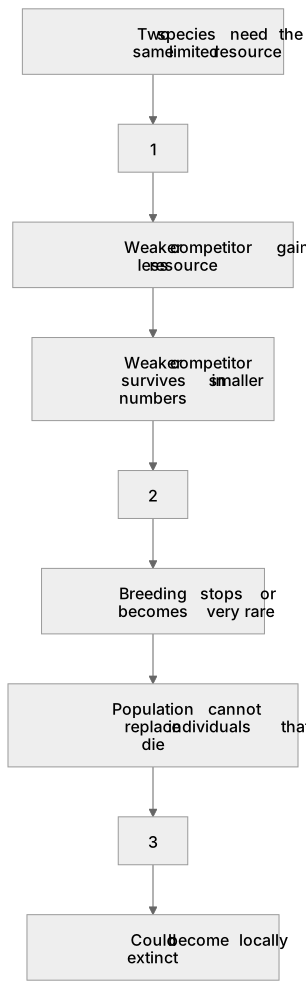
1Box 1
2Box 2
3Box 3
There is more to this lesson
The full lesson goes on to check your understanding and help you earn the marks. Create a free account to carry on, with your progress saved.
A week of Premium from your first lesson · Then the free plan continues · No card, no charge
Test your understanding of Biotic factors: one species outcompeting another so the numbers are no longer sufficient to breed.
Active recall beats re-reading. Take an instant quiz now to test what you’ve learned and lock it into long-term memory.
A week of Premium from your first lesson · Then the free plan continues · No card, no charge