AQA · GCSE · Combined Science
Course version: 8464 · Version from Sept 2018
Biotic factors: Students should be able to explain how a change in a biotic factor might affect a given community given appropriate data or context.
A community is all the interacting populations in a habitat.
- 4 key terms
Study notes
From the checked teaching notes for this specification point.
The idea
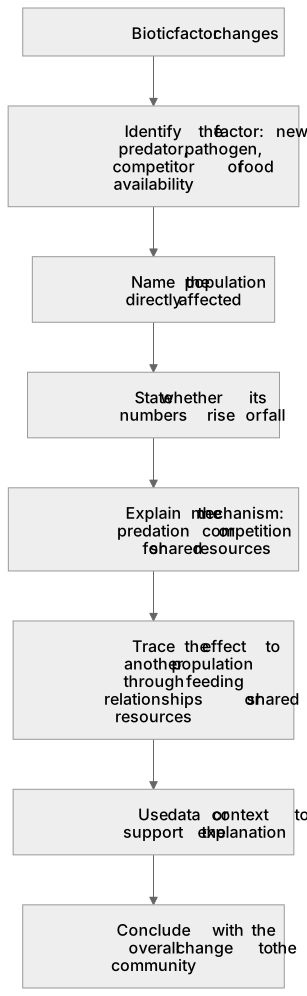
A community is all the interacting populations in a habitat. Biotic factors are living influences: food availability, new predators, new pathogens, and competition between species. To explain a change, identify the factor, name the affected population, then trace the effect through feeding relationships and numbers. For example, if a new predator arrives, prey numbers fall; predators may then compete, and plants the prey ate may grow more. If a pathogen spreads, susceptible species decline while resistant ones may increase. If a competitor is removed, the remaining species may gain resources and increase. Always link cause to effect using data such as population counts, then state the resulting change in the community.
What earns the marks
- Identifies the specific biotic factor that has changed, such as a new predator, pathogen, competitor or change in food availability.
- Names the population directly affected and states whether its numbers rise or fall.
- Explains the mechanism, for example predation reduces prey numbers or competition reduces shared resources.
- Traces the effect to at least one other population through a feeding relationship or shared resource.
- Uses data or context provided, such as population sizes or dates, to support the explanation.
- Concludes with the overall change to the community, such as a fall in biodiversity or a shift in species present.
Common mistakes and how to put them right
Treating a biotic factor as abiotic, for example calling temperature a biotic factor.
Put it right: Biotic factors are living influences such as predators, pathogens and competitors.
Stating only that numbers change without explaining why.
Put it right: Give the mechanism, such as predation or competition for food.
Assuming every population in the community changes in the same direction.
Put it right: Trace each effect separately, as some populations may rise while others fall.
Exam tips
- Underline the factor named in the question and the population it acts on before writing.
- Use connectives such as therefore and as a result to show a clear chain of reasoning.
- Refer to figures from the data, for example a fall from 200 to 120, rather than saying numbers decreased.
Try the lesson
The start of the Biotic factors: Students should be able to explain how a change in a biotic factor might affect a given community given appropriate data or context. lesson, made from checked teaching notes for this specification point.
Have a go first
A woodland community contains rabbits that eat grass. A disease kills most of the rabbits. What is the most likely effect on the grass in this community?
See it
Put it in order
Put these steps in the order they happen.
- 1. Identify the factor: new predator, pathogen, competitor or food availability
- 2. Name the population directly affected
- 3. State whether its numbers rise or fall
- 4. Explain the mechanism: predation or competition for shared resources
- 5. Trace the effect to another population through feeding relationships or shared resources
- 6. Use data or context to support the explanation
- 7. Conclude with the overall change to the community
- 8. Biotic factor changes
Key words
Say what each word means before you turn the card.
Interdependence of organisms in a community
Try answering aloud or in your head before turning the card.
Predation and its effect on prey populations
Try answering aloud or in your head before turning the card.
Competition for resources between species
Try answering aloud or in your head before turning the card.
Pathogens and disease in populations
Try answering aloud or in your head before turning the card.
See every definition
- Interdependence of organisms in a community
- A community is all the interacting populations in a habitat, so a change to one population can be traced through feeding relationships and numbers to other populations.
- Predation and its effect on prey populations
- A new predator is a biotic factor, and predation reduces prey numbers, after which predators may compete and plants the prey ate may grow more.
- Competition for resources between species
- Competition between species is a biotic factor, and if a competitor is removed the remaining species may gain resources and increase.
- Pathogens and disease in populations
- A new pathogen is a biotic factor, and if a pathogen spreads, susceptible species decline while resistant ones may increase.
Label the diagram
Some boxes have lost their names. Pick the right name for each number.
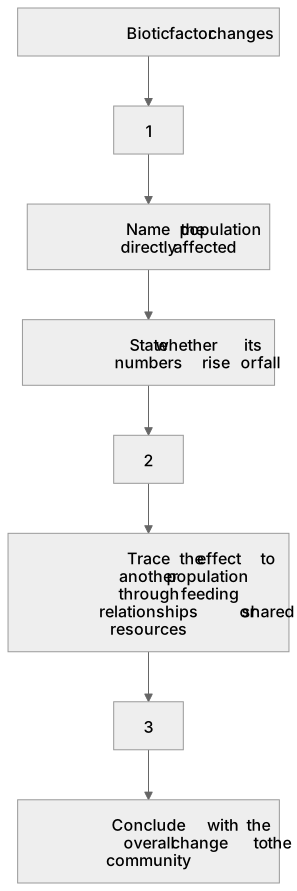
1Box 1
2Box 2
3Box 3
There is more to this lesson
The full lesson goes on to check your understanding and help you earn the marks. Create a free account to carry on, with your progress saved.
A week of Premium from your first lesson · Then the free plan continues · No card, no charge
Test your understanding of Biotic factors: Students should be able to explain how a change in a biotic factor might affect a given community given appropriate data or context.
Active recall beats re-reading. Take an instant quiz now to test what you’ve learned and lock it into long-term memory.
A week of Premium from your first lesson · Then the free plan continues · No card, no charge