AQA · GCSE · Combined Science
Course version: 8464 · Version from Sept 2018
Calculating rates of reactions: calculate the mean rate of a reaction from given information about the quantity of a reactant used or the quantity of a product formed and the time taken
To calculate the mean rate of a reaction, use the equation: mean rate = change in quantity ÷ time taken.
- 3 key terms
Study notes
From the checked teaching notes for this specification point.
The idea
To calculate the mean rate of a reaction, use the equation: mean rate = change in quantity ÷ time taken. The quantity may be a reactant used up or a product formed, measured in grams, cm³ of gas or moles. For example, if the mass of a reaction mixture falls from 50.0 g to 42.0 g in 20 s, the reactant used is 50.0 g − 42.0 g = 8.0 g, so the mean rate is 8.0 g ÷ 20 s = 0.40 g/s. If 15 cm³ of gas is produced in 30 s, the mean rate is 15 cm³ ÷ 30 s = 0.50 cm³/s. The word 'mean' means the average over the whole time interval, so it does not tell you the rate at a single instant. Always subtract the starting value if it is not zero, divide by the time, and give the correct unit.
What earns the marks
- Use the equation mean rate = change in quantity ÷ time taken, stating it or applying it correctly.
- Calculate the change in quantity by subtracting the initial value from the final value when the measurement does not start at zero.
- Use the total time taken for that change, converting minutes to seconds or seconds to minutes when the required unit demands it.
- Divide the change in quantity by the time taken and round appropriately, for example 8.0 g ÷ 20 s = 0.40 g/s.
- Attach the correct compound unit to the answer, such as g/s, cm³/s or mol/s, derived from the quantity and time units.
- For a graph, read two points on the line, calculate the change in y and the change in x, then divide to find the mean rate over that interval.
Common mistakes and how to put them right
Using the final reading as the change in quantity without subtracting the initial reading.
Put it right by calculating final minus initial.
Mixing units, for example dividing grams by minutes but writing g/s.
Put it right by converting time to seconds or writing g/min.
Confusing mean rate with instantaneous rate and reading a single point from a graph.
Put it right by using two points and the change in y divided by the change in x.
Exam tips
- Underline the quantity and the time in the question before calculating, so you use the right values.
- Show the subtraction and division steps clearly; method marks may be available even if the final number is wrong.
- Check that your unit matches the units in the data, and convert if the question asks for a different time unit.
Try the lesson
The start of the Calculating rates of reactions: calculate the mean rate of a reaction from given information about the quantity of a reactant used or the quantity of a product formed and the time taken lesson, made from checked teaching notes for this specification point.
Have a go first
A reaction produces 40 cm³ of gas in 20 seconds. Calculate the mean rate of the reaction in cm³/s.
Listen
To calculate the mean rate of a reaction, use the equation: mean rate = change in quantity ÷ time taken. The quantity may be a reactant used up or a product formed, measured in grams, cm³ of gas or moles. For example, if the mass of a reaction mixture falls from 50.0 g to 42.0 g in 20 s, the reactant used is 50.0 g − 42.0 g = 8.0 g, so the mean rate is 8.0 g ÷ 20 s = 0.40 g/s. If 15 cm³ of gas is produced in 30 s, the mean rate is 15 cm³ ÷ 30 s = 0.50 cm³/s. The word 'mean' means the average over the whole time interval, so it does not tell you the rate at a single instant. Always subtract the starting value if it is not zero, divide by the time, and give the correct unit. A strong answer earns marks for these points. Use the equation mean rate = change in quantity ÷ time taken, stating it or applying it correctly. Calculate the change in quantity by subtracting the initial value from the final value when the measurement does not start at zero. Use the total time taken for that change, converting minutes to seconds or seconds to minutes when the required unit demands it. Divide the change in quantity by the time taken and round appropriately, for example 8.0 g ÷ 20 s = 0.40 g/s. A common slip: Using the final reading as the change in quantity without subtracting the initial reading. Instead, calculating final minus initial. Exam tip: Underline the quantity and the time in the question before calculating, so you use the right values.
See it
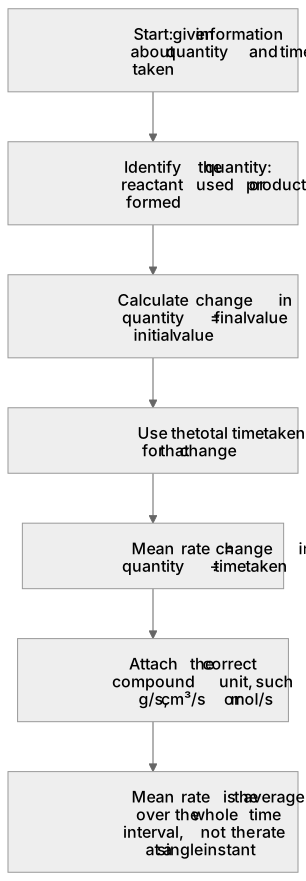
Put it in order
Put these steps in the order they happen.
- 1. Identify the quantity: reactant used or product formed
- 2. Calculate change in quantity = final value − initial value
- 3. Use the total time taken for that change
- 4. Mean rate = change in quantity ÷ time taken
- 5. Attach the correct compound unit, such as g/s, cm³/s or mol/s
- 6. Mean rate is the average over the whole time interval, not the rate at a single instant
- 7. Start: given information about quantity and time taken
Key words
Say what each word means before you turn the card.
Mean rate of reaction
Try answering aloud or in your head before turning the card.
Product formed
Try answering aloud or in your head before turning the card.
Time taken
Try answering aloud or in your head before turning the card.
See every definition
- Mean rate of reaction
- The average over the whole time interval, calculated as change in quantity divided by time taken.
- Product formed
- The quantity of a product formed, which may be measured in grams, cm³ of gas or moles.
- Time taken
- The total time for that change, used as the divisor when calculating the mean rate.
Label the diagram
Some boxes have lost their names. Pick the right name for each number.
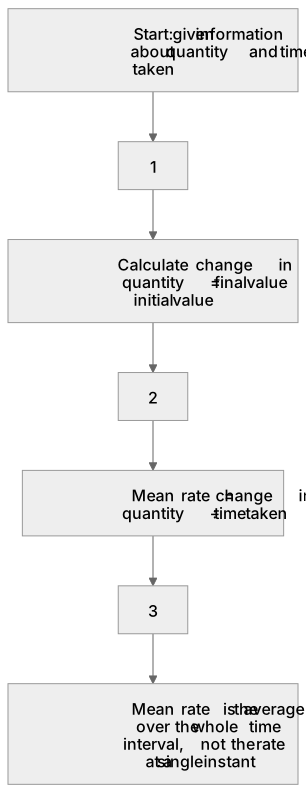
1Box 1
2Box 2
3Box 3
There is more to this lesson
The full lesson goes on to check your understanding and help you earn the marks. Create a free account to carry on, with your progress saved.
A week of Premium from your first lesson · Then the free plan continues · No card, no charge
Test your understanding of Calculating rates of reactions: calculate the mean rate of a reaction from given information about the quantity of a reactant used or the quantity of a product formed and the time taken
Active recall beats re-reading. Take an instant quiz now to test what you’ve learned and lock it into long-term memory.
A week of Premium from your first lesson · Then the free plan continues · No card, no charge