AQA · GCSE · Combined Science
Course version: 8464 · Version from Sept 2018
Calculating rates of reactions: For the Higher Tier, students are also required to use quantity of reactants in terms of moles and units for rate of reaction in mol/s.
For Higher Tier students, the rate of reaction can be expressed using the amount of substance in moles.
- 4 key terms
Study notes
From the checked teaching notes for this specification point.
The idea
For Higher Tier students, the rate of reaction can be expressed using the amount of substance in moles. The amount in moles is calculated from mass and molar mass using the equation moles = mass ÷ molar mass. The rate is then the change in moles divided by the time taken, giving the unit mol/s. For example, if 0.50 mol of reactant is used in 25 s, the mean rate is 0.50 mol ÷ 25 s = 0.020 mol/s. This extends the foundation idea that rate is change divided by time: the change is now an amount in moles rather than a mass or a gas volume, so the unit becomes mol/s. Note that this specific calculation and unit apply only to Higher Tier assessments.
What earns the marks
- Calculate the amount of reactant in moles from mass and molar mass.
- Use rate = change in amount in moles ÷ time taken to find a rate in mol/s.
- Attach the unit mol/s correctly to a rate calculated from mole data.
- Convert between mass and moles before dividing by time when the question supplies mass data but requires mol/s.
- Interpret a rate in mol/s as the number of moles of reactant used or product formed each second.
Common mistakes and how to put them right
Dividing mass by time and labelling the answer mol/s.
Put it right: First converting mass to moles using moles = mass ÷ molar mass.
Forgetting to include the time unit and writing only mol.
Put it right by remembering that rate is per second, so the unit is mol/s.
Using the relative formula mass as the number of moles.
Put it right by dividing the given mass by the relative formula mass to find moles.
Exam tips
- Show the mole calculation and the division by time as separate steps so both the amount and the rate unit are clear.
- When a question gives mass and asks for mol/s, calculate moles first and then divide by the time taken.
Try the lesson
The start of the Calculating rates of reactions: For the Higher Tier, students are also required to use quantity of reactants in terms of moles and units for rate of reaction in mol/s. lesson, made from checked teaching notes for this specification point.
Have a go first
A reaction uses 0.5 mol of a reactant in 10 s. What is the rate of reaction in mol/s?
Listen
For Higher Tier students, the rate of reaction can be expressed using the amount of substance in moles. The amount in moles is calculated from mass and molar mass using the equation moles = mass ÷ molar mass. The rate is then the change in moles divided by the time taken, giving the unit mol/s. For example, if 0.50 mol of reactant is used in 25 s, the mean rate is 0.50 mol ÷ 25 s = 0.020 mol/s. This extends the foundation idea that rate is change divided by time: the change is now an amount in moles rather than a mass or a gas volume, so the unit becomes mol/s. Note that this specific calculation and unit apply only to Higher Tier assessments. A strong answer earns marks for these points. Calculate the amount of reactant in moles from mass and molar mass. Use rate = change in amount in moles ÷ time taken to find a rate in mol/s. Attach the unit mol/s correctly to a rate calculated from mole data. Convert between mass and moles before dividing by time when the question supplies mass data but requires mol/s. A common slip: Dividing mass by time and labelling the answer mol/s. Instead, first converting mass to moles using moles = mass ÷ molar mass. Exam tip: Show the mole calculation and the division by time as separate steps so both the amount and the rate unit are clear.
See it
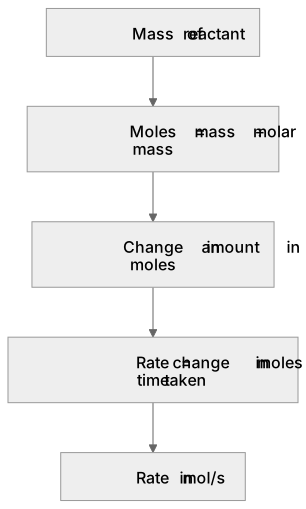
Put it in order
Put these steps in the order they happen.
- 1. Moles = mass ÷ molar mass
- 2. Change in amount in moles
- 3. Rate = change in moles ÷ time taken
- 4. Rate in mol/s
- 5. Mass of reactant
Key words
Say what each word means before you turn the card.
Amount of substance in moles
Try answering aloud or in your head before turning the card.
Molar mass
Try answering aloud or in your head before turning the card.
Rate of reaction
Try answering aloud or in your head before turning the card.
Units mol/s
Try answering aloud or in your head before turning the card.
See every definition
- Amount of substance in moles
- The quantity of reactant used or product formed, calculated from mass and molar mass using moles = mass ÷ molar mass.
- Molar mass
- The value used with mass to calculate the amount in moles, since moles = mass ÷ molar mass.
- Rate of reaction
- The change in amount in moles divided by the time taken, giving a rate in mol/s.
- Units mol/s
- The unit attached to a rate calculated from mole data, meaning moles of reactant used or product formed each second.
Label the diagram
Some boxes have lost their names. Pick the right name for each number.
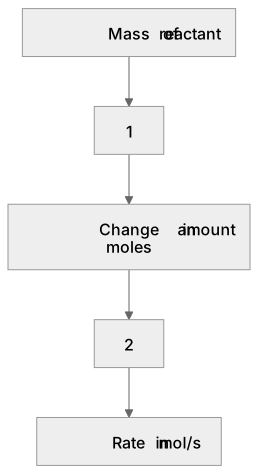
1Box 1
2Box 2
There is more to this lesson
The full lesson goes on to check your understanding and help you earn the marks. Create a free account to carry on, with your progress saved.
A week of Premium from your first lesson · Then the free plan continues · No card, no charge
Test your understanding of Calculating rates of reactions: For the Higher Tier, students are also required to use quantity of reactants in terms of moles and units for rate of reaction in mol/s.
Active recall beats re-reading. Take an instant quiz now to test what you’ve learned and lock it into long-term memory.
A week of Premium from your first lesson · Then the free plan continues · No card, no charge