AQA · GCSE · Combined Science
Course version: 8464 · Version from Sept 2018
Calculating rates of reactions: mean rate of reaction = quantity of product formed / time taken
The mean rate of reaction tells you how quickly a product appears, on average, across a chosen time interval.
- 4 key terms
Study notes
From the checked teaching notes for this specification point.
The idea
The mean rate of reaction tells you how quickly a product appears, on average, across a chosen time interval. You calculate it by dividing the quantity of product formed by the time taken for that formation. The quantity may be a mass in grams or a volume in cm³, so the rate carries units such as g/s or cm³/s. For example, if 24 cm³ of gas is collected in 8 s, the mean rate is 24 cm³ ÷ 8 s = 3 cm³/s. The word mean signals an average over the interval, not the fastest or slowest moment. Choose two clear readings from the start and end of the interval, subtract to find the change in quantity, and divide by the time interval. Always give the unit and check that the time is in seconds before dividing.
What earns the marks
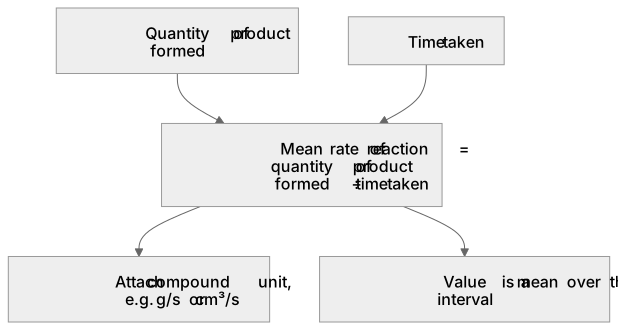
- State the relationship as mean rate of reaction = quantity of product formed ÷ time taken.
- Identify the quantity of product formed as the change in mass in g or volume in cm³ between two chosen times.
- Identify the time taken as the time interval in seconds over which that product quantity formed.
- Substitute measured values correctly and calculate the quotient without arithmetic error.
- Attach the correct compound unit, such as g/s or cm³/s, to the answer.
- Recognise that the value is a mean over the interval and that rate can change during a reaction.
Common mistakes and how to put them right
Dividing time by quantity instead of quantity by time.
Put it right by writing the equation first and checking that the larger quantity of product gives a larger rate.
Using the total time from the start of the reaction when the interval begins later.
Put it right by subtracting the earlier time from the later time to find the interval.
Omitting or miswriting the unit.
Put it right by dividing the unit of quantity by the unit of time, for example cm³ ÷ s = cm³/s.
Exam tips
- Write the equation, then substitute values with units before calculating, so the examiner can follow your method.
- If a graph is given, read two points on the line, find the change in the y-value and divide by the change in the x-value.
- Check whether the question asks for the mean rate over a stated interval or the rate at a particular time, and answer the one requested.
Try the lesson
The start of the Calculating rates of reactions: mean rate of reaction = quantity of product formed / time taken lesson, made from checked teaching notes for this specification point.
Have a go first
A reaction produces 40 cm³ of gas in 20 seconds. What is the mean rate of reaction in cm³/s?
Listen
The mean rate of reaction tells you how quickly a product appears, on average, across a chosen time interval. You calculate it by dividing the quantity of product formed by the time taken for that formation. The quantity may be a mass in grams or a volume in cm³, so the rate carries units such as g/s or cm³/s. For example, if 24 cm³ of gas is collected in 8 s, the mean rate is 24 cm³ ÷ 8 s = 3 cm³/s. The word mean signals an average over the interval, not the fastest or slowest moment. Choose two clear readings from the start and end of the interval, subtract to find the change in quantity, and divide by the time interval. Always give the unit and check that the time is in seconds before dividing. A strong answer earns marks for these points. State the relationship as mean rate of reaction = quantity of product formed ÷ time taken. Identify the quantity of product formed as the change in mass in g or volume in cm³ between two chosen times. Identify the time taken as the time interval in seconds over which that product quantity formed. Substitute measured values correctly and calculate the quotient without arithmetic error. A common slip: Dividing time by quantity instead of quantity by time. Instead, writing the equation first and checking that the larger quantity of product gives a larger rate. Exam tip: Write the equation, then substitute values with units before calculating, so the examiner can follow your method.
See it
Key words
Say what each word means before you turn the card.
Rate of reaction
Try answering aloud or in your head before turning the card.
Measuring product formation
Try answering aloud or in your head before turning the card.
Mass and volume measurements
Try answering aloud or in your head before turning the card.
Using equations and units
Try answering aloud or in your head before turning the card.
See every definition
- Rate of reaction
- The mean rate of reaction tells you how quickly a product appears, on average, across a chosen time interval.
- Measuring product formation
- The quantity of product formed is the change in mass in g or volume in cm³ between two chosen times.
- Mass and volume measurements
- The quantity may be a mass in grams or a volume in cm³, so the rate carries units such as g/s or cm³/s.
- Using equations and units
- The relationship is mean rate of reaction = quantity of product formed ÷ time taken, and the answer carries a compound unit such as g/s or cm³/s.
Label the diagram
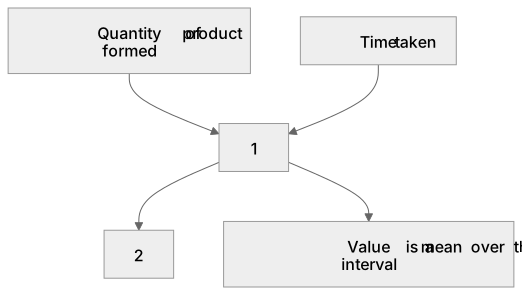
Some boxes have lost their names. Pick the right name for each number.
1Box 1
2Box 2
There is more to this lesson
The full lesson goes on to check your understanding and help you earn the marks. Create a free account to carry on, with your progress saved.
A week of Premium from your first lesson · Then the free plan continues · No card, no charge
Test your understanding of Calculating rates of reactions: mean rate of reaction = quantity of product formed / time taken
Active recall beats re-reading. Take an instant quiz now to test what you’ve learned and lock it into long-term memory.
A week of Premium from your first lesson · Then the free plan continues · No card, no charge