AQA · GCSE · Combined Science
Course version: 8464 · Version from Sept 2018
Catalysts: Students should be able to identify catalysts in reactions from their effect on the rate of reaction and because they are not included in the chemical equation for the reaction.
A catalyst speeds up a reaction without being used up, so it is not consumed and does not appear in the overall chemical equation.
Study notes
From the checked teaching notes for this specification point.
The idea
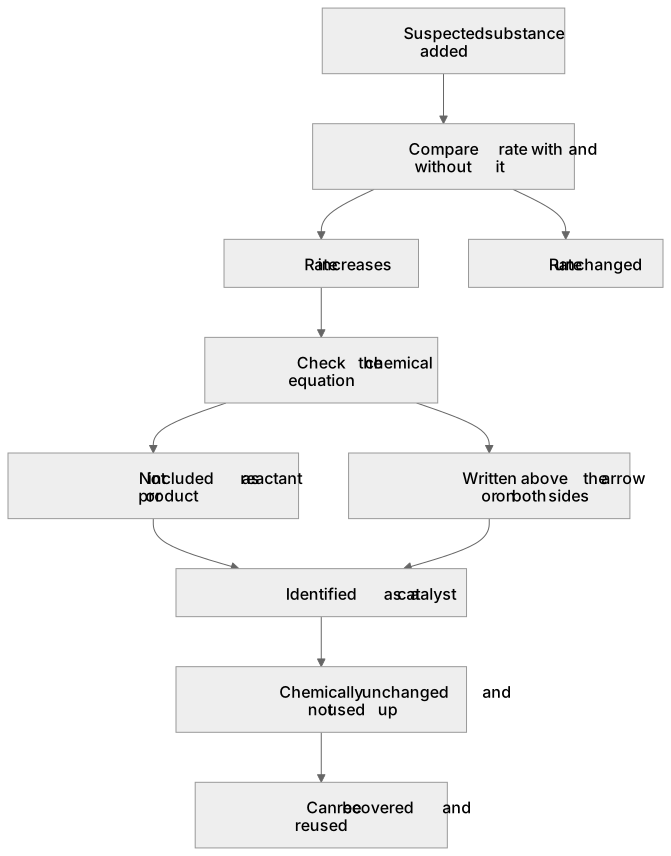
A catalyst speeds up a reaction without being used up, so it is not consumed and does not appear in the overall chemical equation. To identify one, compare rates: adding the suspected catalyst increases the rate, while the same amount of an inert substance does not. Then check the equation: a species that appears on both sides, or is written above the arrow, is a catalyst rather than a reactant or product. For example, in the decomposition of hydrogen peroxide, 2H₂O₂ → 2H₂O + O₂, manganese(IV) oxide, MnO₂, speeds up the reaction but is not in the equation; it can be filtered off and reused. Enzymes are biological catalysts that behave in the same way.
What earns the marks
- A catalyst increases the rate of a reaction while remaining chemically unchanged at the end.
- A catalyst is not used up, so it can often be recovered and reused.
- A catalyst does not appear in the overall chemical equation because it is not a reactant or a product.
- A species written above the reaction arrow, or shown on both sides of an equation, indicates a catalyst.
- Comparing the rate with and without the suspected substance provides evidence that it is a catalyst.
- Enzymes are biological catalysts and can be identified by the same rate and equation evidence.
Common mistakes and how to put them right
Assuming any substance that speeds up a reaction is a catalyst.
Put it right: Check that it is unchanged and absent from the overall equation.
Treating a catalyst as a reactant because it is added at the start.
Put it right: A catalyst is not used up and is not written as a reactant.
Claiming a catalyst increases the yield of a reaction.
Put it right: A catalyst speeds up the forward and reverse reactions equally and does not change the yield.
Exam tips
- Quote the rate evidence and the equation evidence together; one alone is usually insufficient for full credit.
- When a species appears above the arrow, name it as the catalyst and explain that it is not included in the equation.
- Use the phrase 'not used up' or 'chemically unchanged' rather than 'not involved', which is inaccurate.
Try the lesson
The start of the Catalysts: Students should be able to identify catalysts in reactions from their effect on the rate of reaction and because they are not included in the chemical equation for the reaction. lesson, made from checked teaching notes for this specification point.
Have a go first
A student investigates a chemical reaction. In the first experiment, a small amount of solid X is added to the reactants, and the reaction happens much faster. At the end of the experiment, solid X is filtered out, dried, and weighed. Its mass is unchanged. Solid X does not appear in the balanced chemical equation for the reaction. What is solid X?
Listen
A catalyst speeds up a reaction without being used up, so it is not consumed and does not appear in the overall chemical equation. To identify one, compare rates: adding the suspected catalyst increases the rate, while the same amount of an inert substance does not. Then check the equation: a species that appears on both sides, or is written above the arrow, is a catalyst rather than a reactant or product. For example, in the decomposition of hydrogen peroxide, 2H₂O₂ → 2H₂O + O₂, manganese(IV) oxide, MnO₂, speeds up the reaction but is not in the equation; it can be filtered off and reused. Enzymes are biological catalysts that behave in the same way. A strong answer earns marks for these points. A catalyst increases the rate of a reaction while remaining chemically unchanged at the end. A catalyst is not used up, so it can often be recovered and reused. A catalyst does not appear in the overall chemical equation because it is not a reactant or a product. A species written above the reaction arrow, or shown on both sides of an equation, indicates a catalyst. A common slip: Assuming any substance that speeds up a reaction is a catalyst: the error is ignoring whether it is consumed. Instead, check that it is unchanged and absent from the overall equation. Exam tip: Quote the rate evidence and the equation evidence together; one alone is usually insufficient for full credit.
See it
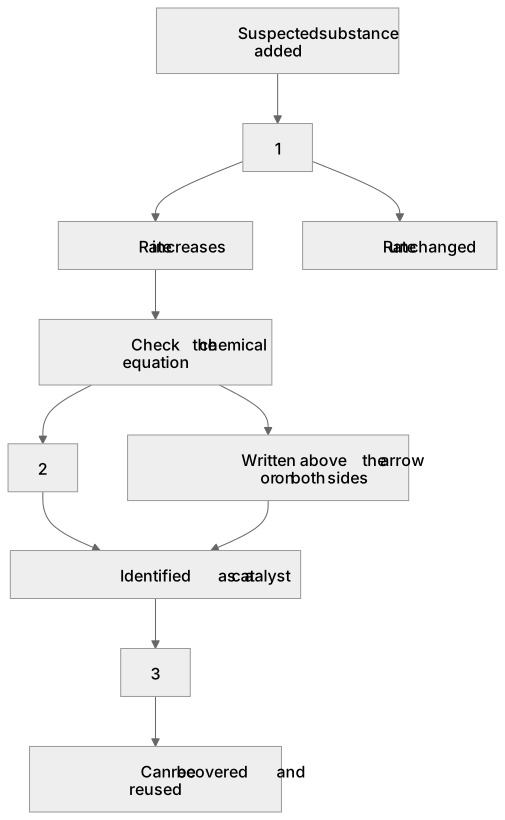
Label the diagram
Some boxes have lost their names. Pick the right name for each number.
1Box 1
2Box 2
3Box 3
There is more to this lesson
The full lesson goes on to check your understanding and help you earn the marks. Create a free account to carry on, with your progress saved.
A week of Premium from your first lesson · Then the free plan continues · No card, no charge
Test your understanding of Catalysts: Students should be able to identify catalysts in reactions from their effect on the rate of reaction and because they are not included in the chemical equation for the reaction.
Active recall beats re-reading. Take an instant quiz now to test what you’ve learned and lock it into long-term memory.
A week of Premium from your first lesson · Then the free plan continues · No card, no charge