AQA · GCSE · Combined Science
Course version: 8464 · Version from Sept 2018
Changes in energy: The kinetic energy of a moving object can be calculated using the equation:
Kinetic energy is the energy stored in an object because it is moving.
- 4 key terms
Study notes
From the checked teaching notes for this specification point.
The idea
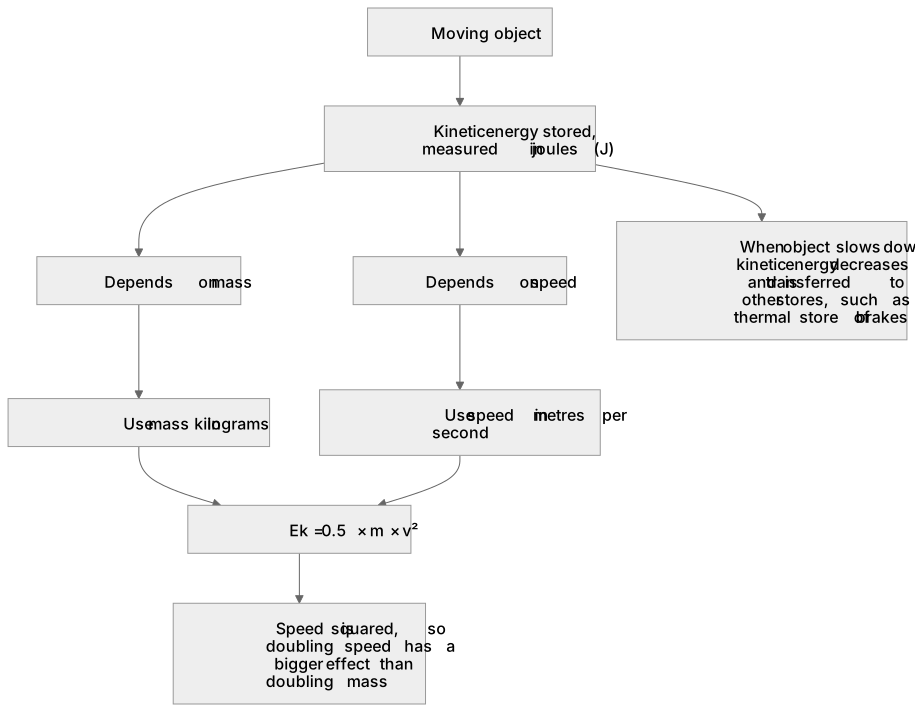
Kinetic energy is the energy stored in an object because it is moving. It depends on the object's mass and on its speed, and it is measured in joules (J). To calculate it, use the equation Ek = 0.5 × m × v², where m is mass in kilograms and v is speed in metres per second. For example, a 2 kg ball moving at 3 m/s has kinetic energy 0.5 × 2 × 3² = 9 J. Doubling the speed has a much bigger effect than doubling the mass, because speed is squared in the equation. This links to energy transfers: when a moving object slows down, its kinetic energy decreases and is transferred to other stores, such as the thermal store of the brakes via mechanical work.
What earns the marks
- State that kinetic energy is the energy stored in a moving object and is measured in joules (J).
- Identify the two variables that kinetic energy depends on: mass and speed.
- Recall and apply the equation Ek = 0.5 × m × v² to calculate kinetic energy.
- Use mass in kilograms and speed in metres per second before substituting into the equation.
- Recognise that speed is squared, so kinetic energy changes by the square of the speed for a fixed mass.
- Describe energy transfers involving kinetic energy, for example kinetic energy transferred to thermal energy when brakes are applied.
Common mistakes and how to put them right
Using grams instead of kilograms.
Put it right: Convert mass to kg by dividing by 1000 before calculating, because the equation requires SI units.
Forgetting to square the speed.
Put it right: Calculate v² first, then multiply by 0.5 and the mass.
Mixing up kinetic energy with other energy equations.
Put it right: Check whether the question gives speed (use Ek = 0.5 × m × v²) or height (use gravitational potential energy).
Exam tips
- Write down the equation Ek = 0.5 × m × v², then substitute values with units before doing the arithmetic, so method marks are visible.
- Check the unit of every value given; convert g to kg and km/h to m/s if needed.
- When a question asks for a comparison, calculate both kinetic energies and state the ratio or factor clearly.
Try the lesson
The start of the Changes in energy: The kinetic energy of a moving object can be calculated using the equation: lesson, made from checked teaching notes for this specification point.
Have a go first
A cyclist and bicycle have a combined mass of 80 kg and are moving at a speed of 5 m/s. Using the equation for kinetic energy, what is the kinetic energy of the cyclist and bicycle?
Listen
Kinetic energy is the energy stored in an object because it is moving. It depends on the object's mass and on its speed, and it is measured in joules (J). To calculate it, use the equation Ek = 0.5 × m × v², where m is mass in kilograms and v is speed in metres per second. For example, a 2 kg ball moving at 3 m/s has kinetic energy 0.5 × 2 × 3² = 9 J. Doubling the speed has a much bigger effect than doubling the mass, because speed is squared in the equation. This links to energy transfers: when a moving object slows down, its kinetic energy decreases and is transferred to other stores, such as the thermal store of the brakes via mechanical work. A strong answer earns marks for these points. State that kinetic energy is the energy stored in a moving object and is measured in joules (J). Identify the two variables that kinetic energy depends on: mass and speed. Recall and apply the equation Ek = 0.5 × m × v² to calculate kinetic energy. Use mass in kilograms and speed in metres per second before substituting into the equation. Exam tip: Write down the equation Ek = 0.5 × m × v², then substitute values with units before doing the arithmetic, so method marks are visible.
See it
Key words
Say what each word means before you turn the card.
Kinetic energy
Try answering aloud or in your head before turning the card.
Use of standard SI units
Try answering aloud or in your head before turning the card.
Effect of squaring a variable
Try answering aloud or in your head before turning the card.
Energy stores and transfers
Try answering aloud or in your head before turning the card.
See every definition
- Kinetic energy
- The energy stored in an object because it is moving, measured in joules (J).
- Use of standard SI units
- Mass is used in kilograms and speed in metres per second before substituting into the equation.
- Effect of squaring a variable
- Speed is squared in the equation, so doubling the speed has a much bigger effect than doubling the mass.
- Energy stores and transfers
- When a moving object slows down, its kinetic energy decreases and is transferred to other stores, such as the thermal store of the brakes via mechanical work.
Label the diagram
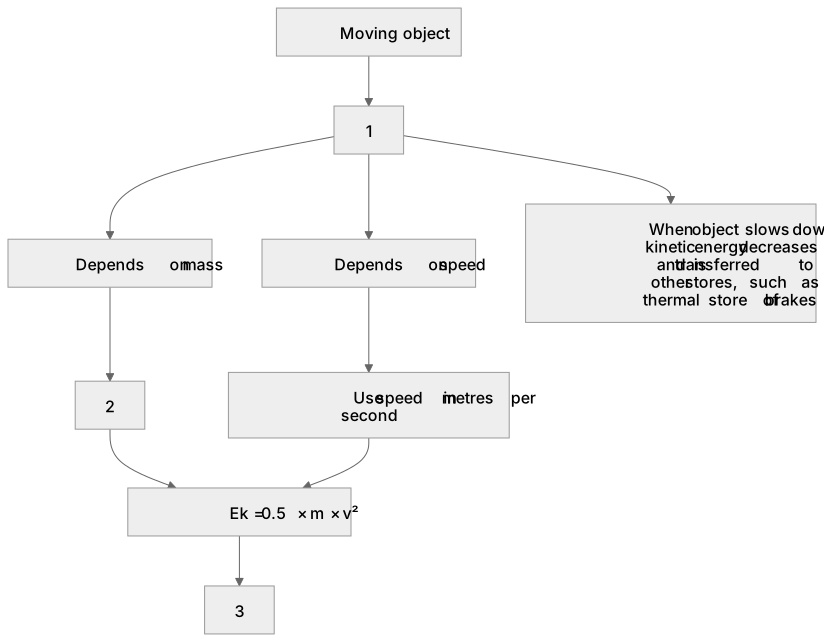
Some boxes have lost their names. Pick the right name for each number.
1Box 1
2Box 2
3Box 3
There is more to this lesson
The full lesson goes on to check your understanding and help you earn the marks. Create a free account to carry on, with your progress saved.
A week of Premium from your first lesson · Then the free plan continues · No card, no charge
Test your understanding of Changes in energy: The kinetic energy of a moving object can be calculated using the equation:
Active recall beats re-reading. Take an instant quiz now to test what you’ve learned and lock it into long-term memory.
A week of Premium from your first lesson · Then the free plan continues · No card, no charge