AQA · GCSE · Combined Science
Course version: 8464 · Version from Sept 2018
Chromatography: The ratio of the distance moved by a compound (centre of spot from origin) to the distance moved by the solvent can be expressed as its R_f value:
Chromatography separates dissolved substances as they travel at different speeds through paper or a thin layer of silica.
- 4 key terms
Study notes
From the checked teaching notes for this specification point.
The idea
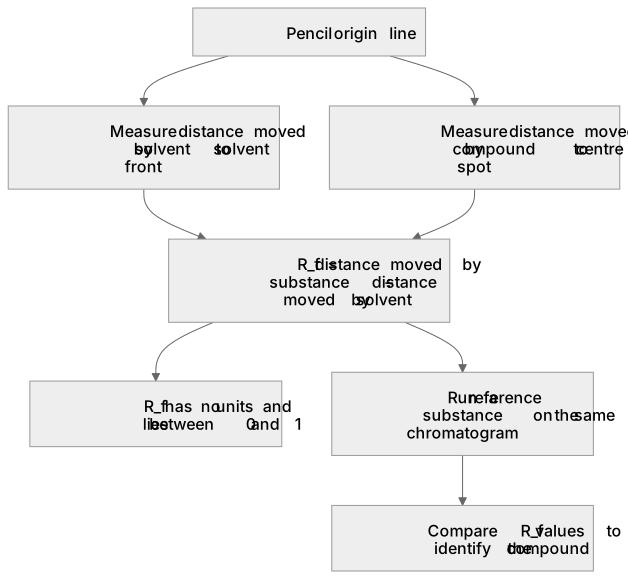
Chromatography separates dissolved substances as they travel at different speeds through paper or a thin layer of silica. You measure two lengths with a ruler, both starting at the pencil origin line: the distance the solvent front travelled, and the distance from the origin to the centre of each coloured spot. Dividing the spot distance by the solvent-front distance gives the R_f value, a number between 0 and 1 with no units. For example, if the solvent front moves 8.0 cm and a spot centre moves 3.2 cm, R_f = 3.2 ÷ 8.0 = 0.40. Because R_f depends on the solvent and conditions, you must run a known reference substance alongside the unknown on the same chromatogram to identify a compound by matching R_f values.
What earns the marks
- State that both distances are measured from the pencil origin line, not from the bottom edge of the paper or plate.
- Measure the distance moved by the solvent to the solvent front, the furthest point reached by the liquid.
- Measure the distance moved by the compound to the centre of the spot, not to its top or bottom edge.
- Calculate R_f by dividing the distance moved by the substance by the distance moved by the solvent.
- Recognise that R_f has no units and normally lies between 0 and 1 because the spot cannot travel further than the solvent front.
- Explain that a reference substance must be run on the same chromatogram under the same conditions for a valid comparison of R_f values.
Common mistakes and how to put them right
Measuring the spot distance to the top or bottom edge of the spot instead of its centre.
Put it right by marking the centre of the spot before measuring.
Measuring from the bottom edge of the paper rather than the pencil origin line.
Put it right by using the origin line as the zero point for both distances.
Dividing the solvent distance by the spot distance.
Put it right by keeping the substance distance on top, so R_f = distance moved by substance ÷ distance moved by solvent.
Exam tips
- Write the equation in words first, then substitute the two measured lengths, so the examiner can see your method clearly.
- Give R_f to two significant figures or as a decimal, and never attach a unit such as cm to the answer.
- When identifying an unknown, compare its R_f with a reference value obtained on the same chromatogram and state that conditions such as solvent must match.
Try the lesson
The start of the Chromatography: The ratio of the distance moved by a compound (centre of spot from origin) to the distance moved by the solvent can be expressed as its R_f value: lesson, made from checked teaching notes for this specification point.
Have a go first
In paper chromatography, a spot of a compound moves 3 cm from the origin and the solvent front moves 6 cm from the origin. What is the R_f value of the compound?
Listen
Chromatography separates dissolved substances as they travel at different speeds through paper or a thin layer of silica. You measure two lengths with a ruler, both starting at the pencil origin line: the distance the solvent front travelled, and the distance from the origin to the centre of each coloured spot. Dividing the spot distance by the solvent-front distance gives the R_f value, a number between 0 and 1 with no units. For example, if the solvent front moves 8.0 cm and a spot centre moves 3.2 cm, R_f = 3.2 ÷ 8.0 = 0.40. Because R_f depends on the solvent and conditions, you must run a known reference substance alongside the unknown on the same chromatogram to identify a compound by matching R_f values. A strong answer earns marks for these points. State that both distances are measured from the pencil origin line, not from the bottom edge of the paper or plate. Measure the distance moved by the solvent to the solvent front, the furthest point reached by the liquid. Measure the distance moved by the compound to the centre of the spot, not to its top or bottom edge. Calculate R_f by dividing the distance moved by the substance by the distance moved by the solvent. A common slip: Measuring the spot distance to the top or bottom edge of the spot instead of its centre. Instead, marking the centre of the spot before measuring. Exam tip: Write the equation in words first, then substitute the two measured lengths, so the examiner can see your method clearly.
See it
Key words
Say what each word means before you turn the card.
Separation techniques
Try answering aloud or in your head before turning the card.
Measurement from a common origin
Try answering aloud or in your head before turning the card.
Ratio and calculation skills
Try answering aloud or in your head before turning the card.
Identification using reference values
Try answering aloud or in your head before turning the card.
See every definition
- Separation techniques
- Chromatography separates dissolved substances as they travel at different speeds through paper or a thin layer of silica.
- Measurement from a common origin
- Both distances are measured from the pencil origin line, not from the bottom edge of the paper or plate.
- Ratio and calculation skills
- R_f is calculated by dividing the distance moved by the substance by the distance moved by the solvent.
- Identification using reference values
- A known reference substance must be run on the same chromatogram under the same conditions to identify a compound by matching R_f values.
Label the diagram
Some boxes have lost their names. Pick the right name for each number.
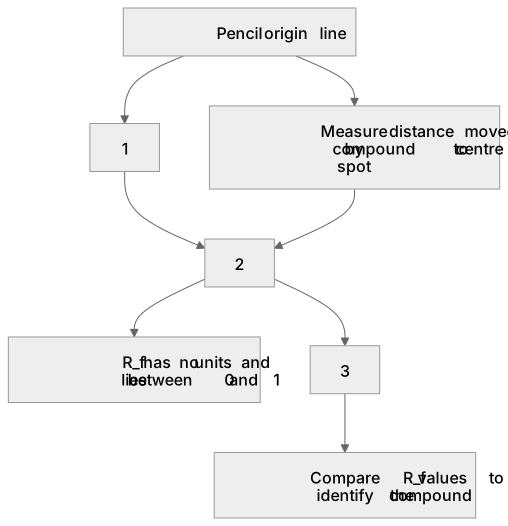
1Box 1
2Box 2
3Box 3
There is more to this lesson
The full lesson goes on to check your understanding and help you earn the marks. Create a free account to carry on, with your progress saved.
A week of Premium from your first lesson · Then the free plan continues · No card, no charge
Test your understanding of Chromatography: The ratio of the distance moved by a compound (centre of spot from origin) to the distance moved by the solvent can be expressed as its R_f value:
Active recall beats re-reading. Take an instant quiz now to test what you’ve learned and lock it into long-term memory.
A week of Premium from your first lesson · Then the free plan continues · No card, no charge