AQA · GCSE · Combined Science
Course version: 8464 · Version from Sept 2018
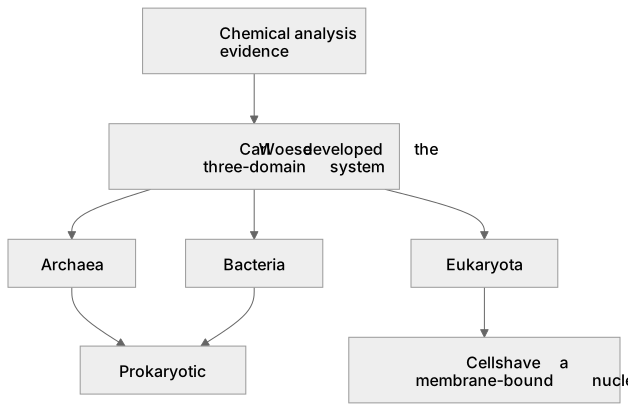
Classification of living organisms: Due to evidence available from chemical analysis there is now a ‘three-domain system’ developed by Carl Woese. In this system organisms are divided into:
Chemical analysis of molecules such as ribosomal RNA showed that some prokaryotes differ as much from each other as they do from eukaryotes.
- 4 key terms
Study notes
From the checked teaching notes for this specification point.
The idea
Chemical analysis of molecules such as ribosomal RNA showed that some prokaryotes differ as much from each other as they do from eukaryotes. Carl Woese used this evidence to propose the three-domain system, which places organisms into three broad groups above kingdom level. The domains are Archaea, Bacteria and Eukaryota. Archaea and Bacteria are prokaryotic, lacking a membrane-bound nucleus, while Eukaryota contains organisms with cells that have a nucleus, including protists, fungi, plants and animals. For example, methanogenic archaea live in oxygen-free conditions and have membrane chemistry and enzymes distinct from bacteria such as Escherichia coli. The three-domain model therefore reflects biochemical evidence rather than only visible structure.
What earns the marks
- Chemical analysis, especially of ribosomal RNA and other molecules, provided evidence that living organisms fall into three major groups.
- Carl Woese developed the three-domain system based on this molecular evidence.
- The three domains are Archaea, Bacteria and Eukaryota.
- Archaea and Bacteria are prokaryotic domains, while Eukaryota contains organisms whose cells have a membrane-bound nucleus.
- The three-domain system is a classification model that places domains above the kingdom level.
Common mistakes and how to put them right
Naming the domains as ‘animals, plants and fungi’.
Put it right: Those are kingdoms within Eukaryota, not the three domains.
Confusing Archaea with Bacteria and treating them as one group.
Put it right: Chemical evidence separates them into two distinct domains.
Writing that Eukaryota contains only animals and plants.
Put it right: Eukaryota also includes protists and fungi.
Exam tips
- Learn the three domain names exactly: Archaea, Bacteria and Eukaryota.
- State that the evidence came from chemical analysis, such as RNA or molecular studies, not just visible features.
- Use the term ‘prokaryotic’ for Archaea and Bacteria, and ‘eukaryotic’ for Eukaryota, to show precise understanding.
Try the lesson
The start of the Classification of living organisms: Due to evidence available from chemical analysis there is now a ‘three-domain system’ developed by Carl Woese. In this system organisms are divided into: lesson, made from checked teaching notes for this specification point.
Have a go first
Who developed the three-domain system of classification?
See it
Key words
Say what each word means before you turn the card.
Three-domain system
Try answering aloud or in your head before turning the card.
Molecular evidence in classification
Try answering aloud or in your head before turning the card.
Prokaryotic and eukaryotic cells
Try answering aloud or in your head before turning the card.
Carl Woese and scientific models
Try answering aloud or in your head before turning the card.
See every definition
- Three-domain system
- A classification model developed by Carl Woese that places organisms into three broad groups above kingdom level.
- Molecular evidence in classification
- Evidence from chemical analysis of molecules such as ribosomal RNA showing that some prokaryotes differ as much from each other as they do from eukaryotes.
- Prokaryotic and eukaryotic cells
- Prokaryotic cells lack a membrane-bound nucleus, while eukaryotic cells have a nucleus.
- Carl Woese and scientific models
- He used evidence from chemical analysis to propose the three-domain system, a classification model reflecting biochemical evidence rather than only visible structure.
Label the diagram
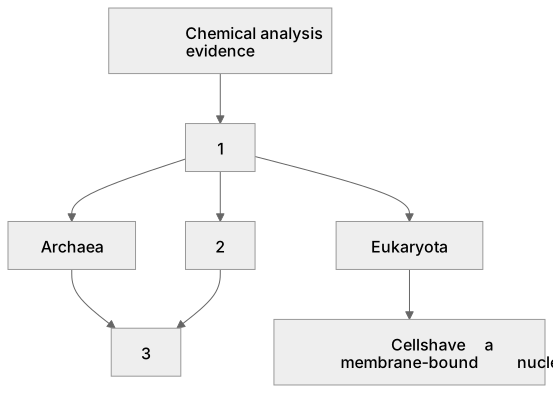
Some boxes have lost their names. Pick the right name for each number.
1Box 1
2Box 2
3Box 3
There is more to this lesson
The full lesson goes on to check your understanding and help you earn the marks. Create a free account to carry on, with your progress saved.
A week of Premium from your first lesson · Then the free plan continues · No card, no charge
Test your understanding of Classification of living organisms: Due to evidence available from chemical analysis there is now a ‘three-domain system’ developed by Carl Woese. In this system organisms are divided into:
Active recall beats re-reading. Take an instant quiz now to test what you’ve learned and lock it into long-term memory.
A week of Premium from your first lesson · Then the free plan continues · No card, no charge