AQA · GCSE · Combined Science
Course version: 8464 · Version from Sept 2018
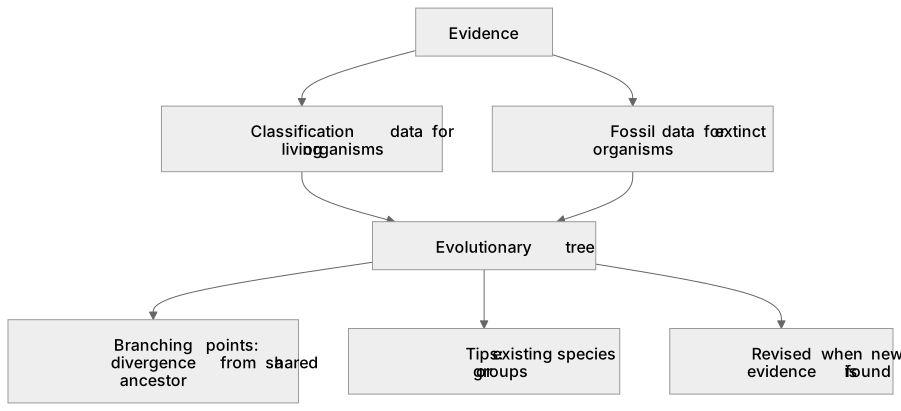
Classification of living organisms: Evolutionary trees are a method used by scientists to show how they believe organisms are related. They use current classification data for living organisms and fossil data for extinct organisms.
Evolutionary trees are branching diagrams that represent scientists' best current ideas about how organisms are related through common ancestors.
- 3 key terms
Study notes
From the checked teaching notes for this specification point.
The idea
Evolutionary trees are branching diagrams that represent scientists' best current ideas about how organisms are related through common ancestors. Each branching point suggests a point where lineages diverged, and the tips usually represent present-day species or groups. To build these trees, scientists combine evidence: classification data from living organisms, such as physical features, DNA base sequences and biochemical similarities, plus fossil data from extinct organisms, including their age and structure. Fossils can show when particular body forms appeared, while molecular data can reveal how closely living species are related. Because new evidence may emerge, evolutionary trees are revised over time rather than being fixed.
What earns the marks
- Evolutionary trees show proposed relationships and common ancestry between organisms.
- Branching points represent divergence from a shared ancestor.
- Current classification data from living organisms, including DNA and physical features, is used.
- Fossil data from extinct organisms provides evidence about past life and timing.
- Trees are based on scientific evidence and may be modified when new data is found.
- The tips of a tree often represent existing species or groups, while internal branches represent ancestral lineages.
Common mistakes and how to put them right
Treating an evolutionary tree as a family tree of individuals.
Put it right: It shows relationships between species or larger groups over evolutionary time.
Assuming the tree is proven fact and never changes.
Put it right: It is a model based on current evidence and can be revised.
Thinking fossils are the only evidence used.
Put it right: Classification data from living organisms, especially DNA, is also essential.
Exam tips
- State clearly that evolutionary trees show relationships and common ancestry.
- Name both types of evidence: classification data for living organisms and fossil data for extinct ones.
- Use terms such as common ancestor and branching when describing what the diagram shows.
Try the lesson
The start of the Classification of living organisms: Evolutionary trees are a method used by scientists to show how they believe organisms are related. They use current classification data for living organisms and fossil data for extinct organisms. lesson, made from checked teaching notes for this specification point.
Have a go first
What is an evolutionary tree used by scientists to show?
See it
Key words
Say what each word means before you turn the card.
Evolutionary trees
Try answering aloud or in your head before turning the card.
Evidence for classification
Try answering aloud or in your head before turning the card.
Scientific models and their revision
Try answering aloud or in your head before turning the card.
See every definition
- Evolutionary trees
- A method used by scientists to show how they believe organisms are related.
- Evidence for classification
- Current classification data for living organisms and fossil data for extinct organisms are used to build evolutionary trees.
- Scientific models and their revision
- Evolutionary trees are revised over time rather than being fixed because new evidence may emerge.
Label the diagram
Some boxes have lost their names. Pick the right name for each number.
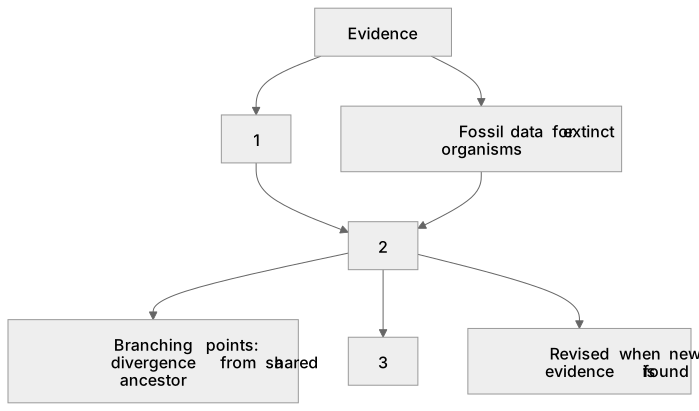
1Box 1
2Box 2
3Box 3
There is more to this lesson
The full lesson goes on to check your understanding and help you earn the marks. Create a free account to carry on, with your progress saved.
A week of Premium from your first lesson · Then the free plan continues · No card, no charge
Test your understanding of Classification of living organisms: Evolutionary trees are a method used by scientists to show how they believe organisms are related. They use current classification data for living organisms and fossil data for extinct organisms.
Active recall beats re-reading. Take an instant quiz now to test what you’ve learned and lock it into long-term memory.
A week of Premium from your first lesson · Then the free plan continues · No card, no charge