AQA · GCSE · Combined Science
Course version: 8464 · Version from Sept 2018
Classification of living organisms: Students should be able to use information given to show understanding of the Linnaean system.
The Linnaean system groups organisms into a hierarchy of ranked groups, from broad kingdom down to species.
- 4 key terms
Study notes
From the checked teaching notes for this specification point.
The idea
The Linnaean system groups organisms into a hierarchy of ranked groups, from broad kingdom down to species. To show understanding, you interpret supplied information such as a table, key or list and explain why an organism belongs to a named group. For example, if a table states that class Mammalia contains animals with fur, and you are told 'Canis lupus has fur', you use this to place it in class Mammalia. You must use the information, not recall it, and explain that each level is nested inside the one above, so members of a genus share more features than members of a class. You should also recognise binomial names, where the genus is capitalised and the species is lower case, and that the system reflects shared characteristics.
What earns the marks
- Identify the ranked groups of the Linnaean system in order: kingdom, phylum, class, order, family, genus, species.
- Use the supplied information to assign an organism to a named group, giving the feature from the information that supports the assignment.
- Explain that the groups are hierarchical and nested, so a species belongs to a genus, which belongs to a family, and so on.
- Interpret a binomial name by identifying the genus as the first, capitalised word and the species as the second, lower-case word.
- Compare two organisms using the information to state which group they share and which group separates them.
- Recognise that organisms in the same species can interbreed to produce fertile offspring, while those in different species generally cannot.
Common mistakes and how to put them right
Writing the levels in the wrong order, such as placing family before order.
Put it right: Learn the mnemonic 'King Philip Came Over For Good Soup' for kingdom, phylum, class, order, family, genus, species.
Capitalising the species name in a binomial, for example 'Canis Lupus'.
Put it right: Only the genus is capitalised; the species is always lower case, as in 'Canis lupus'.
Treating the Linnaean groups as separate boxes rather than nested groups.
Put it right: State that each group sits inside the one above, so all mammals are chordates and animals.
Ignoring the supplied information and writing general knowledge instead.
Put it right: Quote or paraphrase the given feature, such as 'has feathers', to justify the group you choose.
Exam tips
- Read the information table or key carefully and highlight the feature that matches the group you choose.
- When asked to 'use information given', write the feature from the resource in your answer, not just the group name.
- For a binomial name, underline or separate the genus and species and state which is which.
- If asked to compare, use comparative language such as 'both are in the same class, but they are in different orders'.
- Check that your answer names the group at the level the question asks for, for example class rather than kingdom.
Try the lesson
The start of the Classification of living organisms: Students should be able to use information given to show understanding of the Linnaean system. lesson, made from checked teaching notes for this specification point.
Have a go first
The Linnaean system places organisms into groups. Which of these is the largest group in the Linnaean system?
See it
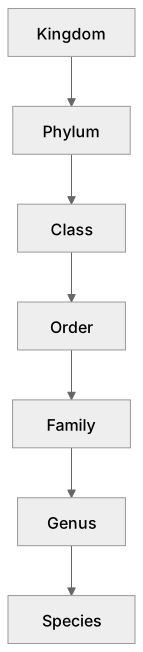
Put it in order
Put these steps in the order they happen.
- 1. Phylum
- 2. Class
- 3. Order
- 4. Family
- 5. Genus
- 6. Species
- 7. Kingdom
Key words
Say what each word means before you turn the card.
Hierarchical classification
Try answering aloud or in your head before turning the card.
Shared characteristics
Try answering aloud or in your head before turning the card.
Binomial nomenclature
Try answering aloud or in your head before turning the card.
Using given information
Try answering aloud or in your head before turning the card.
See every definition
- Hierarchical classification
- A system in which each group is nested inside the one above, so a species belongs to a genus, which belongs to a family, and so on.
- Shared characteristics
- Features that members of a group have in common, so that members of a genus share more features than members of a class.
- Binomial nomenclature
- A naming system in which the genus is the first, capitalised word and the species is the second, lower-case word.
- Using given information
- Interpreting supplied information such as a table, key or list to assign an organism to a named group, giving the feature that supports the assignment.
Label the diagram
Some boxes have lost their names. Pick the right name for each number.
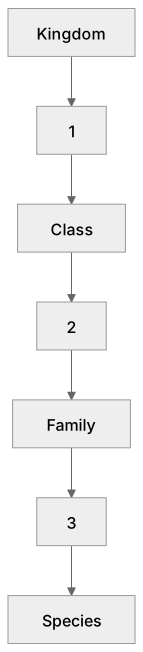
1Box 1
2Box 2
3Box 3
There is more to this lesson
The full lesson goes on to check your understanding and help you earn the marks. Create a free account to carry on, with your progress saved.
A week of Premium from your first lesson · Then the free plan continues · No card, no charge
Test your understanding of Classification of living organisms: Students should be able to use information given to show understanding of the Linnaean system.
Active recall beats re-reading. Take an instant quiz now to test what you’ve learned and lock it into long-term memory.
A week of Premium from your first lesson · Then the free plan continues · No card, no charge