AQA · GCSE · Combined Science
Course version: 8464 · Version from Sept 2018
Classification of living organisms: Traditionally living things have been classified into groups depending on their structure and characteristics in a system developed by Carl Linnaeus.
Classification means sorting organisms into groups based on shared features.
- 4 key terms
Study notes
From the checked teaching notes for this specification point.
The idea
Classification means sorting organisms into groups based on shared features. Traditionally, biologists used observable structure and characteristics, such as whether an organism has a backbone, how many legs it has, or whether it makes its own food. Carl Linnaeus developed a hierarchical system that groups organisms by these similarities. For example, a dog and a cat share a backbone, fur and milk production, so they are placed in the same kingdom, phylum, class and order before being separated at the family level. This system lets scientists organise the huge diversity of life and predict that organisms in the same group share features. Modern evidence from DNA and biochemistry has refined the traditional system, but Linnaeus's structural approach remains the foundation of classification.
What earns the marks
- Classification groups organisms according to shared structure and characteristics.
- The traditional system was developed by Carl Linnaeus.
- Observable features such as body form, skeleton and feeding method are used to place organisms into groups.
- Linnaeus's system is hierarchical, with larger groups containing smaller, more closely related groups.
- Organisms in the same group share more characteristics than organisms in different groups.
- The system helps organise and identify the diversity of living things.
Common mistakes and how to put them right
Thinking classification is based only on where an organism lives.
Put it right: It is based on structural and characteristic similarities.
Believing Linnaeus invented the idea of grouping organisms.
Put it right: He developed a specific hierarchical system, but people had grouped organisms before.
Assuming modern classification ignores Linnaeus completely.
Put it right: Modern systems build on his structural approach and add DNA evidence.
Exam tips
- When asked why organisms are grouped, link your answer to shared structure and characteristics, not habitat.
- Use examples such as 'organisms with a backbone are placed in the same group' to make your explanation concrete.
- If a question mentions Linnaeus, credit his role in developing the traditional classification system.
Try the lesson
The start of the Classification of living organisms: Traditionally living things have been classified into groups depending on their structure and characteristics in a system developed by Carl Linnaeus. lesson, made from checked teaching notes for this specification point.
Have a go first
Carl Linnaeus developed a traditional system for grouping living things. On what basis did this system place organisms into groups?
See it
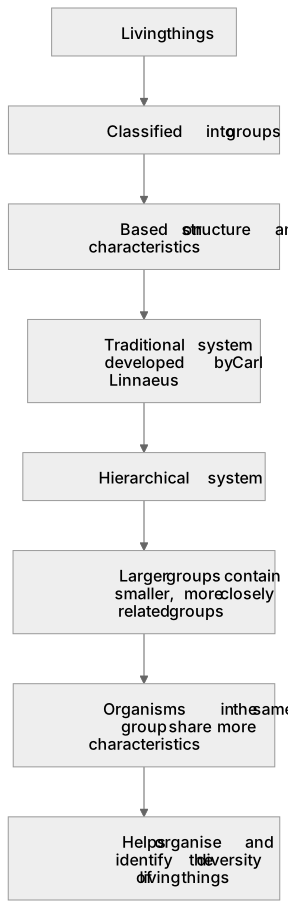
Put it in order
Put these steps in the order they happen.
- 1. Classified into groups
- 2. Based on structure and characteristics
- 3. Traditional system developed by Carl Linnaeus
- 4. Hierarchical system
- 5. Larger groups contain smaller, more closely related groups
- 6. Organisms in the same group share more characteristics
- 7. Helps organise and identify the diversity of living things
- 8. Living things
Key words
Say what each word means before you turn the card.
Classification
Try answering aloud or in your head before turning the card.
Shared characteristics
Try answering aloud or in your head before turning the card.
Hierarchical grouping
Try answering aloud or in your head before turning the card.
Carl Linnaeus
Try answering aloud or in your head before turning the card.
See every definition
- Classification
- Sorting living things into groups depending on their structure and characteristics.
- Shared characteristics
- Features that organisms have in common, which are used to place them into groups.
- Hierarchical grouping
- A system in which larger groups contain smaller, more closely related groups.
- Carl Linnaeus
- The scientist who developed the traditional system for classifying living things into groups.
Label the diagram
Some boxes have lost their names. Pick the right name for each number.
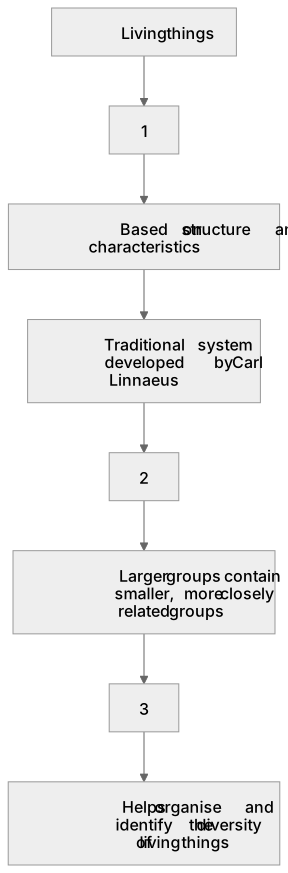
1Box 1
2Box 2
3Box 3
There is more to this lesson
The full lesson goes on to check your understanding and help you earn the marks. Create a free account to carry on, with your progress saved.
A week of Premium from your first lesson · Then the free plan continues · No card, no charge
Test your understanding of Classification of living organisms: Traditionally living things have been classified into groups depending on their structure and characteristics in a system developed by Carl Linnaeus.
Active recall beats re-reading. Take an instant quiz now to test what you’ve learned and lock it into long-term memory.
A week of Premium from your first lesson · Then the free plan continues · No card, no charge