AQA · GCSE · Combined Science
Course version: 8464 · Version from Sept 2018
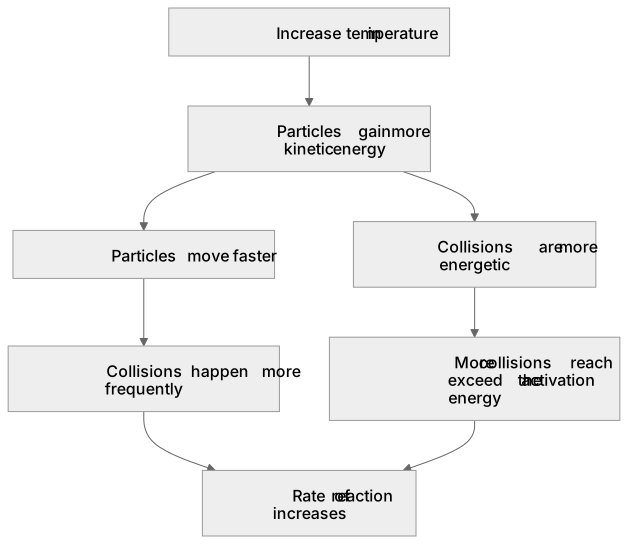
Collision theory and activation energy: Increasing the temperature increases the frequency of collisions and makes the collisions more energetic, and so increases the rate of reaction.
Temperature affects reaction rate in two ways.
- 2 key terms
Study notes
From the checked teaching notes for this specification point.
The idea
Temperature affects reaction rate in two ways. First, warming a reactant gives its particles more kinetic energy, so they move faster and collide more often. Second, each collision carries more energy, so a greater proportion of collisions has at least the activation energy needed to react. Both effects raise the rate. For example, sodium thiosulfate solution reacts with dilute hydrochloric acid faster at 40 °C than at 20 °C: the sulfur cloud appears sooner because more collisions are successful each second. A common practical method is to time how long the cross under the flask disappears at different temperatures, then compare the times.
What earns the marks
- State that raising temperature gives particles more kinetic energy.
- Explain that faster-moving particles collide more frequently.
- Explain that collisions are more energetic, so more collisions reach or exceed the activation energy.
- Link both effects to an increased rate of reaction.
- Use a named example, such as sodium thiosulfate with hydrochloric acid at different temperatures.
- Describe a method that measures rate, such as timing the disappearance of a cross or measuring gas volume over time.
Common mistakes and how to put them right
Claiming temperature only increases collision frequency.
Put it right: It also makes collisions more energetic, so more particles have at least the activation energy.
Saying that all collisions cause reaction at higher temperature.
Put it right: Only collisions with at least the activation energy are successful.
Confusing rate with yield.
Put it right: Temperature changes how fast the reaction goes, not necessarily how much product forms.
Exam tips
- Include both the frequency effect and the energy effect when explaining temperature.
- Refer to the activation energy explicitly to show why more collisions are successful.
- When describing a practical, state the variable measured and how it indicates rate, such as time for a colour change.
Try the lesson
The start of the Collision theory and activation energy: Increasing the temperature increases the frequency of collisions and makes the collisions more energetic, and so increases the rate of reaction. lesson, made from checked teaching notes for this specification point.
Have a go first
A student warms a flask of dilute hydrochloric acid reacting with magnesium ribbon. According to collision theory, why does the reaction speed up when the temperature is raised?
Listen
Temperature affects reaction rate in two ways. First, warming a reactant gives its particles more kinetic energy, so they move faster and collide more often. Second, each collision carries more energy, so a greater proportion of collisions has at least the activation energy needed to react. Both effects raise the rate. For example, sodium thiosulfate solution reacts with dilute hydrochloric acid faster at 40 °C than at 20 °C: the sulfur cloud appears sooner because more collisions are successful each second. A common practical method is to time how long the cross under the flask disappears at different temperatures, then compare the times. A strong answer earns marks for these points. State that raising temperature gives particles more kinetic energy. Explain that faster-moving particles collide more frequently. Explain that collisions are more energetic, so more collisions reach or exceed the activation energy. Link both effects to an increased rate of reaction. A common slip: Claiming temperature only increases collision frequency. Instead, it also makes collisions more energetic, so more particles have at least the activation energy. Exam tip: Include both the frequency effect and the energy effect when explaining temperature.
See it
Key words
Say what each word means before you turn the card.
Activation energy
Try answering aloud or in your head before turning the card.
Rate of reaction
Try answering aloud or in your head before turning the card.
See every definition
- Activation energy
- The energy that a collision must have for a reaction to happen, with more collisions reaching it at higher temperature.
- Rate of reaction
- How fast a reaction goes, increased by raising temperature through more frequent and more energetic collisions.
Label the diagram
Some boxes have lost their names. Pick the right name for each number.
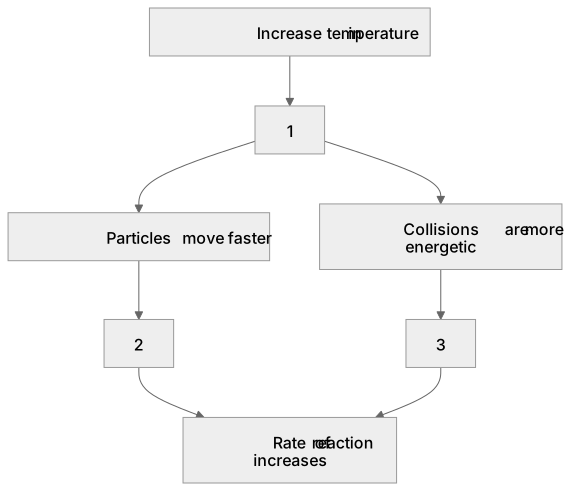
1Box 1
2Box 2
3Box 3
There is more to this lesson
The full lesson goes on to check your understanding and help you earn the marks. Create a free account to carry on, with your progress saved.
A week of Premium from your first lesson · Then the free plan continues · No card, no charge
Test your understanding of Collision theory and activation energy: Increasing the temperature increases the frequency of collisions and makes the collisions more energetic, and so increases the rate of reaction.
Active recall beats re-reading. Take an instant quiz now to test what you’ve learned and lock it into long-term memory.
A week of Premium from your first lesson · Then the free plan continues · No card, no charge