AQA · GCSE · Combined Science
Course version: 8464 · Version from Sept 2018
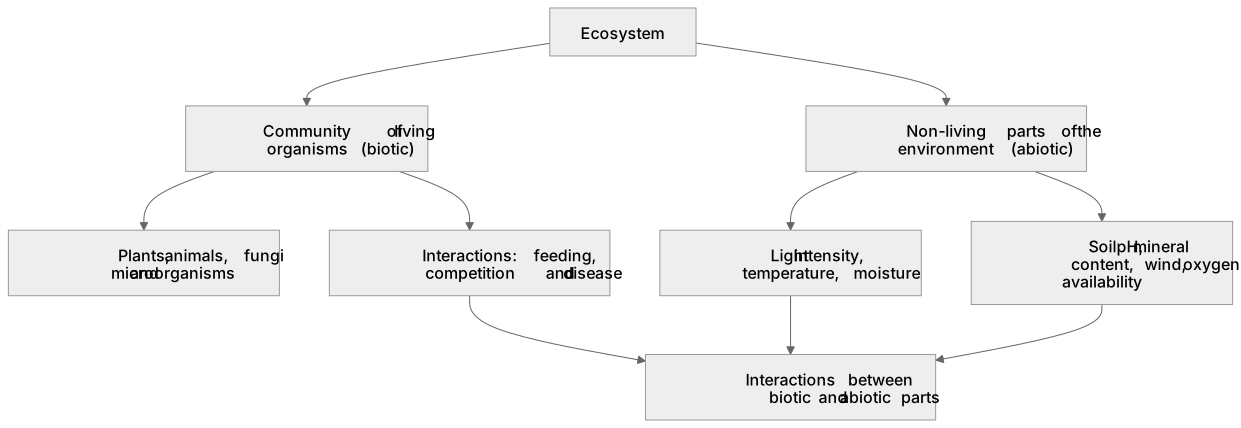
Communities: An ecosystem is the interaction of a community of living organisms (biotic) with the non-living (abiotic) parts of their environment.
An ecosystem is not just the organisms present; it is the whole system in which a community of living organisms interacts with the non-living parts of the environment.
- 4 key terms
Study notes
From the checked teaching notes for this specification point.
The idea
An ecosystem is not just the organisms present; it is the whole system in which a community of living organisms interacts with the non-living parts of the environment. The biotic parts are all the living organisms, including plants, animals, fungi and microorganisms, and their interactions such as feeding, competition and disease. The abiotic parts are the non-living conditions, including light intensity, temperature, moisture, soil pH, mineral content, wind and oxygen availability. These parts interact: plants compete for light and water, animals compete for food and territory, and abiotic factors affect which species can survive.
For example: In a pond, fish, plants and microorganisms interact with water temperature, oxygen concentration and light.
What earns the marks
- Define the community as all the populations of different species living and interacting in a habitat.
- Identify biotic components as living organisms and their interactions, such as predation, competition and disease.
- Identify abiotic components as non-living conditions, such as light, temperature, water, soil pH and oxygen.
- Explain that an ecosystem includes both the community and the abiotic environment, and the interactions between them.
- Give a specific example of an interaction, such as plants competing for light or animals competing for water.
- Recognise that a change in one component, such as reduced rainfall, can affect the whole community.
Common mistakes and how to put them right
Treating an ecosystem as only the living organisms.
Put it right by including the abiotic conditions and their interactions.
Confusing a community with a population.
Put it right by stating that a community contains multiple species, while a population is one species.
Listing abiotic factors without linking them to organisms.
Put it right by explaining how a factor such as temperature affects survival or distribution.
Exam tips
- Use the words biotic and abiotic accurately, and give at least one example of each when explaining an ecosystem.
- When describing an interaction, name both the organisms or factors involved and state the effect on the community.
- Check that your answer covers both the living community and the non-living environment, because the definition requires both.
Try the lesson
The start of the Communities: An ecosystem is the interaction of a community of living organisms (biotic) with the non-living (abiotic) parts of their environment. lesson, made from checked teaching notes for this specification point.
Have a go first
Which of the following is an abiotic (non-living) part of an ecosystem?
See it
Key words
Say what each word means before you turn the card.
Ecosystem
Try answering aloud or in your head before turning the card.
Biotic
Try answering aloud or in your head before turning the card.
Abiotic
Try answering aloud or in your head before turning the card.
Community
Try answering aloud or in your head before turning the card.
See every definition
- Ecosystem
- The interaction of a community of living organisms with the non-living parts of their environment.
- Biotic
- The living organisms, including plants, animals, fungi and microorganisms, and their interactions such as feeding, competition and disease.
- Abiotic
- The non-living conditions, including light intensity, temperature, moisture, soil pH, mineral content, wind and oxygen availability.
- Community
- All the populations of different species living and interacting in a habitat.
Label the diagram
Some boxes have lost their names. Pick the right name for each number.
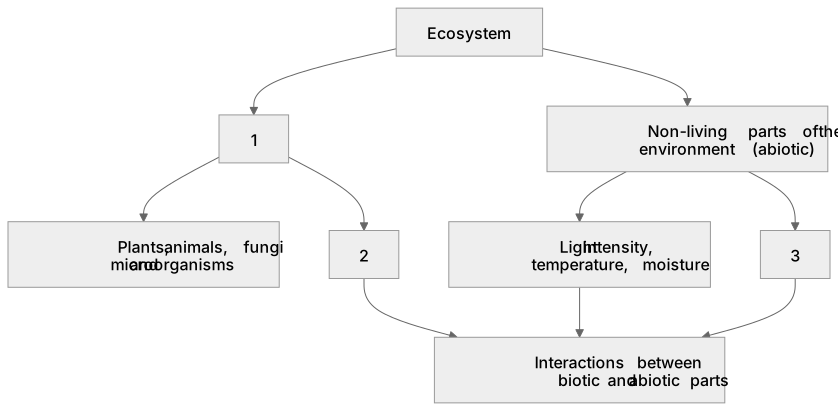
1Box 1
2Box 2
3Box 3
There is more to this lesson
The full lesson goes on to check your understanding and help you earn the marks. Create a free account to carry on, with your progress saved.
A week of Premium from your first lesson · Then the free plan continues · No card, no charge
Test your understanding of Communities: An ecosystem is the interaction of a community of living organisms (biotic) with the non-living (abiotic) parts of their environment.
Active recall beats re-reading. Take an instant quiz now to test what you’ve learned and lock it into long-term memory.
A week of Premium from your first lesson · Then the free plan continues · No card, no charge