AQA · GCSE · Combined Science
Course version: 8464 · Version from Sept 2018
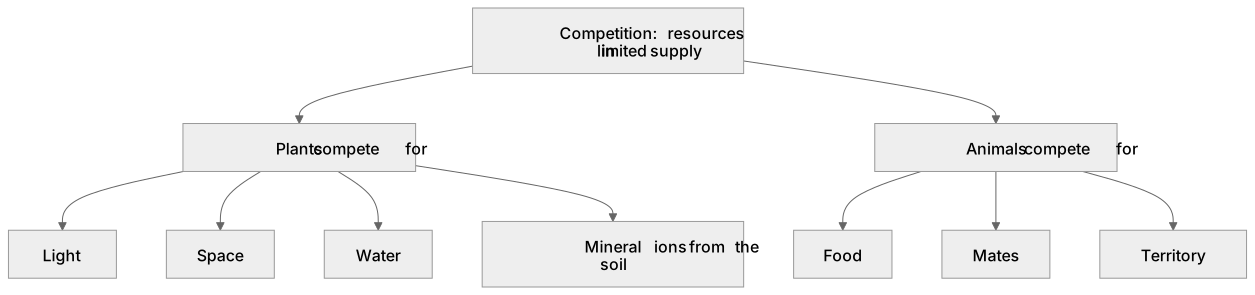
Communities: Plants in a community or habitat often compete with each other for light and space, and for water and mineral ions from the soil. Animals often compete with each other for food, mates and territory.
Competition occurs when organisms need the same resource that is in limited supply.
Study notes
From the checked teaching notes for this specification point.
The idea
Competition occurs when organisms need the same resource that is in limited supply. Plants compete for light, space, water and mineral ions. A tall oak shades smaller plants, while shallow-rooted grasses and deep-rooted shrubs draw water and ions from different soil depths. Animals compete for food, mates and territory. Red squirrels and grey squirrels compete for food and nesting sites; male deer compete for mates and territory. The better-adapted competitor survives and reproduces, so its alleles become more common. Competition can be intraspecific, between members of the same species, or interspecific, between different species. It is a major driver of natural selection and affects population sizes within a community.
What earns the marks
- Plants compete for light, space, water and mineral ions from the soil.
- Animals compete for food, mates and territory.
- Competition happens when resources are limited, so not all organisms obtain enough to survive and reproduce.
- Intraspecific competition occurs between members of the same species; interspecific competition occurs between different species.
- Successful competitors survive and reproduce, passing on advantageous alleles, which links competition to natural selection.
Common mistakes and how to put them right
Listing only food for animals.
Put it right by including mates and territory as well.
Saying plants compete for food.
Put it right by stating that plants compete for light, space, water and mineral ions, because they make their own food.
Treating competition as always between different species.
Put it right by distinguishing intraspecific from interspecific competition.
Exam tips
- Match each resource to the correct group, for example light and space for plants, mates and territory for animals.
- Use comparative language such as 'more likely to survive' or 'less likely to reproduce' when explaining the outcome.
- Give a named example from a habitat you have studied to make your answer concrete.
Try the lesson
The start of the Communities: Plants in a community or habitat often compete with each other for light and space, and for water and mineral ions from the soil. Animals often compete with each other for food, mates and territory. lesson, made from checked teaching notes for this specification point.
Have a go first
In a garden, several rose bushes grow close together. For which two resources do these plants mainly compete?
See it
Label the diagram
Some boxes have lost their names. Pick the right name for each number.
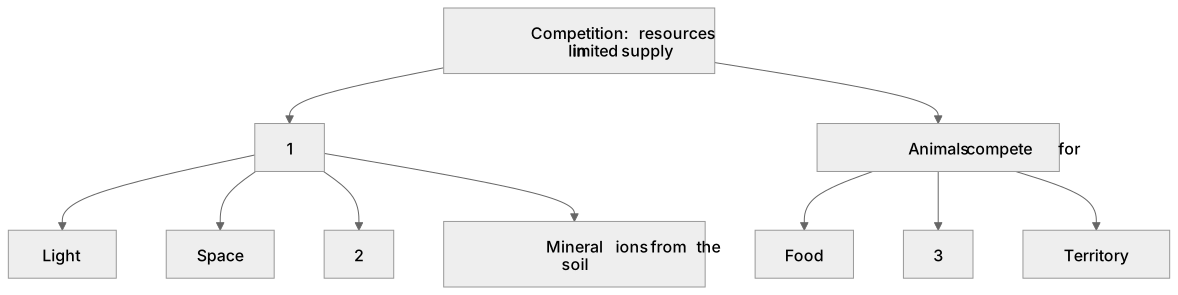
1Box 1
2Box 2
3Box 3
There is more to this lesson
The full lesson goes on to check your understanding and help you earn the marks. Create a free account to carry on, with your progress saved.
A week of Premium from your first lesson · Then the free plan continues · No card, no charge
Test your understanding of Communities: Plants in a community or habitat often compete with each other for light and space, and for water and mineral ions from the soil. Animals often compete with each other for food, mates and territory.
Active recall beats re-reading. Take an instant quiz now to test what you’ve learned and lock it into long-term memory.
A week of Premium from your first lesson · Then the free plan continues · No card, no charge