AQA · GCSE · Combined Science
Course version: 8464 · Version from Sept 2018
Communities: Students should be able to describe:
In this subsection, students learn the levels of organisation in an ecosystem, from individual organisms to populations, communities, and the whole ecosystem.
- 4 key terms
Study notes
From the checked teaching notes for this specification point.
The idea
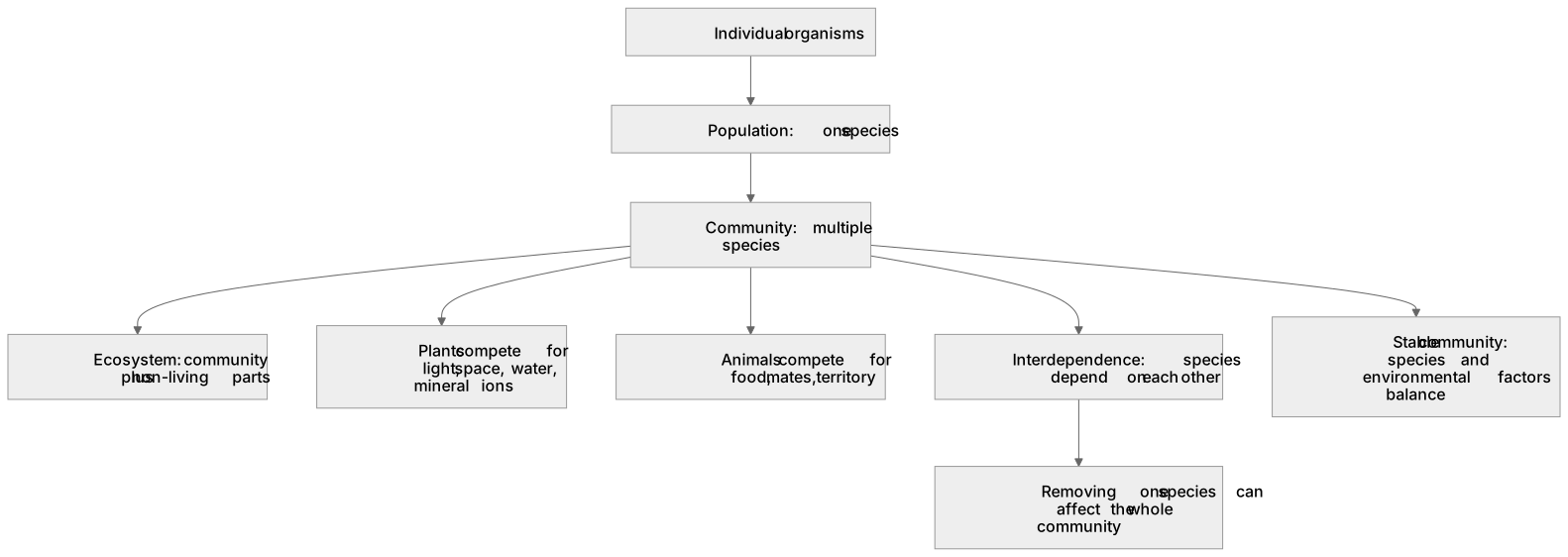
In this subsection, students learn the levels of organisation in an ecosystem, from individual organisms to populations, communities, and the whole ecosystem. An ecosystem is the interaction of a community of living organisms with the non-living parts of their environment. They should explain interdependence, where species depend on each other for food, shelter, pollination, and seed dispersal. Removing one species can affect the whole community. A stable community is one where all species and environmental factors are in balance, keeping population sizes fairly constant.
What earns the marks
- Define the levels of organisation: individual organisms, populations (one species), communities (multiple species), and ecosystems (biotic and abiotic parts).
- Describe competition in plants for light, space, water, and mineral ions from the soil.
- Describe competition in animals for food, mates, and territory.
- Explain interdependence, giving examples such as plants providing food and shelter, insects pollinating flowers, and animals dispersing seeds.
- Define a stable community as one where species and environmental factors are in balance, so population sizes remain fairly constant.
Common mistakes and how to put them right
Using population and community interchangeably.
Put it right by stating that a population is one species in an area, while a community includes all the different species.
Stating that animals compete for space.
Put it right by specifying that animals compete for territory, while plants compete for space.
Treating interdependence as one-way.
Put it right by giving examples where species affect each other, such as pollinators and flowering plants.
Exam tips
- Learn precise definitions of population, community, habitat, and ecosystem, and use them in answers rather than informal wording.
- When describing competition, explicitly state what plants compete for (e.g., light, space) versus what animals compete for (e.g., food, mates).
Try the lesson
The start of the Communities: Students should be able to describe: lesson, made from checked teaching notes for this specification point.
Have a go first
What name is given to all the different populations of organisms that live together in the same habitat?
See it
Key words
Say what each word means before you turn the card.
Ecosystem
Try answering aloud or in your head before turning the card.
Competition in plants and animals
Try answering aloud or in your head before turning the card.
Interdependence
Try answering aloud or in your head before turning the card.
Stable community
Try answering aloud or in your head before turning the card.
See every definition
- Ecosystem
- The interaction of a community of living organisms with the non-living parts of their environment.
- Competition in plants and animals
- Plants compete for light, space, water and mineral ions, while animals compete for food, mates and territory.
- Interdependence
- Species depend on each other for food, shelter, pollination and seed dispersal, so removing one species can affect the whole community.
- Stable community
- One where all species and environmental factors are in balance, keeping population sizes fairly constant.
Label the diagram
Some boxes have lost their names. Pick the right name for each number.
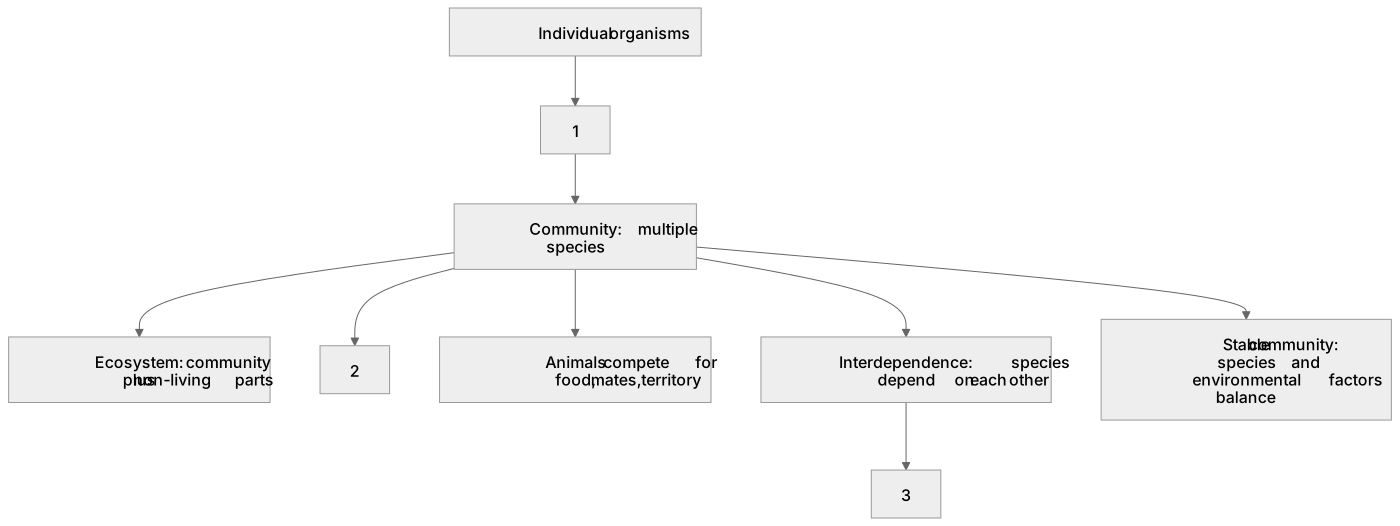
1Box 1
2Box 2
3Box 3
There is more to this lesson
The full lesson goes on to check your understanding and help you earn the marks. Create a free account to carry on, with your progress saved.
A week of Premium from your first lesson · Then the free plan continues · No card, no charge
Test your understanding of Communities: Students should be able to describe:
Active recall beats re-reading. Take an instant quiz now to test what you’ve learned and lock it into long-term memory.
A week of Premium from your first lesson · Then the free plan continues · No card, no charge