AQA · GCSE · Combined Science
Course version: 8464 · Version from Sept 2018
Communities: suggest the factors for which organisms are competing in a given habitat
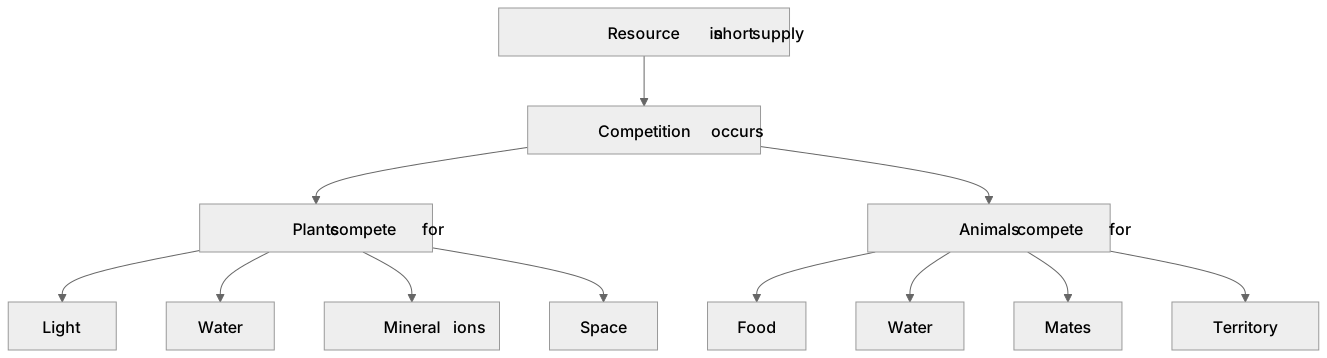
Organisms in a community share a habitat, so when a resource is in short supply they compete for it.
- 2 key terms
Study notes
From the checked teaching notes for this specification point.
The idea
Organisms in a community share a habitat, so when a resource is in short supply they compete for it. Plants compete for light, water, mineral ions and space; animals compete for food, water, mates and territory. In a given habitat you should identify which of these is likely to be limiting by reading the description: a dense woodland suggests light is scarce for ground plants, while a dry desert suggests water is the key factor. The command word 'suggest' means you apply your knowledge to the context rather than recall a list. Name the factor, then justify it from the habitat details, for example 'the shrubs compete for light because the tall trees cast shade'. Competition between members of the same species is intraspecific; between different species it is interspecific.
What earns the marks
- Name a specific resource, such as light, water, mineral ions, space, food, mates or territory, rather than writing the vague phrase 'resources'.
- Match the named factor to the habitat described, for example water in a dry environment or light in a shaded woodland.
- Justify the choice by referring to a feature of the habitat, such as dense canopy, low rainfall or a crowded rock pool.
- Distinguish between intraspecific competition within one species and interspecific competition between different species where the question allows.
- Recognise that competition occurs when a resource is limited, and that the organism best adapted to obtain it is more likely to survive and reproduce.
- Give more than one factor where the habitat description supports it, since real habitats usually have several limiting resources.
Common mistakes and how to put them right
Writing only 'food' for plants.
Put it right: Plants make their own food by photosynthesis, so they compete for light, water, mineral ions and space.
Naming a factor without linking it to the habitat.
Put it right: Add a clause explaining why that resource is scarce, such as 'because the canopy blocks sunlight'.
Confusing competition with predation.
Put it right: Competition is a struggle for the same limited resource; predation is one organism eating another.
Exam tips
- Use the habitat words in the question as your evidence, quoting them briefly to justify each factor.
- Aim for two or three different factors so you cover more of the available credit.
- Write the factor first and the reason second, keeping each point to one clear sentence.
- Check whether the question asks about plants, animals or both before choosing your factors.
Try the lesson
The start of the Communities: suggest the factors for which organisms are competing in a given habitat lesson, made from checked teaching notes for this specification point.
Have a go first
Oak trees in a wood compete with each other for light. Which other resource do plants in the same habitat compete for?
See it
Key words
Say what each word means before you turn the card.
Competition for limited resources
Try answering aloud or in your head before turning the card.
Intraspecific competition
Try answering aloud or in your head before turning the card.
See every definition
- Competition for limited resources
- Organisms in a community share a habitat, so when a resource is in short supply they compete for it.
- Intraspecific competition
- Competition between members of the same species.
There is more to this lesson
The full lesson goes on to check your understanding and help you earn the marks. Create a free account to carry on, with your progress saved.
A week of Premium from your first lesson · Then the free plan continues · No card, no charge
Test your understanding of Communities: suggest the factors for which organisms are competing in a given habitat
Active recall beats re-reading. Take an instant quiz now to test what you’ve learned and lock it into long-term memory.
A week of Premium from your first lesson · Then the free plan continues · No card, no charge