AQA · GCSE · Combined Science
Course version: 8464 · Version from Sept 2018
Communities: Within a community each species depends on other species for food, shelter, pollination, seed dispersal etc. If one species is removed it can affect the whole community. This is called interdependence. A stable community is one where all the species and environmental factors are in balance so that population sizes remain fairly constant.
A community is all the populations of different species living together in a habitat.
- 4 key terms
Study notes
From the checked teaching notes for this specification point.
The idea
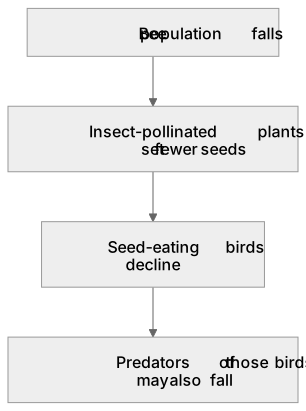
A community is all the populations of different species living together in a habitat. Interdependence means each species relies on others: for food through food webs, for shelter such as trees housing birds, for pollination as bees transfer pollen between flowers, and for seed dispersal as birds or mammals carry fruits away. Removing one species can ripple through the community. For example, if a bee population falls, insect-pollinated plants set fewer seeds, so seed-eating birds decline and predators of those birds may also fall. A stable community has all species and environmental factors in balance, so population sizes stay fairly constant over time. Stability does not mean nothing changes; numbers fluctuate slightly around a steady level because births, deaths, predation and resources balance out.
What earns the marks
- Define a community as all the populations of different species living together in one habitat, and distinguish it from a population of a single species.
- Describe a consequence of removing one species, tracing the effect through at least two other species, such as loss of a pollinator reducing plant seeds and then reducing seed-eating bird numbers.
- State that a stable community has species and environmental factors in balance so population sizes remain fairly constant, and explain that small fluctuations still occur around that steady level.
- Use data or a food web to support a prediction about how removing or adding a species changes other populations.
Common mistakes and how to put them right
Treating community and population as the same thing.
Put it right: A population is one species in a habitat, while a community is all the populations of all species there.
Assuming removing a species only affects its direct predator or prey.
Put it right: Effects can spread indirectly through the food web, for example to species two or more feeding links away.
Believing a stable community never changes.
Put it right: Population sizes fluctuate slightly; stability means they stay fairly constant because births, deaths and resources are balanced.
Exam tips
- When asked about interdependence, name the species and state the exact benefit, such as 'the oak tree provides shelter for the owl', rather than writing 'they need each other'.
- For removal questions, write a chain of at least two consequences using arrows or 'so' to show the direction of effect.
- For stability questions, use the phrase 'population sizes remain fairly constant' and mention balance between species and environmental factors.
Try the lesson
The start of the Communities: Within a community each species depends on other species for food, shelter, pollination, seed dispersal etc. If one species is removed it can affect the whole community. This is called interdependence. A stable community is one where all the species and environmental factors are in balance so that population sizes remain fairly constant. lesson, made from checked teaching notes for this specification point.
Have a go first
In a community, a species of bee pollinates a species of flowering plant. What name is given to the way these two species depend on each other?
See it
Put it in order
Put these steps in the order they happen.
- 1. Insect-pollinated plants set fewer seeds
- 2. Seed-eating birds decline
- 3. Predators of those birds may also fall
- 4. Bee population falls
Key words
Say what each word means before you turn the card.
Interdependence
Try answering aloud or in your head before turning the card.
Stable community
Try answering aloud or in your head before turning the card.
Community
Try answering aloud or in your head before turning the card.
Population
Try answering aloud or in your head before turning the card.
See every definition
- Interdependence
- Each species in a community depends on other species for food, shelter, pollination, seed dispersal etc, so removing one species can affect the whole community.
- Stable community
- One where all the species and environmental factors are in balance so that population sizes remain fairly constant.
- Community
- All the populations of different species living together in a habitat.
- Population
- One species in a habitat, as distinguished from a community of all the populations of all species there.
Label the diagram
Some boxes have lost their names. Pick the right name for each number.
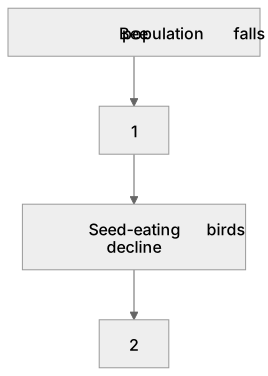
1Box 1
2Box 2
There is more to this lesson
The full lesson goes on to check your understanding and help you earn the marks. Create a free account to carry on, with your progress saved.
A week of Premium from your first lesson · Then the free plan continues · No card, no charge
Test your understanding of Communities: Within a community each species depends on other species for food, shelter, pollination, seed dispersal etc. If one species is removed it can affect the whole community. This is called interdependence. A stable community is one where all the species and environmental factors are in balance so that population sizes remain fairly constant.
Active recall beats re-reading. Take an instant quiz now to test what you’ve learned and lock it into long-term memory.
A week of Premium from your first lesson · Then the free plan continues · No card, no charge