AQA · GCSE · Combined Science
Course version: 8464 · Version from Sept 2018
Contraception: surgical methods of male and female sterilisation.
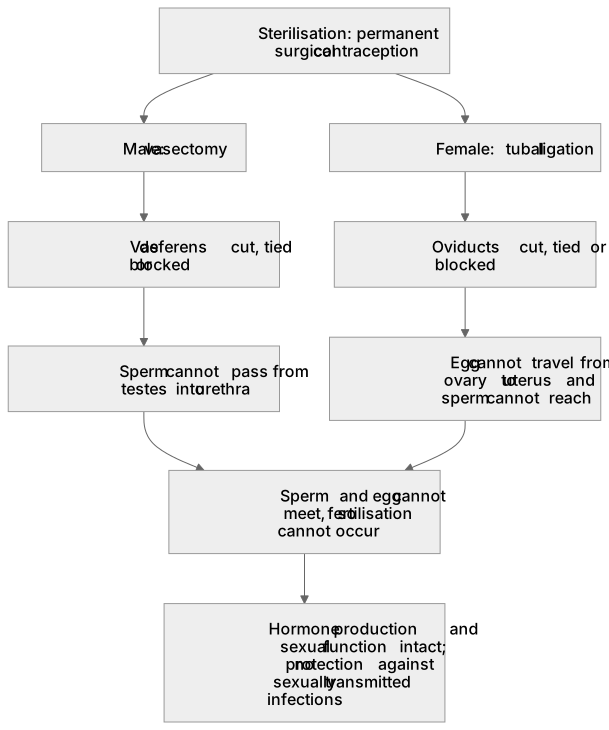
Sterilisation is a permanent, surgical method of contraception that prevents sperm and egg meeting.
- 4 key terms
Study notes
From the checked teaching notes for this specification point.
The idea
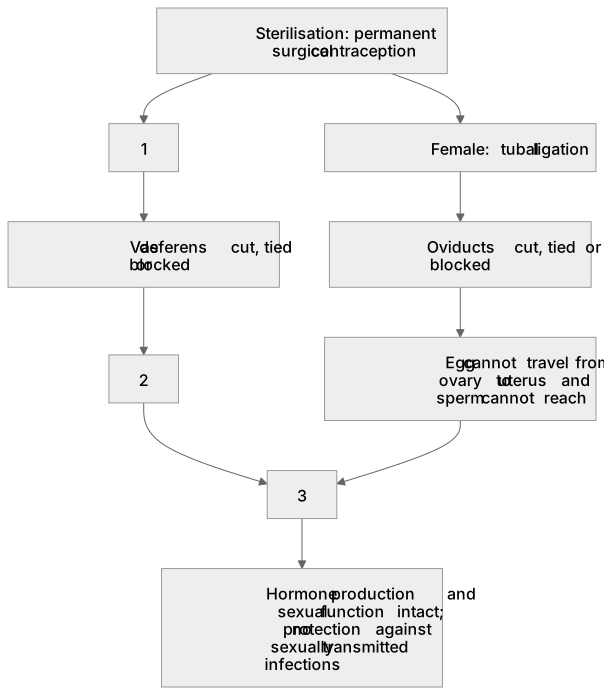
Sterilisation is a permanent, surgical method of contraception that prevents sperm and egg meeting. In males, vasectomy cuts or ties the vas deferens, so sperm cannot leave the testes and enter the urethra; semen still contains seminal fluid but no sperm. In females, tubal ligation cuts, ties or blocks the oviducts, so the egg cannot travel from the ovary to the uterus and sperm cannot reach it. Both procedures leave sex hormone production and sexual function intact, but they do not protect against sexually transmitted infections. They are intended to be irreversible, so they suit people who are certain they do not want children; reversal surgery is difficult and not always successful.
What earns the marks
- A vasectomy involves cutting, tying or blocking the vas deferens so that sperm cannot pass from the testes into the urethra.
- A tubal ligation involves cutting, tying or blocking the oviducts so that the egg cannot travel from the ovary to the uterus and sperm cannot reach the egg.
- Sterilisation is intended to be a permanent method of contraception and is difficult or impossible to reverse reliably.
- Neither method prevents the transmission of sexually transmitted infections, so barrier methods may still be needed.
- Hormone production by the testes and ovaries continues, so secondary sexual characteristics and sex drive are not removed.
Common mistakes and how to put them right
Thinking that a vasectomy removes the testes or stops sperm production.
Put it right: Sperm are still produced in the testes, but the vas deferens is blocked so sperm cannot leave the body.
Confusing the oviduct with the uterus and saying the uterus is cut.
Put it right: Tubal ligation blocks the oviducts, which are the tubes carrying the egg towards the uterus.
Claiming sterilisation is easily reversed.
Put it right: It is intended to be permanent, and reversal is difficult and not always successful.
Exam tips
- Name the exact structure cut or blocked in each sex: vas deferens in males and oviducts in females.
- Link each method to the general principle that contraception prevents sperm and egg meeting, rather than simply listing operations.
- If asked to compare methods, mention that sterilisation is permanent and gives no protection against sexually transmitted infections.
Try the lesson
The start of the Contraception: surgical methods of male and female sterilisation. lesson, made from checked teaching notes for this specification point.
Have a go first
Which surgical method of contraception is used in females?
See it
Key words
Say what each word means before you turn the card.
Vasectomy
Try answering aloud or in your head before turning the card.
Tubal ligation
Try answering aloud or in your head before turning the card.
Sterilisation
Try answering aloud or in your head before turning the card.
Fertilisation
Try answering aloud or in your head before turning the card.
See every definition
- Vasectomy
- A surgical method of male sterilisation that cuts, ties or blocks the vas deferens so that sperm cannot pass from the testes into the urethra.
- Tubal ligation
- A surgical method of female sterilisation that cuts, ties or blocks the oviducts so that the egg cannot travel from the ovary to the uterus and sperm cannot reach it.
- Sterilisation
- A permanent, surgical method of contraception that prevents sperm and egg meeting, intended to be irreversible and giving no protection against sexually transmitted infections.
- Fertilisation
- The meeting of sperm and egg, which both methods of sterilisation work to prevent so that it cannot occur.
Label the diagram
Some boxes have lost their names. Pick the right name for each number.
1Box 1
2Box 2
3Box 3
There is more to this lesson
The full lesson goes on to check your understanding and help you earn the marks. Create a free account to carry on, with your progress saved.
7 days Premium · Then the free plan continues · No card, no charge
Test your understanding of Contraception: surgical methods of male and female sterilisation.
Active recall beats re-reading. Take an instant quiz now to test what you’ve learned and lock it into long-term memory.
7 days Premium · Then the free plan continues · No card, no charge