AQA · GCSE · Combined Science
Course version: 8464 · Version from Sept 2018
Control of blood glucose concentration: Blood glucose concentration is monitored and controlled by the pancreas.
The pancreas monitors and controls blood glucose concentration.
- 4 key terms
Study notes
From the checked teaching notes for this specification point.
The idea
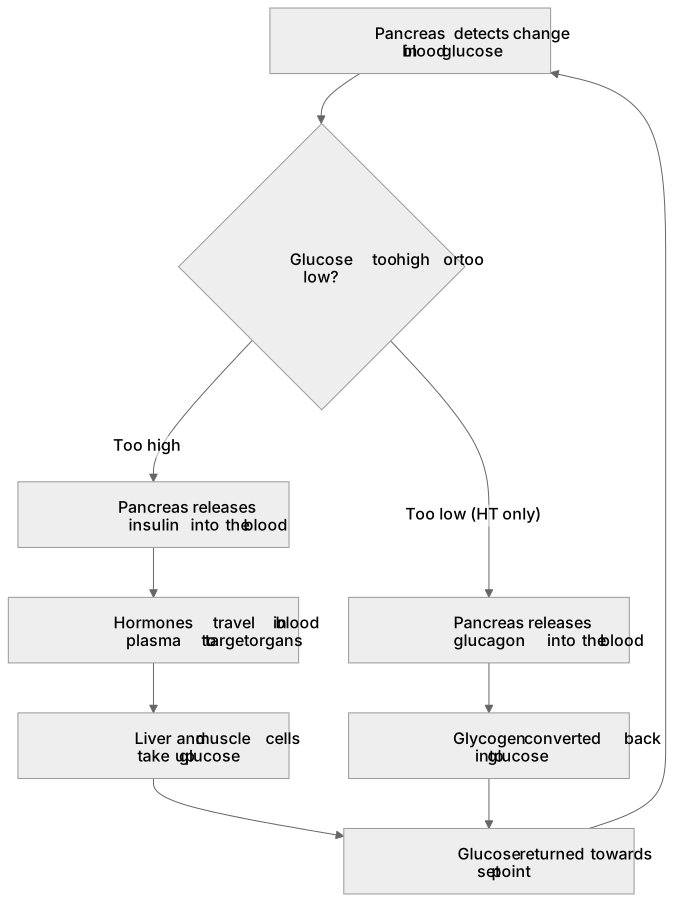
The pancreas monitors and controls blood glucose concentration. Its cells detect changes in blood plasma glucose and respond by secreting hormones. If glucose rises (e.g. after a carbohydrate meal), the pancreas releases insulin, causing cells to take up glucose. (HT only: If glucose falls, the pancreas releases glucagon, causing glycogen to be converted back into glucose). These hormones travel in the blood to target organs like the liver and muscles. This negative feedback mechanism ensures the corrective response reverses the original change, returning glucose to a set point. The pancreas thus links stimulus detection to an effector response, maintaining a steady energy supply.
What earns the marks
- The pancreas contains receptor cells that detect changes in blood glucose concentration.
- The pancreas acts as an endocrine gland by secreting the hormone insulin directly into the blood when glucose levels are too high.
- (HT only) The pancreas secretes the hormone glucagon when blood glucose levels are too low, interacting with insulin in a negative feedback cycle.
- Hormones travel in the blood plasma to target organs, primarily the liver and muscle cells, to regulate glucose uptake and storage.
- Blood glucose must be maintained within a narrow range to provide a constant supply of respiratory substrate for cells.
Common mistakes and how to put them right
Saying the pancreas 'makes' glucose or 'filters' blood.
Put it right: The pancreas detects glucose concentration and releases hormones that change how cells handle glucose.
Confusing hormones with enzymes.
Put it right: Insulin (and glucagon for HT) are hormones released into the blood, not digestive enzymes released into the gut.
Treating the pancreas as the effector.
Put it right: The effector cells are mainly liver and muscle cells that change their glucose uptake or release.
Foundation students discussing glucagon.
Put it right: Foundation tier only requires knowledge of insulin lowering high blood glucose. (HT only: remember glucagon raises low blood glucose).
Exam tips
- Name the pancreas as the receptor and control centre, and explicitly name the liver and muscles as the target effector tissues.
- (HT only) When explaining negative feedback, clearly link each hormone (insulin or glucagon) to the specific direction of change in blood glucose.
Try the lesson
The start of the Control of blood glucose concentration: Blood glucose concentration is monitored and controlled by the pancreas. lesson, made from checked teaching notes for this specification point.
Have a go first
Which organ monitors and controls the concentration of glucose in the blood?
See it
Key words
Say what each word means before you turn the card.
Pancreas
Try answering aloud or in your head before turning the card.
Insulin
Try answering aloud or in your head before turning the card.
Negative feedback
Try answering aloud or in your head before turning the card.
Target organs
Try answering aloud or in your head before turning the card.
See every definition
- Pancreas
- Organ that monitors blood glucose concentration and controls it by secreting hormones.
- Insulin
- Hormone released by the pancreas when glucose levels are too high, causing cells to take up glucose.
- Negative feedback
- Mechanism in which the corrective response reverses the original change, returning glucose to a set point.
- Target organs
- Organs such as the liver and muscles to which hormones travel in the blood to regulate glucose uptake and storage.
There is more to this lesson
The full lesson goes on to check your understanding and help you earn the marks. Create a free account to carry on, with your progress saved.
7 days Premium · Then the free plan continues · No card, no charge
Test your understanding of Control of blood glucose concentration: Blood glucose concentration is monitored and controlled by the pancreas.
Active recall beats re-reading. Take an instant quiz now to test what you’ve learned and lock it into long-term memory.
7 days Premium · Then the free plan continues · No card, no charge