AQA · GCSE · Combined Science
Course version: 8464 · Version from Sept 2018
Control of blood glucose concentration: (HT only) If the blood glucose concentration is too low, the pancreas produces the hormone glucagon that causes glycogen to be converted into glucose and released into the blood.
When blood glucose falls below the normal level, the pancreas detects this and secretes glucagon into the blood.
- 4 key terms
Study notes
From the checked teaching notes for this specification point.
The idea
When blood glucose falls below the normal level, the pancreas detects this and secretes glucagon into the blood. Glucagon travels to the liver, where it stimulates the breakdown of glycogen into glucose. The glucose then leaves the liver cells and enters the blood, so blood glucose concentration rises back towards normal. This is an example of negative feedback: the original change is reversed. Glycogen is a storage polysaccharide made of many glucose units; glucagon is a hormone, not an enzyme, and it does not directly convert glycogen. Instead, it triggers the cells to carry out the conversion. In a person without diabetes, this response helps keep glucose steady between meals.
What earns the marks
- State that a fall in blood glucose concentration is detected by the pancreas, which acts as the receptor and coordinator.
- State that the pancreas produces and secretes the hormone glucagon into the blood when blood glucose is too low.
- State that glucagon causes glycogen to be converted into glucose; glycogen is the storage form of glucose in the liver.
- State that the glucose produced is released into the blood, so blood glucose concentration increases.
- Explain that this is negative feedback because the response reverses the original fall in blood glucose.
- Distinguish glucagon from insulin: insulin lowers blood glucose, whereas glucagon raises it, and both are hormones secreted by the pancreas.
Common mistakes and how to put them right
Saying that glucagon is an enzyme that digests glycogen.
Put it right: Glucagon is a hormone that stimulates cells to break down glycogen; enzymes such as glycogen phosphorylase carry out the reaction inside cells.
Confusing glucagon with glycogen.
Put it right: Glucagon is a hormone; glycogen is a storage carbohydrate made of glucose units.
Saying that glucagon is released when blood glucose is too high.
Put it right: Glucagon is released when blood glucose is too low; insulin is released when it is too high.
Writing that glucose is converted into glycogen when glucagon acts.
Put it right: Glucagon causes glycogen to be converted into glucose, the opposite direction.
Exam tips
- Use the sequence: low blood glucose → pancreas detects → glucagon secreted → glycogen converted to glucose → glucose released into blood → blood glucose rises.
- Name the hormone and the storage molecule precisely; do not use 'sugar hormone' or 'glycogen hormone'.
- If asked to explain negative feedback, state the original change and how the response reverses it.
- Link the site of action to the liver, where glycogen is broken down to release glucose into the blood, rather than saying glucagon acts everywhere.
Try the lesson
The start of the Control of blood glucose concentration: (HT only) If the blood glucose concentration is too low, the pancreas produces the hormone glucagon that causes glycogen to be converted into glucose and released into the blood. lesson, made from checked teaching notes for this specification point.
Have a go first
What is the role of glucagon in the control of blood glucose concentration?
See it
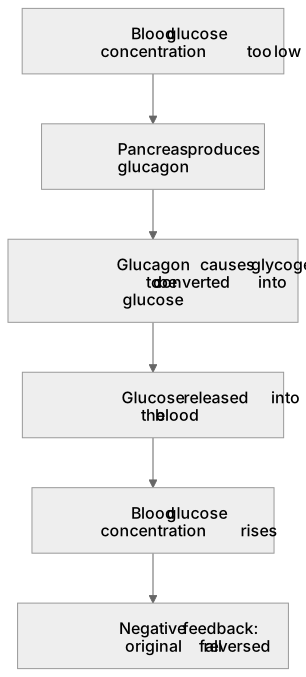
Put it in order
Put these steps in the order they happen.
- 1. Pancreas produces glucagon
- 2. Glucagon causes glycogen to be converted into glucose
- 3. Glucose released into the blood
- 4. Blood glucose concentration rises
- 5. Negative feedback: original fall reversed
- 6. Blood glucose concentration too low
Key words
Say what each word means before you turn the card.
Negative feedback
Try answering aloud or in your head before turning the card.
Hormonal control by the pancreas
Try answering aloud or in your head before turning the card.
Glycogen as a glucose store
Try answering aloud or in your head before turning the card.
Blood glucose homeostasis
Try answering aloud or in your head before turning the card.
See every definition
- Negative feedback
- A response in which the original change is reversed, as when blood glucose concentration rises back towards normal.
- Hormonal control by the pancreas
- The pancreas produces and secretes the hormone glucagon into the blood when blood glucose is too low.
- Glycogen as a glucose store
- A storage polysaccharide made of many glucose units, which is converted into glucose and released into the blood.
- Blood glucose homeostasis
- Keeping glucose steady between meals, with the pancreas detecting a fall and secreting glucagon so blood glucose concentration rises back towards normal.
Label the diagram
Some boxes have lost their names. Pick the right name for each number.
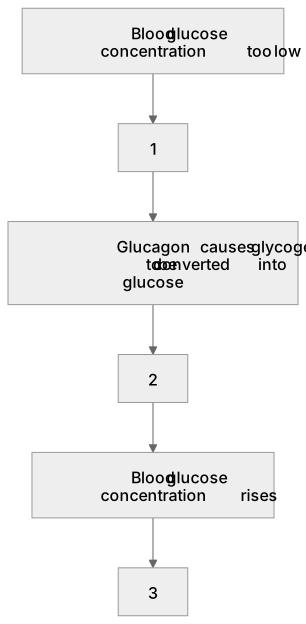
1Box 1
2Box 2
3Box 3
There is more to this lesson
The full lesson goes on to check your understanding and help you earn the marks. Create a free account to carry on, with your progress saved.
7 days Premium · Then the free plan continues · No card, no charge
Test your understanding of Control of blood glucose concentration: (HT only) If the blood glucose concentration is too low, the pancreas produces the hormone glucagon that causes glycogen to be converted into glucose and released into the blood.
Active recall beats re-reading. Take an instant quiz now to test what you’ve learned and lock it into long-term memory.
7 days Premium · Then the free plan continues · No card, no charge