AQA · GCSE · Combined Science
Course version: 8464 · Version from Sept 2018
Control of blood glucose concentration: Students should be able to explain how insulin controls blood glucose (sugar) levels in the body.
Blood glucose must stay within a narrow range to supply cells with fuel without damaging them.
- 4 key terms
Study notes
From the checked teaching notes for this specification point.
The idea
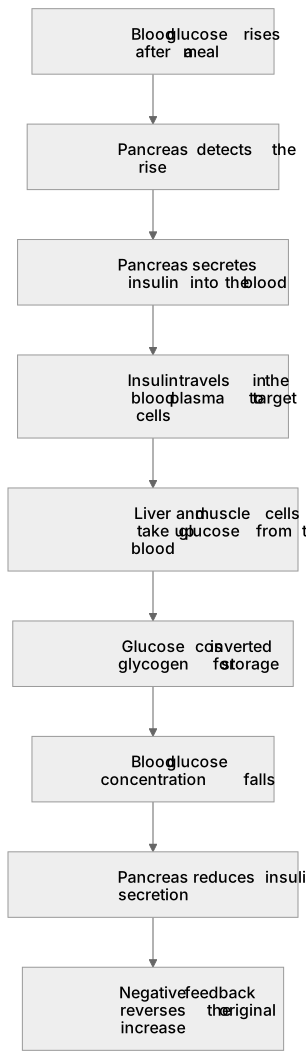
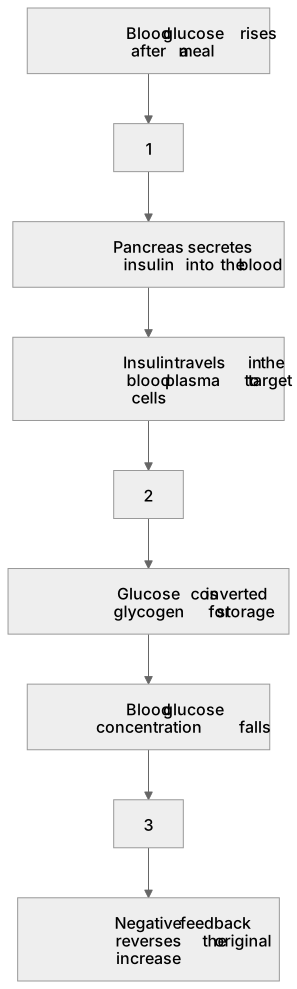
Blood glucose must stay within a narrow range to supply cells with fuel without damaging them. After a meal, glucose absorbed from the small intestine raises blood glucose. The pancreas detects this rise and secretes insulin into the blood. Insulin travels to target cells, mainly liver and muscle, where it increases the rate at which glucose is taken up from the blood and converted into glycogen for storage. As cells remove glucose, blood glucose falls, so the pancreas reduces insulin secretion. This is negative feedback: the response cancels the original change.
For example: After a carbohydrate-rich meal blood glucose might rise from about 5 mmol/dm³ towards 8 mmol/dm³; insulin restores it towards the set point.
What earns the marks
- The pancreas detects a rise in blood glucose concentration and secretes insulin into the bloodstream.
- Insulin is a hormone that travels in the blood plasma to target cells such as liver and muscle cells.
- Insulin increases the uptake of glucose from the blood into cells and increases the conversion of glucose to glycogen for storage.
- As glucose is removed from the blood, blood glucose concentration falls, which reduces insulin secretion.
- The fall in blood glucose is an example of negative feedback because the response reverses the original increase.
- Glycogen is the storage polysaccharide in liver and muscle; it is not the same as the hormone glucagon.
Common mistakes and how to put them right
Writing that insulin is an enzyme that digests glucose.
Put it right: Insulin is a hormone that changes cell activity, and glucose is not digested in the blood.
Stating that insulin converts glucose into glucagon.
Put it right: Glucose is stored as glycogen, while glucagon is a separate hormone that raises blood glucose.
Saying the liver produces insulin.
Put it right: The pancreas produces insulin, and the liver is a target organ that stores glucose as glycogen.
Exam tips
- Use the sequence stimulus, hormone, target, response, negative feedback when explaining the control pathway.
- Name the pancreas, insulin, liver or muscle, glucose and glycogen explicitly, because vague terms such as 'it controls sugar' do not show understanding.
- Link the fall in blood glucose back to reduced insulin secretion to demonstrate negative feedback rather than describing only a one-way process.
Try the lesson
The start of the Control of blood glucose concentration: Students should be able to explain how insulin controls blood glucose (sugar) levels in the body. lesson, made from checked teaching notes for this specification point.
Have a go first
How does the hormone insulin help to lower blood glucose concentration in the body?
See it
Key words
Say what each word means before you turn the card.
Insulin
Try answering aloud or in your head before turning the card.
Glycogen
Try answering aloud or in your head before turning the card.
Negative feedback
Try answering aloud or in your head before turning the card.
Pancreas
Try answering aloud or in your head before turning the card.
See every definition
- Insulin
- A hormone secreted by the pancreas into the blood when blood glucose rises, which travels to target cells such as liver and muscle.
- Glycogen
- The storage polysaccharide in liver and muscle, formed when glucose is converted for storage; it is not the same as the hormone glucagon.
- Negative feedback
- A response that cancels the original change, as when a fall in blood glucose reduces insulin secretion.
- Pancreas
- The organ that detects a rise in blood glucose concentration and secretes insulin into the bloodstream.
Label the diagram
Some boxes have lost their names. Pick the right name for each number.
1Box 1
2Box 2
3Box 3
There is more to this lesson
The full lesson goes on to check your understanding and help you earn the marks. Create a free account to carry on, with your progress saved.
7 days Premium · Then the free plan continues · No card, no charge
Test your understanding of Control of blood glucose concentration: Students should be able to explain how insulin controls blood glucose (sugar) levels in the body.
Active recall beats re-reading. Take an instant quiz now to test what you’ve learned and lock it into long-term memory.
7 days Premium · Then the free plan continues · No card, no charge