AQA · GCSE · Combined Science
Course version: 8464 · Version from Sept 2018
Cracking and alkenes: Cracking can be done by various methods including catalytic cracking and steam cracking.
Cracking is thermal decomposition of large, less useful hydrocarbon molecules into smaller, more useful ones, often producing alkenes as well as shorter alkanes.
Study notes
From the checked teaching notes for this specification point.
The idea
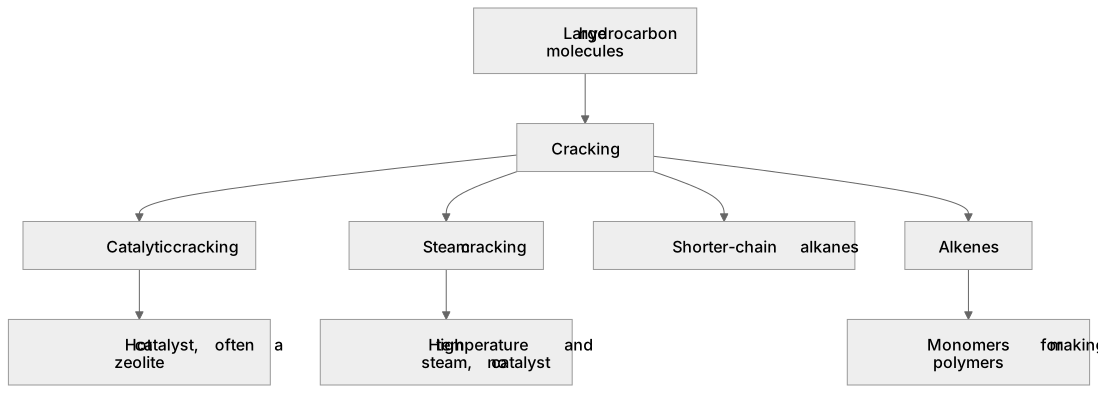
Cracking is thermal decomposition of large, less useful hydrocarbon molecules into smaller, more useful ones, often producing alkenes as well as shorter alkanes. It can be done by various methods, including catalytic cracking and steam cracking. In catalytic cracking, vaporised long-chain hydrocarbons pass over a hot catalyst such as zeolite, giving shorter chains and alkenes. In steam cracking, the feedstock is mixed with steam and heated strongly without a catalyst. Both methods break C–C and C–H bonds, so products include alkanes and alkenes; for example, decane can crack to octane and ethene. Alkenes are valuable because they are used to make polymers, so cracking helps match supply to demand for fuels and petrochemicals.
What earns the marks
- Cracking is the breakdown of large hydrocarbon molecules into smaller molecules, usually by heating.
- Catalytic cracking uses a hot catalyst, often a zeolite, to speed up the breakdown of vaporised long-chain hydrocarbons.
- Steam cracking uses high temperature and steam, without a catalyst, to crack hydrocarbons.
- Products of cracking include shorter-chain alkanes and alkenes, which are more useful than the original large molecules.
- Alkenes produced by cracking are important as monomers for making polymers.
- Cracking is a form of thermal decomposition and requires an input of energy to break covalent bonds.
Common mistakes and how to put them right
Thinking cracking only produces alkenes.
Put it right: It typically produces a mixture of shorter alkanes and alkenes.
Confusing catalytic cracking with steam cracking.
Put it right: Catalytic cracking uses a catalyst, while steam cracking uses steam and high temperature without a catalyst.
Writing that cracking adds hydrogen or removes carbon.
Put it right: Cracking rearranges the same atoms into smaller hydrocarbon molecules, so the total number of carbon and hydrogen atoms is conserved.
Exam tips
- Name the method and state its key condition, such as catalyst or steam, rather than saying only 'heat'.
- Use a balanced equation or a labelled example to show that atoms are conserved during cracking.
- Link the products to a use, such as alkenes for polymers, to show why cracking is economically important.
Try the lesson
The start of the Cracking and alkenes: Cracking can be done by various methods including catalytic cracking and steam cracking. lesson, made from checked teaching notes for this specification point.
Have a go first
Which two methods can be used to crack long-chain hydrocarbon molecules?
Listen
Cracking is thermal decomposition of large, less useful hydrocarbon molecules into smaller, more useful ones, often producing alkenes as well as shorter alkanes. It can be done by various methods, including catalytic cracking and steam cracking. In catalytic cracking, vaporised long-chain hydrocarbons pass over a hot catalyst such as zeolite, giving shorter chains and alkenes. In steam cracking, the feedstock is mixed with steam and heated strongly without a catalyst. Both methods break C–C and C–H bonds, so products include alkanes and alkenes; for example, decane can crack to octane and ethene. Alkenes are valuable because they are used to make polymers, so cracking helps match supply to demand for fuels and petrochemicals. A strong answer earns marks for these points. Cracking is the breakdown of large hydrocarbon molecules into smaller molecules, usually by heating. Catalytic cracking uses a hot catalyst, often a zeolite, to speed up the breakdown of vaporised long-chain hydrocarbons. Steam cracking uses high temperature and steam, without a catalyst, to crack hydrocarbons. Products of cracking include shorter-chain alkanes and alkenes, which are more useful than the original large molecules. A common slip: Thinking cracking only produces alkenes. Instead, it typically produces a mixture of shorter alkanes and alkenes. Exam tip: Name the method and state its key condition, such as catalyst or steam, rather than saying only 'heat'.
See it
Label the diagram
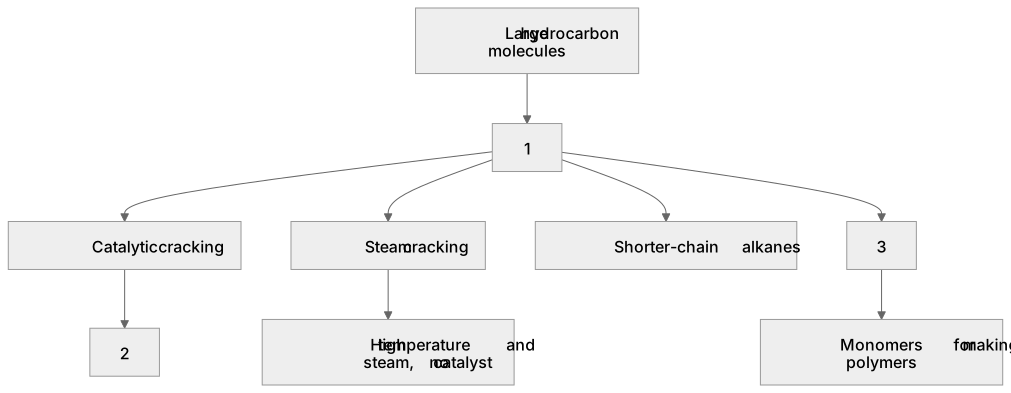
Some boxes have lost their names. Pick the right name for each number.
1Box 1
2Box 2
3Box 3
There is more to this lesson
The full lesson goes on to check your understanding and help you earn the marks. Create a free account to carry on, with your progress saved.
A week of Premium from your first lesson · Then the free plan continues · No card, no charge
Test your understanding of Cracking and alkenes: Cracking can be done by various methods including catalytic cracking and steam cracking.
Active recall beats re-reading. Take an instant quiz now to test what you’ve learned and lock it into long-term memory.
A week of Premium from your first lesson · Then the free plan continues · No card, no charge