AQA · GCSE · Combined Science
Course version: 8464 · Version from Sept 2018
Cracking and alkenes: Students should be able to recall the colour change when bromine water reacts with an alkene.
Bromine water is an orange solution used as a test for unsaturation.
- 4 key terms
Study notes
From the checked teaching notes for this specification point.
The idea
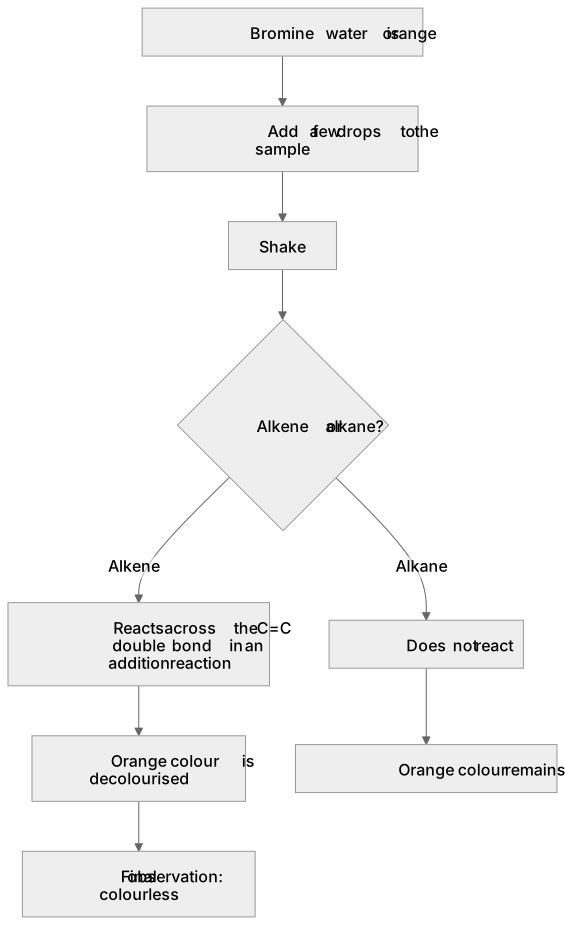
Bromine water is an orange solution used as a test for unsaturation. When shaken with an alkene such as ethene, the C=C double bond reacts with bromine in an addition reaction, so the orange colour is decolourised and the mixture turns colourless. An alkane such as ethane has only single C–C bonds and does not react this way under the same conditions, so the orange colour persists. To perform the test, add a few drops of bromine water to the sample, shake, and observe. The colour change from orange to colourless shows an alkene is present. This links the functional group to a visible result and is assessed by asking you to state the starting and finishing colours accurately.
What earns the marks
- Bromine water is orange (or orange-brown/yellow-orange) before the test.
- An alkene reacts with bromine water and the colour is lost.
- The final observation is colourless, not clear or white.
- The reaction is an addition reaction across the C=C double bond.
- An alkane does not decolourise bromine water, so the orange colour remains.
- The test distinguishes unsaturated alkenes from saturated alkanes.
Common mistakes and how to put them right
Saying the colour change is orange to clear.
Put it right: Clear describes a transparent solution, not a loss of colour; the correct term is colourless.
Saying the solution turns white.
Put it right: A white precipitate or cloudiness is not the observation; the orange colour is removed, giving a colourless solution.
Claiming alkanes also decolourise bromine water.
Put it right: Alkanes are saturated and do not react in this test, so the orange colour stays.
Exam tips
- Learn both colours as a pair: orange to colourless.
- Name the substance being tested, for example ethene, and state that it is an alkene.
- If asked to compare, state that the alkane stays orange while the alkene goes colourless.
- Use the term decolourised to show precise scientific vocabulary.
Try the lesson
The start of the Cracking and alkenes: Students should be able to recall the colour change when bromine water reacts with an alkene. lesson, made from checked teaching notes for this specification point.
Have a go first
Bromine water is added to a sample of ethene. What colour change is seen?
Listen
Bromine water is an orange solution used as a test for unsaturation. When shaken with an alkene such as ethene, the C=C double bond reacts with bromine in an addition reaction, so the orange colour is decolourised and the mixture turns colourless. An alkane such as ethane has only single C–C bonds and does not react this way under the same conditions, so the orange colour persists. To perform the test, add a few drops of bromine water to the sample, shake, and observe. The colour change from orange to colourless shows an alkene is present. This links the functional group to a visible result and is assessed by asking you to state the starting and finishing colours accurately. A strong answer earns marks for these points. Bromine water is orange (or orange-brown/yellow-orange) before the test. An alkene reacts with bromine water and the colour is lost. The final observation is colourless, not clear or white. The reaction is an addition reaction across the C=C double bond. Exam tip: Learn both colours as a pair: orange to colourless.
See it
Key words
Say what each word means before you turn the card.
Bromine water
Try answering aloud or in your head before turning the card.
Addition reaction
Try answering aloud or in your head before turning the card.
Decolourised
Try answering aloud or in your head before turning the card.
Alkane
Try answering aloud or in your head before turning the card.
See every definition
- Bromine water
- An orange solution used as a test for unsaturation, which is decolourised when shaken with an alkene.
- Addition reaction
- The reaction in which the C=C double bond reacts with bromine, so the orange colour is decolourised and the mixture turns colourless.
- Decolourised
- Describes the loss of the orange colour of bromine water when it reacts with an alkene, leaving a colourless mixture.
- Alkane
- A hydrocarbon with only single C–C bonds that does not react this way under the same conditions, so the orange colour persists.
Label the diagram
Some boxes have lost their names. Pick the right name for each number.
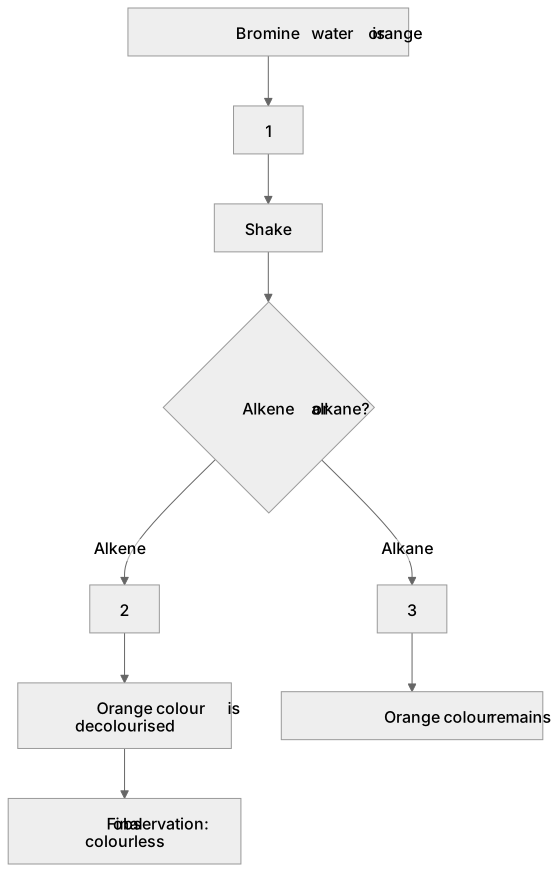
1Box 1
2Box 2
3Box 3
There is more to this lesson
The full lesson goes on to check your understanding and help you earn the marks. Create a free account to carry on, with your progress saved.
A week of Premium from your first lesson · Then the free plan continues · No card, no charge
Test your understanding of Cracking and alkenes: Students should be able to recall the colour change when bromine water reacts with an alkene.
Active recall beats re-reading. Take an instant quiz now to test what you’ve learned and lock it into long-term memory.
A week of Premium from your first lesson · Then the free plan continues · No card, no charge