AQA · GCSE · Combined Science
Course version: 8464 · Version from Sept 2018
Cracking and alkenes: The products of cracking include alkanes and another type of hydrocarbon called alkenes.
Cracking breaks large, less useful hydrocarbon molecules into smaller, more useful ones.
- 4 key terms
Study notes
From the checked teaching notes for this specification point.
The idea
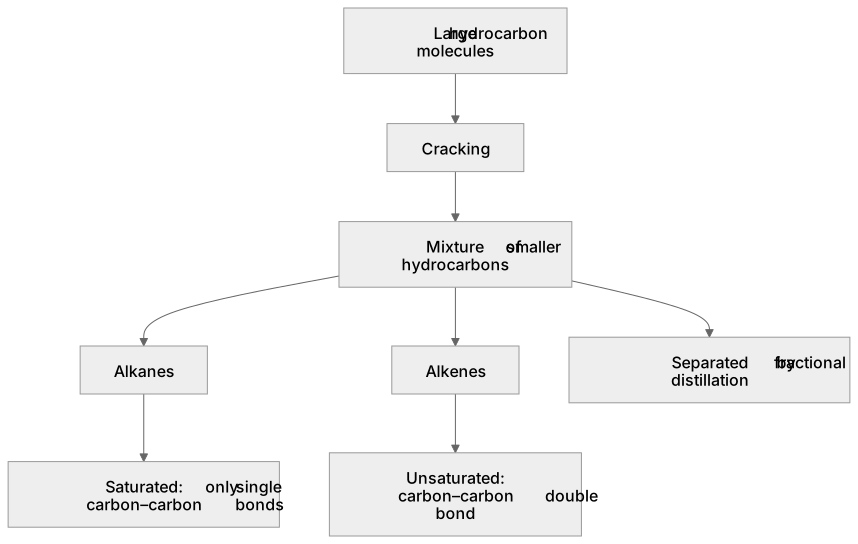
Cracking breaks large, less useful hydrocarbon molecules into smaller, more useful ones. The products are a mixture: shorter-chain alkanes and a different family called alkenes. Alkanes have only single carbon–carbon bonds and are saturated; alkenes contain a carbon–carbon double bond and are unsaturated. For example, cracking decane, C₁₀H₂₂, can give octane, C₈H₁₈, and ethene, C₂H₄. The alkane product is useful as a fuel, while the alkene is a feedstock for polymers. You must be able to recognise both families from their names and formulae, and explain that cracking produces a mixture that is separated by fractional distillation. The key idea is that cracking does not make a single product; it makes a range of smaller molecules, including at least one alkane and at least one alkene.
What earns the marks
- Cracking converts large hydrocarbon molecules into smaller molecules that are more useful as fuels or chemical feedstocks.
- The products of cracking always include alkanes, which are saturated hydrocarbons with only single carbon–carbon bonds.
- The products also include alkenes, which are unsaturated hydrocarbons containing a carbon–carbon double bond.
- A named example such as decane cracking to octane and ethene shows one alkane and one alkene product.
- Alkenes are a different homologous series from alkanes, with the general formula CₙH₂ₙ for alkenes and CₙH₂ₙ₊₂ for alkanes.
- The mixture of products is separated by fractional distillation because the products have different boiling points.
Common mistakes and how to put them right
Thinking cracking produces only alkenes.
Put it right: Cracking produces a mixture that includes alkanes as well as alkenes.
Confusing the general formulae.
Put it right: Alkanes are CₙH₂ₙ₊₂ and alkenes are CₙH₂ₙ.
Believing alkenes are saturated.
Put it right: Alkenes are unsaturated because they contain a carbon–carbon double bond.
Exam tips
- When asked for the products of cracking, name at least one alkane and one alkene and state that a mixture forms.
- Use displayed or structural formulae to show the double bond in an alkene if the question asks you to explain unsaturation.
- Link cracking to the demand for shorter-chain fuels and to polymer production to show why the process is useful.
Try the lesson
The start of the Cracking and alkenes: The products of cracking include alkanes and another type of hydrocarbon called alkenes. lesson, made from checked teaching notes for this specification point.
Have a go first
Cracking produces two types of hydrocarbon. One type is alkanes. What is the name of the other type of hydrocarbon produced by cracking?
Listen
Cracking breaks large, less useful hydrocarbon molecules into smaller, more useful ones. The products are a mixture: shorter-chain alkanes and a different family called alkenes. Alkanes have only single carbon–carbon bonds and are saturated; alkenes contain a carbon–carbon double bond and are unsaturated. For example, cracking decane, C₁₀H₂₂, can give octane, C₈H₁₈, and ethene, C₂H₄. The alkane product is useful as a fuel, while the alkene is a feedstock for polymers. You must be able to recognise both families from their names and formulae, and explain that cracking produces a mixture that is separated by fractional distillation. The key idea is that cracking does not make a single product; it makes a range of smaller molecules, including at least one alkane and at least one alkene. A strong answer earns marks for these points. Cracking converts large hydrocarbon molecules into smaller molecules that are more useful as fuels or chemical feedstocks. The products of cracking always include alkanes, which are saturated hydrocarbons with only single carbon–carbon bonds. The products also include alkenes, which are unsaturated hydrocarbons containing a carbon–carbon double bond. A named example such as decane cracking to octane and ethene shows one alkane and one alkene product. A common slip: Thinking cracking produces only alkenes. Instead, cracking produces a mixture that includes alkanes as well as alkenes. Exam tip: When asked for the products of cracking, name at least one alkane and one alkene and state that a mixture forms.
See it
Key words
Say what each word means before you turn the card.
Alkanes
Try answering aloud or in your head before turning the card.
Alkenes
Try answering aloud or in your head before turning the card.
Cracking
Try answering aloud or in your head before turning the card.
Fractional distillation
Try answering aloud or in your head before turning the card.
See every definition
- Alkanes
- Saturated hydrocarbons with only single carbon–carbon bonds, with the general formula CₙH₂ₙ₊₂.
- Alkenes
- Unsaturated hydrocarbons containing a carbon–carbon double bond, with the general formula CₙH₂ₙ.
- Cracking
- Converts large hydrocarbon molecules into smaller molecules that are more useful as fuels or chemical feedstocks, producing a mixture.
- Fractional distillation
- Separates the mixture of products because the products have different boiling points.
Label the diagram
Some boxes have lost their names. Pick the right name for each number.
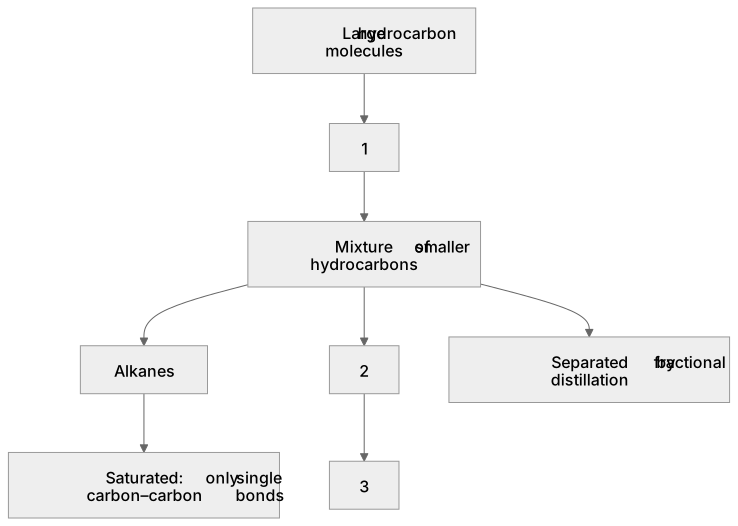
1Box 1
2Box 2
3Box 3
There is more to this lesson
The full lesson goes on to check your understanding and help you earn the marks. Create a free account to carry on, with your progress saved.
A week of Premium from your first lesson · Then the free plan continues · No card, no charge
Test your understanding of Cracking and alkenes: The products of cracking include alkanes and another type of hydrocarbon called alkenes.
Active recall beats re-reading. Take an instant quiz now to test what you’ve learned and lock it into long-term memory.
A week of Premium from your first lesson · Then the free plan continues · No card, no charge