AQA · GCSE · Combined Science
Course version: 8464 · Version from Sept 2018
Cracking and alkenes: There is a high demand for fuels with small molecules and so some of the products of cracking are useful as fuels.
Cracking breaks large hydrocarbon molecules into smaller, more useful ones.
- 4 key terms
Study notes
From the checked teaching notes for this specification point.
The idea
Cracking breaks large hydrocarbon molecules into smaller, more useful ones. Small molecules such as methane, ethane, propane and butane have weak intermolecular forces, so they have low boiling points and are gases or volatile liquids that ignite and burn easily. This makes them valuable as fuels for cooking, heating and transport. Demand for these small-molecule fuels is high because they release energy readily when burned. Cracking therefore supplies fuels such as petrol and diesel components as well as alkenes for making polymers.
For example: Decane can be cracked to produce octane and ethene; the octane is a useful fuel while the ethene is a feedstock for plastics.
What earns the marks
- Cracking converts large hydrocarbon molecules into smaller molecules.
- Small molecules have weaker intermolecular forces and lower boiling points than large molecules.
- Small-molecule fuels are gases or volatile liquids that burn readily, so they are in high demand.
- Some cracking products, such as petrol components, are used as fuels.
- Cracking also produces alkenes, which are useful for making polymers.
- The demand for small-molecule fuels is a reason why cracking is carried out industrially.
Common mistakes and how to put them right
Saying cracking only makes alkenes.
Put it right: Cracking also produces smaller alkanes that are used as fuels.
Confusing small molecules with low demand.
Put it right: Small molecules are in high demand because they are useful fuels, not because they are scarce.
Stating that large molecules burn better.
Put it right: Large molecules have stronger intermolecular forces and are less volatile, so they are less useful as fuels.
Exam tips
- Link the small size of the molecule to weak intermolecular forces and a low boiling point.
- Give a named example of a small-molecule fuel, such as methane or petrol.
- Mention both products of cracking: fuels and alkenes for polymers.
- Use the phrase high demand for fuels with small molecules when explaining why cracking is useful.
Try the lesson
The start of the Cracking and alkenes: There is a high demand for fuels with small molecules and so some of the products of cracking are useful as fuels. lesson, made from checked teaching notes for this specification point.
Have a go first
Why is there a high demand for fuels made of small molecules?
Listen
Cracking breaks large hydrocarbon molecules into smaller, more useful ones. Small molecules such as methane, ethane, propane and butane have weak intermolecular forces, so they have low boiling points and are gases or volatile liquids that ignite and burn easily. This makes them valuable as fuels for cooking, heating and transport. Demand for these small-molecule fuels is high because they release energy readily when burned. Cracking therefore supplies fuels such as petrol and diesel components as well as alkenes for making polymers. For example, decane can be cracked to produce octane and ethene; the octane is a useful fuel while the ethene is a feedstock for plastics. A strong answer earns marks for these points. Cracking converts large hydrocarbon molecules into smaller molecules. Small molecules have weaker intermolecular forces and lower boiling points than large molecules. Small-molecule fuels are gases or volatile liquids that burn readily, so they are in high demand. Some cracking products, such as petrol components, are used as fuels. Exam tip: Link the small size of the molecule to weak intermolecular forces and a low boiling point.
See it
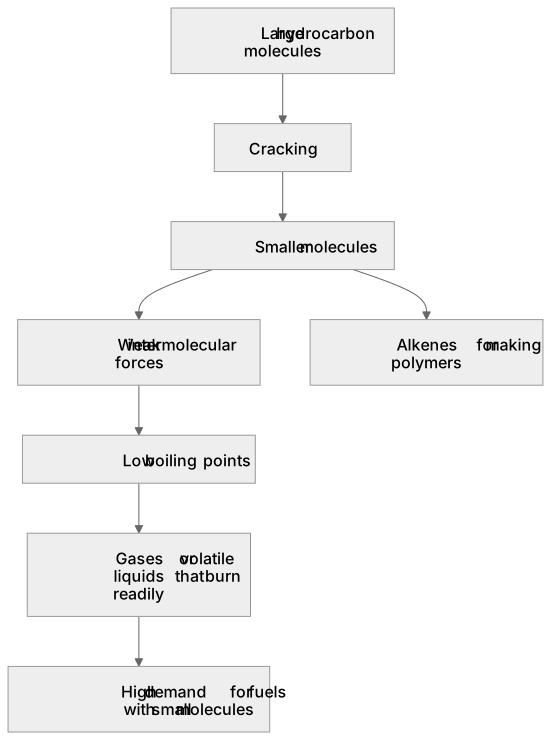
Key words
Say what each word means before you turn the card.
Cracking of hydrocarbons
Try answering aloud or in your head before turning the card.
Intermolecular forces and boiling point
Try answering aloud or in your head before turning the card.
Fuels and energy resources
Try answering aloud or in your head before turning the card.
Industrial uses of alkenes
Try answering aloud or in your head before turning the card.
See every definition
- Cracking of hydrocarbons
- Breaks large hydrocarbon molecules into smaller, more useful ones, supplying fuels such as petrol and diesel components as well as alkenes for making polymers.
- Intermolecular forces and boiling point
- Small molecules have weak intermolecular forces, so they have low boiling points and are gases or volatile liquids that ignite and burn easily.
- Fuels and energy resources
- Small-molecule fuels are in high demand because they release energy readily when burned, making them valuable for cooking, heating and transport.
- Industrial uses of alkenes
- Cracking produces alkenes, which are useful for making polymers.
Label the diagram
Some boxes have lost their names. Pick the right name for each number.
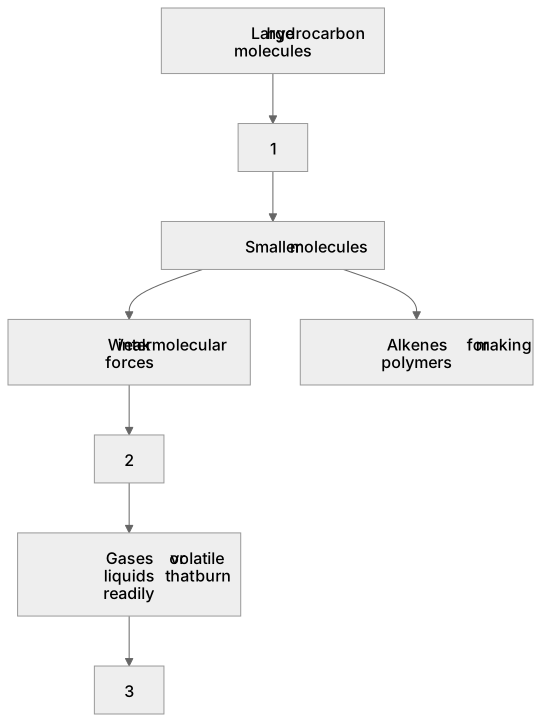
1Box 1
2Box 2
3Box 3
There is more to this lesson
The full lesson goes on to check your understanding and help you earn the marks. Create a free account to carry on, with your progress saved.
A week of Premium from your first lesson · Then the free plan continues · No card, no charge
Test your understanding of Cracking and alkenes: There is a high demand for fuels with small molecules and so some of the products of cracking are useful as fuels.
Active recall beats re-reading. Take an instant quiz now to test what you’ve learned and lock it into long-term memory.
A week of Premium from your first lesson · Then the free plan continues · No card, no charge