AQA · GCSE · Combined Science
Course version: 8464 · Version from Sept 2018
Crude oil, hydrocarbons and alkanes: Crude oil is a finite resource found in rocks. Crude oil is the remains of an ancient biomass consisting mainly of plankton that was buried in mud.
Crude oil is a dark, smelly liquid trapped in porous rocks such as sandstone beneath impermeable cap rock.
- 4 key terms
Study notes
From the checked teaching notes for this specification point.
The idea
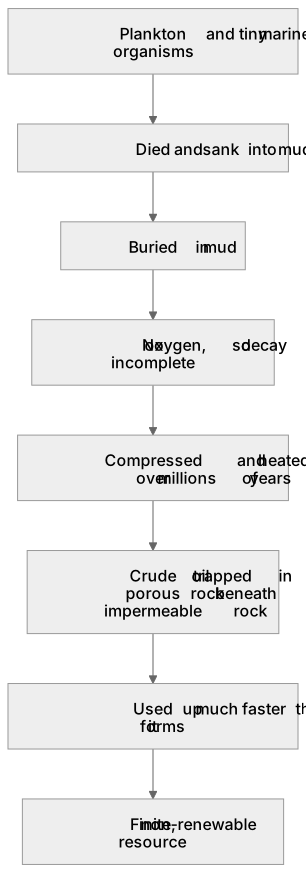
Crude oil is a dark, smelly liquid trapped in porous rocks such as sandstone beneath impermeable cap rock. It formed over millions of years: plankton and other tiny marine organisms died, sank into mud and were buried. Without oxygen, decay was incomplete, so the remains were compressed and heated, slowly converting the ancient biomass into crude oil. Because this process takes millions of years and we burn oil far faster than it forms, crude oil is finite: once used, it cannot be replaced within a human timescale. A useful check is to compare the rate of formation with the rate of extraction; the huge mismatch explains why chemists seek renewable alternatives and why oil is described as a non-renewable resource.
What earns the marks
- Crude oil is described as a finite resource because it is being used up much faster than it is formed.
- Crude oil is found in rocks, typically trapped in porous reservoir rock beneath impermeable rock.
- Crude oil originated from the remains of ancient biomass, mainly plankton.
- The plankton were buried in mud, where lack of oxygen prevented complete decay.
- Over millions of years, heat and pressure changed the buried biomass into crude oil.
- A correct comparison of formation time (millions of years) with extraction time (decades) shows why the resource is finite.
Common mistakes and how to put them right
Saying crude oil is a fossil fuel made from dead dinosaurs.
Put it right: The main source is plankton, a marine biomass.
Stating crude oil is found in underground caves or lakes.
Put it right: It is held in pores within rocks such as sandstone.
Claiming crude oil is renewable because more is always forming.
Put it right: Formation takes millions of years, so it is finite on a human timescale.
Exam tips
- Use the word finite and immediately explain it as used up faster than it forms.
- Link each stage of formation in order: plankton, burial in mud, no oxygen, heat and pressure, millions of years.
- When asked why crude oil is non-renewable, compare the timescale of formation with the rate of human use.
Try the lesson
The start of the Crude oil, hydrocarbons and alkanes: Crude oil is a finite resource found in rocks. Crude oil is the remains of an ancient biomass consisting mainly of plankton that was buried in mud. lesson, made from checked teaching notes for this specification point.
Have a go first
Crude oil is described as a finite resource. What does the word finite mean in this description?
Listen
Crude oil is a dark, smelly liquid trapped in porous rocks such as sandstone beneath impermeable cap rock. It formed over millions of years: plankton and other tiny marine organisms died, sank into mud and were buried. Without oxygen, decay was incomplete, so the remains were compressed and heated, slowly converting the ancient biomass into crude oil. Because this process takes millions of years and we burn oil far faster than it forms, crude oil is finite: once used, it cannot be replaced within a human timescale. A useful check is to compare the rate of formation with the rate of extraction; the huge mismatch explains why chemists seek renewable alternatives and why oil is described as a non-renewable resource. A strong answer earns marks for these points. Crude oil is described as a finite resource because it is being used up much faster than it is formed. Crude oil is found in rocks, typically trapped in porous reservoir rock beneath impermeable rock. Crude oil originated from the remains of ancient biomass, mainly plankton. The plankton were buried in mud, where lack of oxygen prevented complete decay. A common slip: Saying crude oil is a fossil fuel made from dead dinosaurs. Instead, the main source is plankton, a marine biomass. Exam tip: Use the word finite and immediately explain it as used up faster than it forms.
See it
Put it in order
Put these steps in the order they happen.
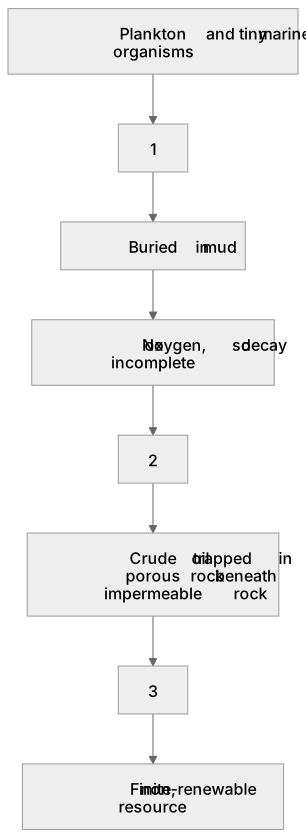
- 1. Died and sank into mud
- 2. Buried in mud
- 3. No oxygen, so decay incomplete
- 4. Compressed and heated over millions of years
- 5. Crude oil trapped in porous rock beneath impermeable rock
- 6. Used up much faster than it forms
- 7. Finite, non-renewable resource
- 8. Plankton and tiny marine organisms
Key words
Say what each word means before you turn the card.
Finite resource
Try answering aloud or in your head before turning the card.
Ancient biomass
Try answering aloud or in your head before turning the card.
Formation over millions of years
Try answering aloud or in your head before turning the card.
Non-renewable resource
Try answering aloud or in your head before turning the card.
See every definition
- Finite resource
- Crude oil is being used up much faster than it is formed, so once used it cannot be replaced within a human timescale.
- Ancient biomass
- Crude oil is the remains of an ancient biomass consisting mainly of plankton that was buried in mud.
- Formation over millions of years
- Plankton and other tiny marine organisms died, sank into mud and were buried, and without oxygen decay was incomplete, so heat and pressure slowly converted the remains into crude oil.
- Non-renewable resource
- Because formation takes millions of years and oil is burned far faster than it forms, the resource is described as non-renewable.
Label the diagram
Some boxes have lost their names. Pick the right name for each number.
1Box 1
2Box 2
3Box 3
There is more to this lesson
The full lesson goes on to check your understanding and help you earn the marks. Create a free account to carry on, with your progress saved.
A week of Premium from your first lesson · Then the free plan continues · No card, no charge
Test your understanding of Crude oil, hydrocarbons and alkanes: Crude oil is a finite resource found in rocks. Crude oil is the remains of an ancient biomass consisting mainly of plankton that was buried in mud.
Active recall beats re-reading. Take an instant quiz now to test what you’ve learned and lock it into long-term memory.
A week of Premium from your first lesson · Then the free plan continues · No card, no charge