AQA · GCSE · Combined Science
Course version: 8464 · Version from Sept 2018
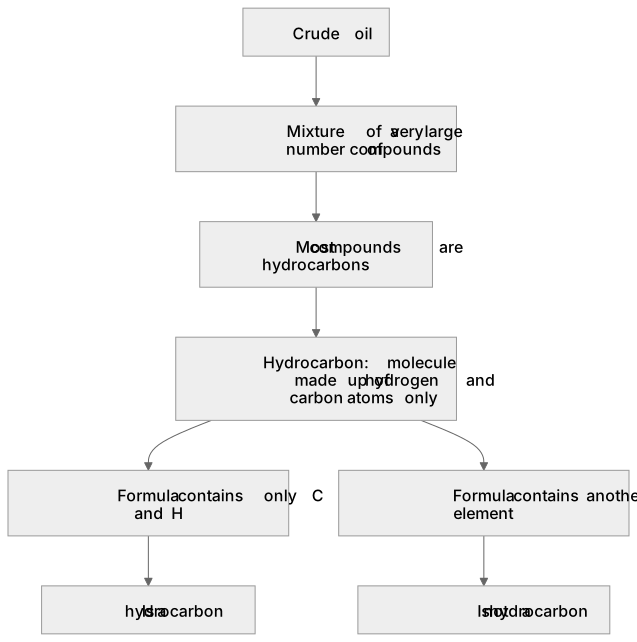
Crude oil, hydrocarbons and alkanes: Crude oil is a mixture of a very large number of compounds. Most of the compounds in crude oil are hydrocarbons, which are molecules made up of hydrogen and carbon atoms only.
Crude oil is not a single substance but a mixture of a very large number of compounds, so it has no sharp boiling point and its composition varies between sources.
- 3 key terms
Study notes
From the checked teaching notes for this specification point.
The idea
Crude oil is not a single substance but a mixture of a very large number of compounds, so it has no sharp boiling point and its composition varies between sources. Most of these compounds are hydrocarbons: molecules containing only carbon and hydrogen atoms. In a hydrocarbon such as methane, CH₄, or octane, C₈H₁₈, every atom is either carbon or hydrogen; there is no oxygen, nitrogen or sulfur in the molecule itself. Because the compounds have different chain lengths and boiling points, they can be separated by fractional distillation. A quick test of understanding is to examine a formula: if it contains only C and H, it is a hydrocarbon; if another element appears, it is not.
What earns the marks
- Crude oil is a mixture, not a single compound, so it contains many different substances.
- The compounds in crude oil have different boiling points, which allows separation by fractional distillation.
- Most compounds in crude oil are hydrocarbons.
- A hydrocarbon is defined as a molecule containing only carbon and hydrogen atoms.
- Formulae such as CH₄ and C₈H₁₈ contain only carbon and hydrogen, so they are hydrocarbons.
- A formula containing another element, for example C₂H₅OH, is not a hydrocarbon because it contains oxygen.
Common mistakes and how to put them right
Calling crude oil a compound.
Put it right: It is a mixture of many compounds.
Defining a hydrocarbon as a molecule containing carbon and hydrogen.
Put it right: It contains only carbon and hydrogen.
Assuming any fuel is a hydrocarbon.
Put it right: Fuels such as ethanol contain oxygen and are not hydrocarbons.
Exam tips
- Use the phrase mixture of compounds and support it with the idea of different boiling points.
- When identifying a hydrocarbon, check that the formula contains only C and H, with no other element symbols.
- Contrast a hydrocarbon with a non-hydrocarbon such as ethanol to show the boundary of the definition.
Try the lesson
The start of the Crude oil, hydrocarbons and alkanes: Crude oil is a mixture of a very large number of compounds. Most of the compounds in crude oil are hydrocarbons, which are molecules made up of hydrogen and carbon atoms only. lesson, made from checked teaching notes for this specification point.
Have a go first
Which two elements are present in a hydrocarbon molecule?
Listen
Crude oil is not a single substance but a mixture of a very large number of compounds, so it has no sharp boiling point and its composition varies between sources. Most of these compounds are hydrocarbons: molecules containing only carbon and hydrogen atoms. In a hydrocarbon such as methane, CH₄, or octane, C₈H₁₈, every atom is either carbon or hydrogen; there is no oxygen, nitrogen or sulfur in the molecule itself. Because the compounds have different chain lengths and boiling points, they can be separated by fractional distillation. A quick test of understanding is to examine a formula: if it contains only C and H, it is a hydrocarbon; if another element appears, it is not. A strong answer earns marks for these points. Crude oil is a mixture, not a single compound, so it contains many different substances. The compounds in crude oil have different boiling points, which allows separation by fractional distillation. Most compounds in crude oil are hydrocarbons. A hydrocarbon is defined as a molecule containing only carbon and hydrogen atoms. A common slip: Calling crude oil a compound. Instead, it is a mixture of many compounds. Exam tip: Use the phrase mixture of compounds and support it with the idea of different boiling points.
See it
Key words
Say what each word means before you turn the card.
Crude oil
Try answering aloud or in your head before turning the card.
Hydrocarbon
Try answering aloud or in your head before turning the card.
Fractional distillation
Try answering aloud or in your head before turning the card.
See every definition
- Crude oil
- A mixture of a very large number of compounds, not a single substance, so it has no sharp boiling point.
- Hydrocarbon
- A molecule made up of hydrogen and carbon atoms only, with no other element in the molecule itself.
- Fractional distillation
- The separation of the compounds in crude oil, which is possible because the compounds have different boiling points.
Label the diagram
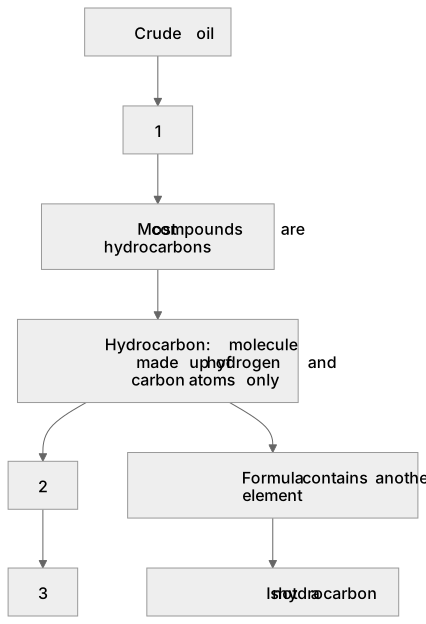
Some boxes have lost their names. Pick the right name for each number.
1Box 1
2Box 2
3Box 3
There is more to this lesson
The full lesson goes on to check your understanding and help you earn the marks. Create a free account to carry on, with your progress saved.
A week of Premium from your first lesson · Then the free plan continues · No card, no charge
Test your understanding of Crude oil, hydrocarbons and alkanes: Crude oil is a mixture of a very large number of compounds. Most of the compounds in crude oil are hydrocarbons, which are molecules made up of hydrogen and carbon atoms only.
Active recall beats re-reading. Take an instant quiz now to test what you’ve learned and lock it into long-term memory.
A week of Premium from your first lesson · Then the free plan continues · No card, no charge