AQA · GCSE · Combined Science
Course version: 8464 · Version from Sept 2018
Crude oil, hydrocarbons and alkanes: Students should be able to recognise substances as alkanes given their formulae in these forms.
Alkanes are saturated hydrocarbons whose molecules contain only single covalent bonds between carbon atoms.
- 3 key terms
Study notes
From the checked teaching notes for this specification point.
The idea
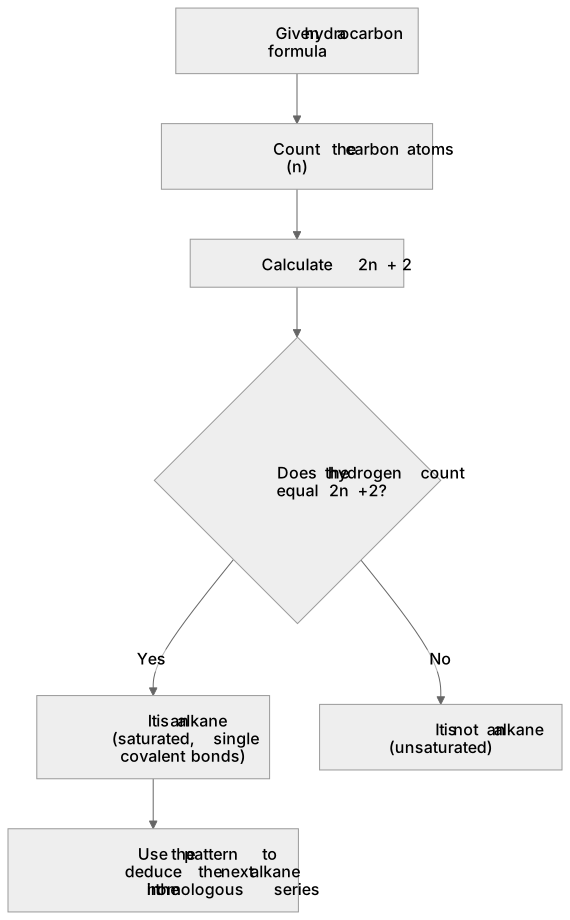
Alkanes are saturated hydrocarbons whose molecules contain only single covalent bonds between carbon atoms. Their general formula is CnH2n+2, so for n = 1, 2, 3 and 4 the formulae are CH₄, C₂H₆, C₃H₈ and C₄H₁₀. To recognise an alkane from a displayed, structural or molecular formula, count the carbon atoms and check that the hydrogen count equals twice the carbon count plus two. For example, C₅H₁₂ fits because 2 × 5 + 2 = 12, whereas C₅H₁₀ does not because it has two fewer hydrogen atoms and is unsaturated. Recognising the pattern allows you to classify an unknown hydrocarbon correctly and to predict the formula of the next member of the homologous series.
What earns the marks
- State that alkanes are saturated hydrocarbons containing only single covalent bonds between carbon atoms.
- Apply the general formula CnH2n+2 to a given molecular formula and check that the hydrogen count equals twice the carbon count plus two.
- Recognise the displayed or structural formulae of methane, ethane, propane and butane as alkanes.
- Identify a formula that does not fit CnH2n+2, such as C₃H₆, and explain that it is not an alkane because it is unsaturated.
- Use the pattern of the homologous series to deduce the formula of the next alkane, for example C₅H₁₂ after C₄H₁₀.
Common mistakes and how to put them right
Assuming every hydrocarbon formula is an alkane.
Put it right: Test the formula against CnH2n+2 before classifying it.
Miscounting hydrogen atoms in a displayed formula by ignoring hydrogens shown at the ends of bonds.
Put it right: Count every hydrogen atom attached to every carbon atom.
Writing C₃H₈ as C₃H₆ or C₄H₁₀ as C₄H₈.
Put it right: Apply the rule 2n + 2 carefully, so propane is C₃H₈ and butane is C₄H₁₀.
Exam tips
- Write out the calculation 2n + 2 beside the formula so the examiner can see how you checked it.
- When a displayed formula is given, count carbon atoms first, then count hydrogen atoms, and compare the two numbers.
- If asked to explain, link the formula to saturation and single bonds rather than only stating the name of the substance.
Try the lesson
The start of the Crude oil, hydrocarbons and alkanes: Students should be able to recognise substances as alkanes given their formulae in these forms. lesson, made from checked teaching notes for this specification point.
Have a go first
Which of these formulae represents an alkane?
Listen
Alkanes are saturated hydrocarbons whose molecules contain only single covalent bonds between carbon atoms. Their general formula is CnH2n+2, so for n = 1, 2, 3 and 4 the formulae are CH₄, C₂H₆, C₃H₈ and C₄H₁₀. To recognise an alkane from a displayed, structural or molecular formula, count the carbon atoms and check that the hydrogen count equals twice the carbon count plus two. For example, C₅H₁₂ fits because 2 × 5 + 2 = 12, whereas C₅H₁₀ does not because it has two fewer hydrogen atoms and is unsaturated. Recognising the pattern allows you to classify an unknown hydrocarbon correctly and to predict the formula of the next member of the homologous series. A strong answer earns marks for these points. State that alkanes are saturated hydrocarbons containing only single covalent bonds between carbon atoms. Apply the general formula CnH2n+2 to a given molecular formula and check that the hydrogen count equals twice the carbon count plus two. Recognise the displayed or structural formulae of methane, ethane, propane and butane as alkanes. Identify a formula that does not fit CnH2n+2, such as C₃H₆, and explain that it is not an alkane because it is unsaturated. A common slip: Assuming every hydrocarbon formula is an alkane. Instead, test the formula against CnH2n+2 before classifying it. Exam tip: Write out the calculation 2n + 2 beside the formula so the examiner can see how you checked it.
See it
Key words
Say what each word means before you turn the card.
Saturated hydrocarbons
Try answering aloud or in your head before turning the card.
Homologous series
Try answering aloud or in your head before turning the card.
General formula CnH2n+2
Try answering aloud or in your head before turning the card.
See every definition
- Saturated hydrocarbons
- Hydrocarbons whose molecules contain only single covalent bonds between carbon atoms.
- Homologous series
- A series whose pattern allows you to predict the formula of the next member.
- General formula CnH2n+2
- The formula applied to a given molecular formula, checking that the hydrogen count equals twice the carbon count plus two.
There is more to this lesson
The full lesson goes on to check your understanding and help you earn the marks. Create a free account to carry on, with your progress saved.
A week of Premium from your first lesson · Then the free plan continues · No card, no charge
Test your understanding of Crude oil, hydrocarbons and alkanes: Students should be able to recognise substances as alkanes given their formulae in these forms.
Active recall beats re-reading. Take an instant quiz now to test what you’ve learned and lock it into long-term memory.
A week of Premium from your first lesson · Then the free plan continues · No card, no charge