AQA · GCSE · Combined Science
Course version: 8464 · Version from Sept 2018
Electrolysis of aqueous solutions: The ions discharged when an aqueous solution is electrolysed using inert electrodes depend on the relative reactivity of the elements involved.
In aqueous solution, water molecules dissociate slightly to give hydrogen ions, H⁺, and hydroxide ions, OH⁻, as well as the ions from the dissolved compound.
- 3 key terms
Study notes
From the checked teaching notes for this specification point.
The idea
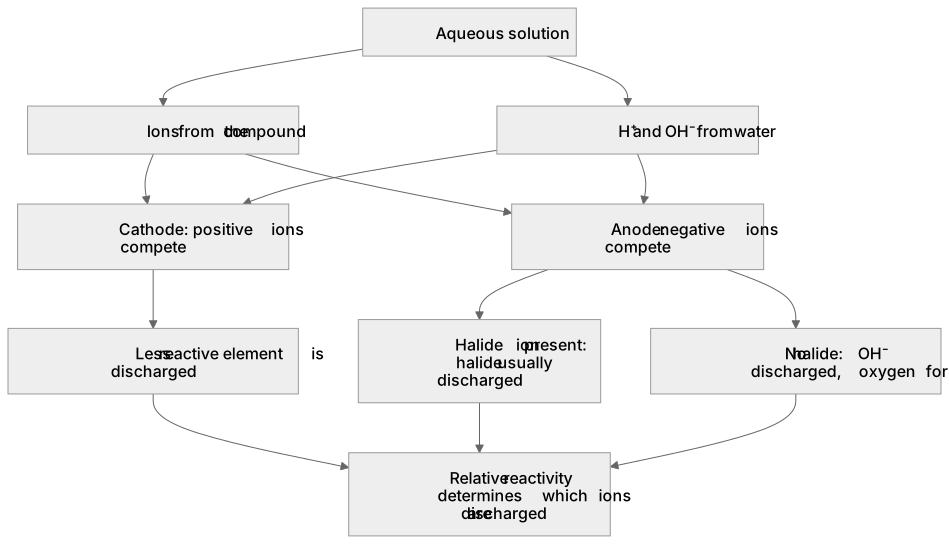
In aqueous solution, water molecules dissociate slightly to give hydrogen ions, H⁺, and hydroxide ions, OH⁻, as well as the ions from the dissolved compound. At the cathode, positive ions compete: the less reactive element is discharged. For example, in copper chloride solution, Cu²⁺ ions are discharged rather than H⁺ because copper is less reactive than hydrogen, so copper metal forms. At the anode, negative ions compete: if a halide ion such as Cl⁻ is present, it is usually discharged; otherwise OH⁻ is discharged and oxygen forms. For example, in sodium chloride solution, Cl⁻ is discharged to give chlorine, while in sodium sulfate solution, OH⁻ is discharged to give oxygen. The relative reactivity of the elements involved therefore determines which ions are discharged.
What earns the marks
- Aqueous solutions contain ions from the compound plus H⁺ and OH⁻ from water.
- At the cathode, the less reactive positive ion or element is discharged; for example, Cu²⁺ is discharged instead of H⁺.
- At the anode, halide ions such as Cl⁻ are usually discharged if present; otherwise OH⁻ is discharged and oxygen is produced.
- The relative reactivity of the elements involved determines which ions are discharged.
- Examples: copper chloride solution gives copper at the cathode and chlorine at the anode; sodium sulfate solution gives hydrogen at the cathode and oxygen at the anode.
Common mistakes and how to put them right
Assuming the metal ion is always discharged at the cathode.
Put it right: A reactive metal ion such as Na⁺ remains in solution while H⁺ is discharged to form hydrogen.
Thinking oxygen is always produced at the anode.
Put it right: A halide ion such as Cl⁻ is usually discharged in preference to OH⁻.
Forgetting that water contributes H⁺ and OH⁻ ions.
Put it right: Include these ions when explaining the competition at each electrode.
Exam tips
- State the ions present, including H⁺ and OH⁻ from water, before predicting the products.
- Use the reactivity series to decide which positive ion is discharged at the cathode.
- For the anode, check for a halide ion first; if none is present, discharge OH⁻ to form oxygen.
Try the lesson
The start of the Electrolysis of aqueous solutions: The ions discharged when an aqueous solution is electrolysed using inert electrodes depend on the relative reactivity of the elements involved. lesson, made from checked teaching notes for this specification point.
Have a go first
In the electrolysis of aqueous copper chloride using inert electrodes, copper is less reactive than hydrogen. Which product forms at the negative electrode?
Listen
In aqueous solution, water molecules dissociate slightly to give hydrogen ions, H⁺, and hydroxide ions, OH⁻, as well as the ions from the dissolved compound. At the cathode, positive ions compete: the less reactive element is discharged. For example, in copper chloride solution, Cu²⁺ ions are discharged rather than H⁺ because copper is less reactive than hydrogen, so copper metal forms. At the anode, negative ions compete: if a halide ion such as Cl⁻ is present, it is usually discharged; otherwise OH⁻ is discharged and oxygen forms. For example, in sodium chloride solution, Cl⁻ is discharged to give chlorine, while in sodium sulfate solution, OH⁻ is discharged to give oxygen. The relative reactivity of the elements involved therefore determines which ions are discharged. A strong answer earns marks for these points. Aqueous solutions contain ions from the compound plus H⁺ and OH⁻ from water. At the cathode, the less reactive positive ion or element is discharged; for example, Cu²⁺ is discharged instead of H⁺. At the anode, halide ions such as Cl⁻ are usually discharged if present; otherwise OH⁻ is discharged and oxygen is produced. The relative reactivity of the elements involved determines which ions are discharged. A common slip: Assuming the metal ion is always discharged at the cathode. Instead, a reactive metal ion such as Na⁺ remains in solution while H⁺ is discharged to form hydrogen. Exam tip: State the ions present, including H⁺ and OH⁻ from water, before predicting the products.
See it
Key words
Say what each word means before you turn the card.
Competing ions in aqueous electrolysis
Try answering aloud or in your head before turning the card.
Reactivity series and selective discharge
Try answering aloud or in your head before turning the card.
Inert electrodes and electrode products
Try answering aloud or in your head before turning the card.
See every definition
- Competing ions in aqueous electrolysis
- In aqueous solution, water molecules dissociate slightly to give hydrogen ions, H⁺, and hydroxide ions, OH⁻, as well as the ions from the dissolved compound, and these positive and negative ions compete at the electrodes.
- Reactivity series and selective discharge
- The relative reactivity of the elements involved determines which ions are discharged, with the less reactive element discharged at the cathode.
- Inert electrodes and electrode products
- When an aqueous solution is electrolysed using inert electrodes, the ions discharged depend on the relative reactivity of the elements involved.
Label the diagram
Some boxes have lost their names. Pick the right name for each number.
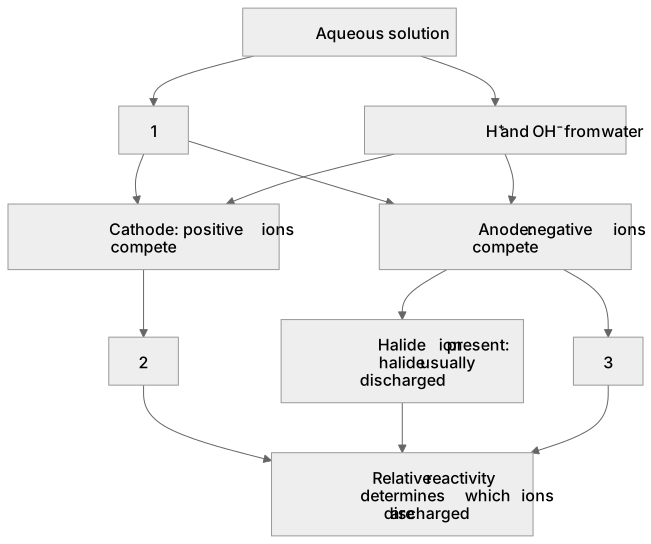
1Box 1
2Box 2
3Box 3
There is more to this lesson
The full lesson goes on to check your understanding and help you earn the marks. Create a free account to carry on, with your progress saved.
A week of Premium from your first lesson · Then the free plan continues · No card, no charge
Test your understanding of Electrolysis of aqueous solutions: The ions discharged when an aqueous solution is electrolysed using inert electrodes depend on the relative reactivity of the elements involved.
Active recall beats re-reading. Take an instant quiz now to test what you’ve learned and lock it into long-term memory.
A week of Premium from your first lesson · Then the free plan continues · No card, no charge