AQA · GCSE · Combined Science
Course version: 8464 · Version from Sept 2018
Energy stores and systems: A system is an object or group of objects.
A system is simply whatever you choose to study: a single object, or a group of objects that you treat as one unit.
Study notes
From the checked teaching notes for this specification point.
The idea
A system is simply whatever you choose to study: a single object, or a group of objects that you treat as one unit. Choosing the system sets the boundary for your energy account. Anything inside the boundary is part of the system; everything else is the surroundings. For example, a falling ball can be the system, or the ball plus the air it falls through can be the system. A boiling kettle can be the system, or the kettle plus the water inside it. Once the boundary is chosen, you can list the energy stores inside it and track transfers between them or to the surroundings. The same physical situation can be modelled with different systems, and the choice affects which stores you count as internal and which changes you describe as transfers across the boundary.
What earns the marks
- Defines a system as a single object or a group of objects treated as one unit for analysis.
- Explains that choosing a system sets a boundary between the system and its surroundings.
- States that energy stores inside the system can be listed and tracked as they change.
- Uses a concrete example, such as a ball, a kettle plus water, or a battery plus lamp, to show the boundary.
- Recognises that the same situation can be modelled using different systems, changing which stores are internal.
Common mistakes and how to put them right
Thinking a system must contain more than one object.
Put it right: A single object, such as one ball, is a valid system.
Confusing the system with its surroundings.
Put it right: The surroundings are everything outside the chosen boundary.
Assuming the system boundary is fixed by the question.
Put it right: The boundary is a modelling choice and should be stated clearly.
Exam tips
- Underline the object or group of objects named in the question before listing energy stores.
- State the boundary explicitly, for example 'taking the ball as the system'.
- If a question allows more than one system, choose the simplest one that answers the question.
Try the lesson
The start of the Energy stores and systems: A system is an object or group of objects. lesson, made from checked teaching notes for this specification point.
Have a go first
Which of these best describes a system in physics?
Listen
A system is simply whatever you choose to study: a single object, or a group of objects that you treat as one unit. Choosing the system sets the boundary for your energy account. Anything inside the boundary is part of the system; everything else is the surroundings. For example, a falling ball can be the system, or the ball plus the air it falls through can be the system. A boiling kettle can be the system, or the kettle plus the water inside it. Once the boundary is chosen, you can list the energy stores inside it and track transfers between them or to the surroundings. The same physical situation can be modelled with different systems, and the choice affects which stores you count as internal and which changes you describe as transfers across the boundary. A strong answer earns marks for these points. Defines a system as a single object or a group of objects treated as one unit for analysis. Explains that choosing a system sets a boundary between the system and its surroundings. States that energy stores inside the system can be listed and tracked as they change. Uses a concrete example, such as a ball, a kettle plus water, or a battery plus lamp, to show the boundary. A common slip: Thinking a system must contain more than one object. Instead, a single object, such as one ball, is a valid system. Exam tip: Underline the object or group of objects named in the question before listing energy stores.
See it
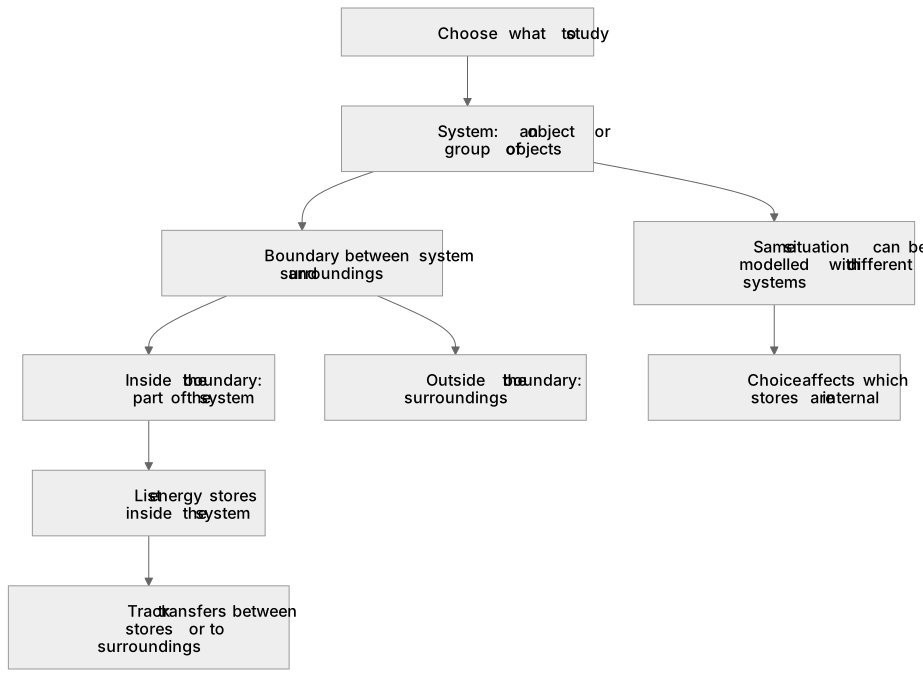
Label the diagram
Some boxes have lost their names. Pick the right name for each number.
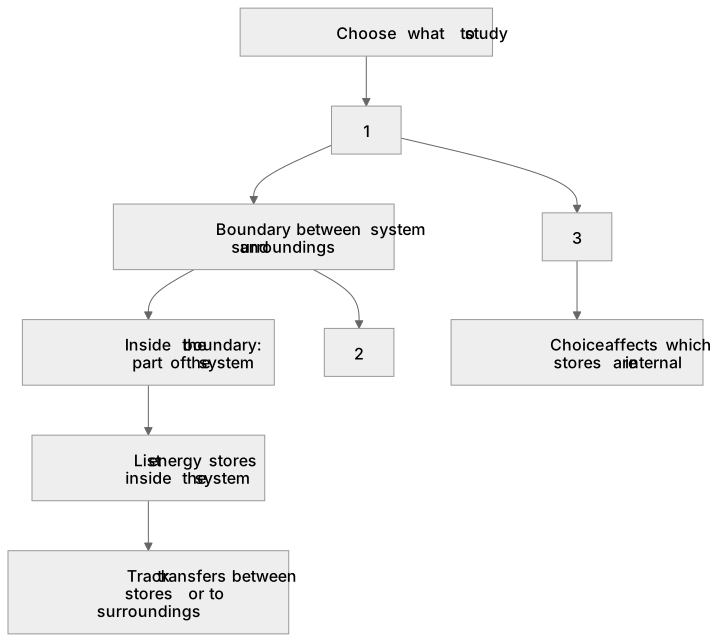
1Box 1
2Box 2
3Box 3
There is more to this lesson
The full lesson goes on to check your understanding and help you earn the marks. Create a free account to carry on, with your progress saved.
A week of Premium from your first lesson · Then the free plan continues · No card, no charge
Test your understanding of Energy stores and systems: A system is an object or group of objects.
Active recall beats re-reading. Take an instant quiz now to test what you’ve learned and lock it into long-term memory.
A week of Premium from your first lesson · Then the free plan continues · No card, no charge