AQA · GCSE · Combined Science
Course version: 8464 · Version from Sept 2018
Energy stores and systems: Students should be able to describe all the changes involved in the way energy is stored when a system changes, for common situations. For example:
A system is an object or group of objects; when it changes, energy is transferred between stores rather than created or destroyed.
- 4 key terms
Study notes
From the checked teaching notes for this specification point.
The idea
A system is an object or group of objects; when it changes, energy is transferred between stores rather than created or destroyed. To describe a change fully, name the store that decreases, the store that increases, and the pathway of transfer, such as mechanical work, electrical work, heating or radiation. For a falling ball, the gravitational potential store of the ball–Earth system decreases while its kinetic store increases, transferred mechanically by gravity doing work. For a battery-powered torch, the chemical store of the battery decreases while the thermal store of the surroundings increases, transferred electrically then by heating and radiation. Always state the system boundary and avoid saying energy is 'used up' or 'lost'.
What earns the marks
- Identifies the system and the stores that change, naming both the store that decreases and the store that increases.
- States the transfer pathway: mechanically, electrically, by heating or by radiation.
- Recognises that total energy is conserved, so a decrease in one store equals the increase in others plus any energy dissipated to the surroundings.
- Describes changes for common situations such as a falling object, a moving vehicle braking, a kettle heating water, a battery-powered device, a stretched spring or an object projected upwards.
- Uses correct terminology: 'energy is transferred' rather than 'energy is used up' or 'lost'.
- Links each store to a physical quantity where useful, for example kinetic store to speed and mass, gravitational potential store to height and mass, thermal store to temperature.
Common mistakes and how to put them right
Saying energy is 'lost' or 'used up' when it is dissipated to the surroundings.
Put it right: State that energy is transferred to the thermal store of the surroundings by heating.
Naming only one store, for example saying a falling ball has kinetic energy.
Put it right: Describe both the gravitational potential store decreasing and the kinetic store increasing.
Confusing stores with pathways, for example calling radiation a store.
Put it right: Work, heating and radiation are transfer pathways, while kinetic, thermal and chemical are stores.
Exam tips
- Use the structure 'the ... store of the ... decreases, and the ... store of the ... increases, transferred by ...' for each situation.
- Name the system explicitly, such as 'the ball–Earth system' or 'the water in the kettle', so the examiner can see which stores you mean.
- If a question says 'describe all the changes', include the pathway and the final store as well as the initial store, and mention dissipation where it occurs.
Try the lesson
The start of the Energy stores and systems: Students should be able to describe all the changes involved in the way energy is stored when a system changes, for common situations. For example: lesson, made from checked teaching notes for this specification point.
Have a go first
A book is lifted from a table to a higher shelf. Which energy store of the book increases?
Listen
A system is an object or group of objects; when it changes, energy is transferred between stores rather than created or destroyed. To describe a change fully, name the store that decreases, the store that increases, and the pathway of transfer, such as mechanical work, electrical work, heating or radiation. For a falling ball, the gravitational potential store of the ball–Earth system decreases while its kinetic store increases, transferred mechanically by gravity doing work. For a battery-powered torch, the chemical store of the battery decreases while the thermal store of the surroundings increases, transferred electrically then by heating and radiation. Always state the system boundary and avoid saying energy is 'used up' or 'lost'. A strong answer earns marks for these points. Identifies the system and the stores that change, naming both the store that decreases and the store that increases. States the transfer pathway: mechanically, electrically, by heating or by radiation. Recognises that total energy is conserved, so a decrease in one store equals the increase in others plus any energy dissipated to the surroundings. Describes changes for common situations such as a falling object, a moving vehicle braking, a kettle heating water, a battery-powered device, a stretched spring or an object projected upwards. A common slip: Saying energy is 'lost' or 'used up' when it is dissipated to the surroundings. Instead, state that energy is transferred to the thermal store of the surroundings by heating. Exam tip: Use the structure 'the ... store of the ... decreases, and the ... store of the ... increases, transferred by ... for each situation.
See it
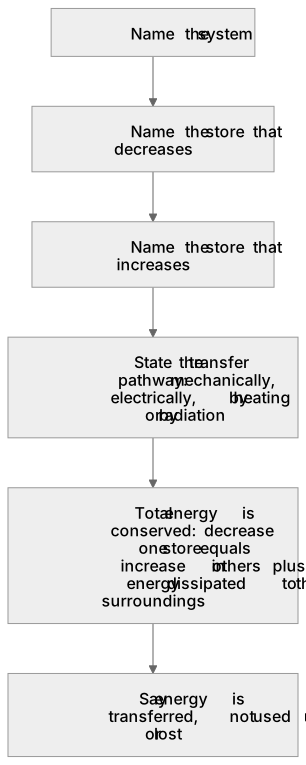
Put it in order
Put these steps in the order they happen.
- 1. Name the store that decreases
- 2. Name the store that increases
- 3. State the transfer pathway: mechanically, electrically, by heating or by radiation
- 4. Total energy is conserved: decrease in one store equals increase in others plus energy dissipated to the surroundings
- 5. Say energy is transferred, not used up or lost
- 6. Name the system
Key words
Say what each word means before you turn the card.
Conservation of energy
Try answering aloud or in your head before turning the card.
Energy stores and transfer pathways
Try answering aloud or in your head before turning the card.
Systems and system boundaries
Try answering aloud or in your head before turning the card.
Dissipation to the surroundings
Try answering aloud or in your head before turning the card.
See every definition
- Conservation of energy
- Total energy is conserved, so a decrease in one store equals the increase in others plus any energy dissipated to the surroundings.
- Energy stores and transfer pathways
- Kinetic, thermal and chemical are stores, while work, heating and radiation are transfer pathways.
- Systems and system boundaries
- A system is an object or group of objects, and its boundary should always be stated.
- Dissipation to the surroundings
- Energy transferred to the thermal store of the surroundings by heating, rather than being 'lost' or 'used up'.
Label the diagram
Some boxes have lost their names. Pick the right name for each number.
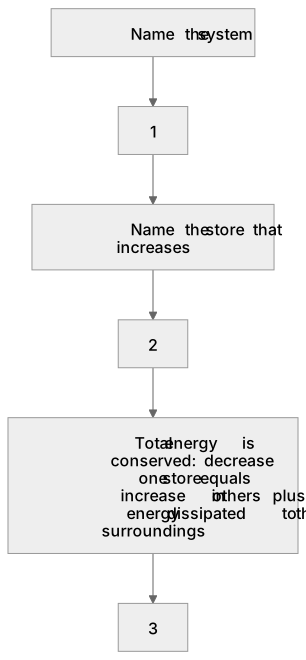
1Box 1
2Box 2
3Box 3
There is more to this lesson
The full lesson goes on to check your understanding and help you earn the marks. Create a free account to carry on, with your progress saved.
A week of Premium from your first lesson · Then the free plan continues · No card, no charge
Test your understanding of Energy stores and systems: Students should be able to describe all the changes involved in the way energy is stored when a system changes, for common situations. For example:
Active recall beats re-reading. Take an instant quiz now to test what you’ve learned and lock it into long-term memory.
A week of Premium from your first lesson · Then the free plan continues · No card, no charge