AQA · GCSE · Combined Science
Course version: 8464 · Version from Sept 2018
Energy stores and systems: Throughout this section on Energy students should be able to calculate the changes in energy involved when a system is changed by:
This overarching statement sets the quantitative expectation for the whole Energy section: whenever a system changes, you should be able to work out the energy transferred, using the correct…
Study notes
From the checked teaching notes for this specification point.
The idea
This overarching statement sets the quantitative expectation for the whole Energy section: whenever a system changes, you should be able to work out the energy transferred, using the correct relationship for the mechanism involved. A system is an object or group of objects; a change means energy moves between stores or is transferred by heating, by forces doing work, or by electrical work. For example, lifting a 2.0 kg mass by 3.0 m transfers ΔE = m × g × h = 2.0 × 9.8 × 3.0 = 58.8 J to the gravitational potential store. Identify the store that decreases and the one that increases, choose the equation linking the given quantities, substitute with units, then calculate. Energy is conserved, so the total input equals the useful output plus any energy dissipated to the surroundings.
What earns the marks
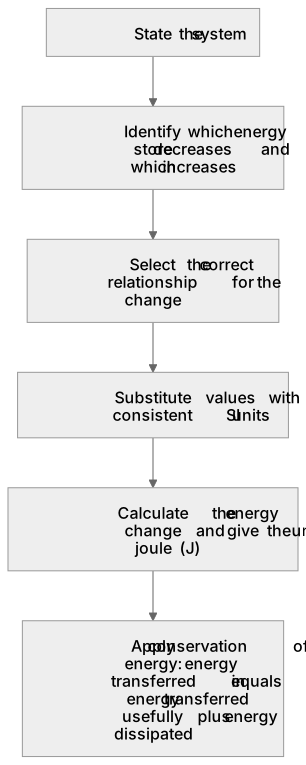
- State the system and identify which energy store decreases and which increases before calculating.
- Select the correct relationship for the change described, such as ΔE = m × g × h for a change in height or E = ½ × m × v² for a change in speed.
- Substitute values with consistent SI units, converting grams to kilograms, centimetres to metres and minutes to seconds where needed.
- Calculate the energy change and give the unit joule (J), or kilojoule (kJ) where the value is large.
- Apply conservation of energy: energy transferred in equals energy transferred usefully plus energy dissipated, so totals balance.
- Show working clearly so that a correct method can be followed even if an arithmetic slip occurs.
Common mistakes and how to put them right
Using the mass in grams instead of kilograms.
Put it right: Convert 250 g to 0.25 kg before substituting into any equation.
Forgetting to square the speed in E = ½ × m × v².
Put it right: Square the velocity first, then multiply by mass and halve.
Treating dissipated energy as destroyed.
Put it right: It is still transferred to the surroundings, usually by heating, so include it in the total.
Mixing up the gravitational field strength value.
Put it right: On Earth use g = 9.8 N/kg unless the question states otherwise.
Exam tips
- Underline the quantities given in the question and the quantity required, then choose the equation that links exactly those quantities.
- Write the equation, substitute numbers with units, then calculate; this earns method credit and makes errors easy to spot.
- Check the size of your answer: lifting a book transfers tens of joules, while heating a kettle transfers hundreds of thousands of joules.
- Give the unit with every numerical answer and round sensibly, usually to two or three significant figures.
Try the lesson
The start of the Energy stores and systems: Throughout this section on Energy students should be able to calculate the changes in energy involved when a system is changed by: lesson, made from checked teaching notes for this specification point.
Have a go first
A student lifts a 2.0 kg box from the floor onto a shelf 1.5 m high. Gravitational field strength is 9.8 N/kg. Calculate the change in the gravitational potential energy store of the box.
Listen
This overarching statement sets the quantitative expectation for the whole Energy section: whenever a system changes, you should be able to work out the energy transferred, using the correct relationship for the mechanism involved. A system is an object or group of objects; a change means energy moves between stores or is transferred by heating, by forces doing work, or by electrical work. For example, lifting a 2.0 kg mass by 3.0 m transfers ΔE = m × g × h = 2.0 × 9.8 × 3.0 = 58.8 J to the gravitational potential store. Identify the store that decreases and the one that increases, choose the equation linking the given quantities, substitute with units, then calculate. Energy is conserved, so the total input equals the useful output plus any energy dissipated to the surroundings. A strong answer earns marks for these points. State the system and identify which energy store decreases and which increases before calculating. Select the correct relationship for the change described, such as ΔE = m × g × h for a change in height or E = ½ × m × v² for a change in speed. Substitute values with consistent SI units, converting grams to kilograms, centimetres to metres and minutes to seconds where needed. Calculate the energy change and give the unit joule (J), or kilojoule (kJ) where the value is large. Exam tip: Underline the quantities given in the question and the quantity required, then choose the equation that links exactly those quantities.
See it
Put it in order
Put these steps in the order they happen.
- 1. Identify which energy store decreases and which increases
- 2. Select the correct relationship for the change
- 3. Substitute values with consistent SI units
- 4. Calculate the energy change and give the unit joule (J)
- 5. Apply conservation of energy: energy transferred in equals energy transferred usefully plus energy dissipated
- 6. State the system
Label the diagram
Some boxes have lost their names. Pick the right name for each number.
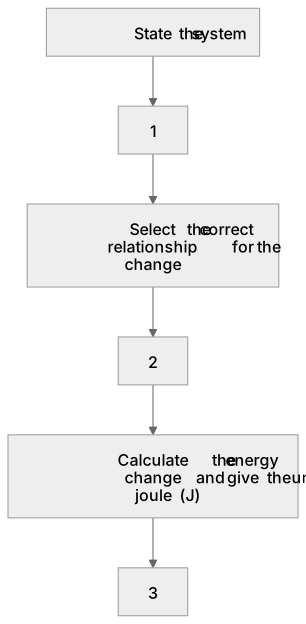
1Box 1
2Box 2
3Box 3
There is more to this lesson
The full lesson goes on to check your understanding and help you earn the marks. Create a free account to carry on, with your progress saved.
A week of Premium from your first lesson · Then the free plan continues · No card, no charge
Test your understanding of Energy stores and systems: Throughout this section on Energy students should be able to calculate the changes in energy involved when a system is changed by:
Active recall beats re-reading. Take an instant quiz now to test what you’ve learned and lock it into long-term memory.
A week of Premium from your first lesson · Then the free plan continues · No card, no charge