AQA · GCSE · Combined Science
Course version: 8464 · Version from Sept 2018
Energy transfer during exothermic and endothermic reactions: evaluate uses and applications of exothermic and endothermic reactions given appropriate information.
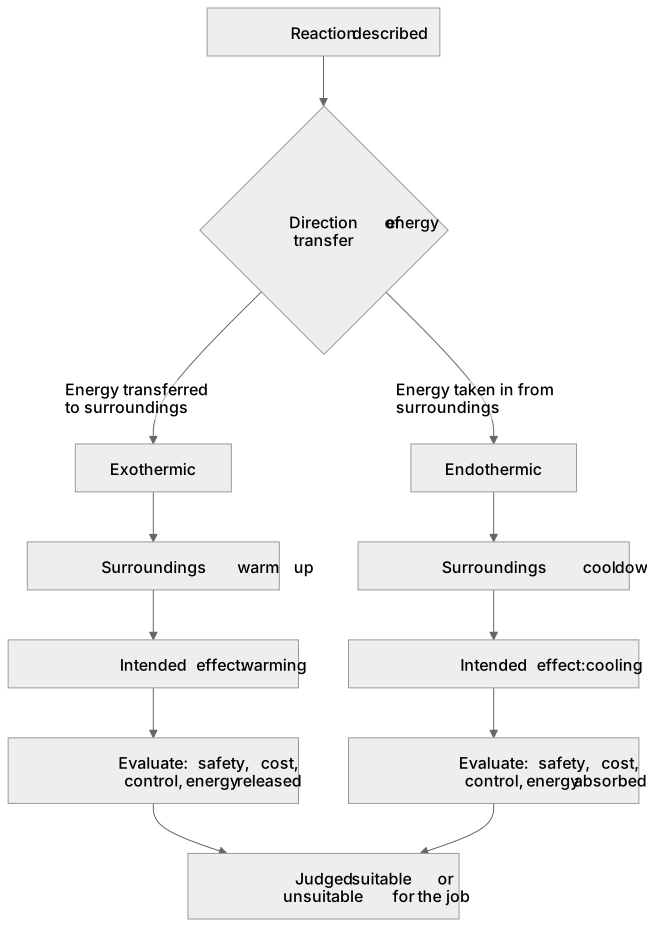
Exothermic reactions transfer energy to the surroundings, so the surroundings warm up; endothermic reactions take in energy from the surroundings, so they cool down.
- 3 key terms
Study notes
From the checked teaching notes for this specification point.
The idea
Exothermic reactions transfer energy to the surroundings, so the surroundings warm up; endothermic reactions take in energy from the surroundings, so they cool down. To evaluate a use, weigh the useful energy change against practical factors such as safety, cost, control and whether the effect suits the purpose. For example, a self-heating can uses an exothermic reaction to warm food, but the reaction must be safe, controllable and give enough energy. A sports injury pack uses an endothermic reaction to cool tissue, but it must not become dangerously cold. Evaluation means judging how well the reaction fits the job, not simply naming it as exothermic or endothermic.
What earns the marks
- Correctly classify a described reaction as exothermic or endothermic from temperature change or energy transfer information.
- Link the direction of energy transfer to the intended effect, such as warming or cooling.
- Judge suitability using practical criteria such as safety, cost, controllability, reversibility and energy released or absorbed per unit.
- Compare two possible reactions or applications and justify a choice with evidence from the supplied information.
- Recognise that a reaction may be unsuitable even when the energy change is in the right direction.
- Use the supplied data rather than assumed values, and state when information is insufficient for a firm judgement.
Common mistakes and how to put them right
Saying that exothermic reactions 'give out heat' but not linking this to warming the surroundings.
Put it right by stating that energy is transferred to the surroundings, raising their temperature.
Assuming any exothermic reaction is automatically a good hand warmer.
Put it right by checking safety, cost, controllability and how much energy is released.
Treating 'endothermic' as meaning no energy transfer occurs.
Put it right by explaining that energy is taken in from the surroundings, so they cool.
Exam tips
- Underline the purpose in the question, such as warming food or cooling an injury, then judge the reaction against that purpose.
- Use the supplied information as evidence; quote or refer to the data rather than relying on memory.
- Structure an evaluation as a benefit, a limitation and a justified overall judgement.
- Check that every claim about temperature change matches the direction of energy transfer you have identified.
Try the lesson
The start of the Energy transfer during exothermic and endothermic reactions: evaluate uses and applications of exothermic and endothermic reactions given appropriate information. lesson, made from checked teaching notes for this specification point.
Have a go first
A company wants a portable heater that releases as much energy as possible for each gram of fuel burned. The table shows the energy released per gram for four fuels. Which fuel should the company choose? Fuel P: 20 kJ/g; Fuel Q: 35 kJ/g; Fuel R: 28 kJ/g; Fuel S: 42 kJ/g.
Listen
Exothermic reactions transfer energy to the surroundings, so the surroundings warm up; endothermic reactions take in energy from the surroundings, so they cool down. To evaluate a use, weigh the useful energy change against practical factors such as safety, cost, control and whether the effect suits the purpose. For example, a self-heating can uses an exothermic reaction to warm food, but the reaction must be safe, controllable and give enough energy. A sports injury pack uses an endothermic reaction to cool tissue, but it must not become dangerously cold. Evaluation means judging how well the reaction fits the job, not simply naming it as exothermic or endothermic. A strong answer earns marks for these points. Correctly classify a described reaction as exothermic or endothermic from temperature change or energy transfer information. Link the direction of energy transfer to the intended effect, such as warming or cooling. Judge suitability using practical criteria such as safety, cost, controllability, reversibility and energy released or absorbed per unit. Compare two possible reactions or applications and justify a choice with evidence from the supplied information. A common slip: Saying that exothermic reactions 'give out heat' but not linking this to warming the surroundings. Instead, stating that energy is transferred to the surroundings, raising their temperature. Exam tip: Underline the purpose in the question, such as warming food or cooling an injury, then judge the reaction against that purpose.
See it
Key words
Say what each word means before you turn the card.
Exothermic reaction
Try answering aloud or in your head before turning the card.
Endothermic reaction
Try answering aloud or in your head before turning the card.
Evaluation
Try answering aloud or in your head before turning the card.
See every definition
- Exothermic reaction
- A reaction that transfers energy to the surroundings, so the surroundings warm up.
- Endothermic reaction
- A reaction that takes in energy from the surroundings, so the surroundings cool down.
- Evaluation
- Judging how well a reaction fits the job by weighing the useful energy change against practical factors such as safety, cost and control.
There is more to this lesson
The full lesson goes on to check your understanding and help you earn the marks. Create a free account to carry on, with your progress saved.
A week of Premium from your first lesson · Then the free plan continues · No card, no charge
Test your understanding of Energy transfer during exothermic and endothermic reactions: evaluate uses and applications of exothermic and endothermic reactions given appropriate information.
Active recall beats re-reading. Take an instant quiz now to test what you’ve learned and lock it into long-term memory.
A week of Premium from your first lesson · Then the free plan continues · No card, no charge