AQA · GCSE · Combined Science
Course version: 8464 · Version from Sept 2018
Energy transfer during exothermic and endothermic reactions: Exothermic reactions include combustion, many oxidation reactions and neutralisation.
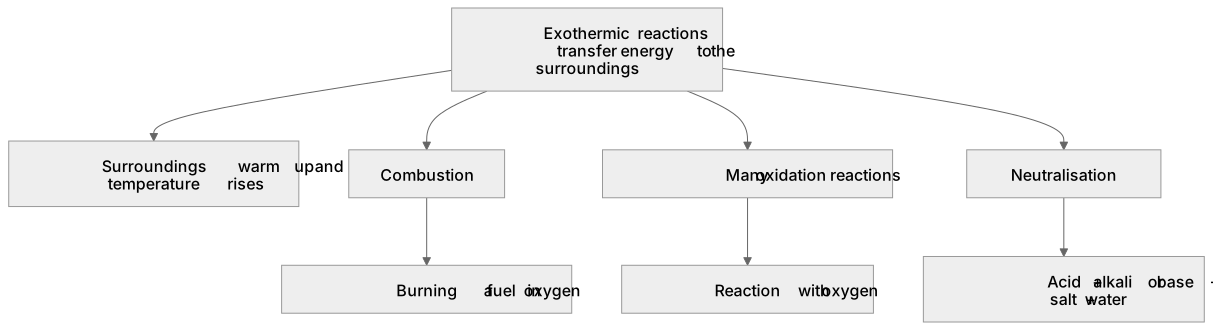
Exothermic reactions transfer energy to the surroundings, causing the surroundings to warm up and the temperature to rise.
- 4 key terms
Study notes
From the checked teaching notes for this specification point.
The idea
Exothermic reactions transfer energy to the surroundings, causing the surroundings to warm up and the temperature to rise. Combustion is burning a fuel in oxygen, for example methane + oxygen → carbon dioxide + water, which releases energy. Many oxidation reactions also release energy, such as iron reacting with oxygen to form iron oxide during rusting, or respiration in cells. Neutralisation occurs when an acid reacts with an alkali or base to form a salt and water, for example hydrochloric acid + sodium hydroxide → sodium chloride + water; the temperature rise confirms energy is released. In all these cases, the overall energy change is negative and the reaction mixture warms up. Measuring this temperature increase is a standard way to identify an exothermic process.
What earns the marks
- States that exothermic reactions transfer energy to the surroundings, causing a temperature rise.
- Identifies combustion as burning in oxygen, giving examples such as methane + oxygen → carbon dioxide + water.
- Describes oxidation as a reaction with oxygen, for example iron + oxygen → iron oxide, and notes that many oxidation reactions are exothermic.
- Explains neutralisation as acid + alkali/base → salt + water, for example hydrochloric acid + sodium hydroxide → sodium chloride + water, and links the temperature rise to energy release.
- Interprets temperature change data from a simple experiment, such as measuring the temperature rise when sodium hydroxide solution is added to hydrochloric acid.
Common mistakes and how to put them right
Thinking that all oxidation reactions are exothermic.
Put it right: Is to note that while many are exothermic, some oxidation reactions, such as the reaction between nitrogen and oxygen to form nitrogen monoxide, are endothermic.
Confusing neutralisation with combustion.
Put it right: Is to remember that neutralisation forms a salt and water from an acid and a base, while combustion needs oxygen and a fuel and produces oxides.
Writing that exothermic reactions 'create' energy.
Put it right: Is to state that energy is transferred to the surroundings, not created.
Exam tips
- When asked to classify a reaction, look for a temperature rise in the surroundings as evidence of exothermic behaviour.
- Give the general word equation for neutralisation and one named example with the salt formed, rather than only naming the reaction type.
- If a question gives temperature data, calculate or describe the temperature change and link it to energy transfer to the surroundings.
Try the lesson
The start of the Energy transfer during exothermic and endothermic reactions: Exothermic reactions include combustion, many oxidation reactions and neutralisation. lesson, made from checked teaching notes for this specification point.
Have a go first
Which list contains only examples of exothermic reactions?
Listen
Exothermic reactions transfer energy to the surroundings, causing the surroundings to warm up and the temperature to rise. Combustion is burning a fuel in oxygen, for example methane + oxygen → carbon dioxide + water, which releases energy. Many oxidation reactions also release energy, such as iron reacting with oxygen to form iron oxide during rusting, or respiration in cells. Neutralisation occurs when an acid reacts with an alkali or base to form a salt and water, for example hydrochloric acid + sodium hydroxide → sodium chloride + water; the temperature rise confirms energy is released. In all these cases, the overall energy change is negative and the reaction mixture warms up. Measuring this temperature increase is a standard way to identify an exothermic process. A strong answer earns marks for these points. States that exothermic reactions transfer energy to the surroundings, causing a temperature rise. Identifies combustion as burning in oxygen, giving examples such as methane + oxygen → carbon dioxide + water. Describes oxidation as a reaction with oxygen, for example iron + oxygen → iron oxide, and notes that many oxidation reactions are exothermic. Explains neutralisation as acid + alkali/base → salt + water, for example hydrochloric acid + sodium hydroxide → sodium chloride + water, and links the temperature rise to energy release. A common slip: Thinking that all oxidation reactions are exothermic: the error is assuming every oxidation releases heat. Instead, is to note that while many are exothermic, some oxidation reactions, such as the reaction between nitrogen and oxygen to form nitrogen monoxide, are endothermic. Exam tip: When asked to classify a reaction, look for a temperature rise in the surroundings as evidence of exothermic behaviour.
See it
Key words
Say what each word means before you turn the card.
Exothermic reaction
Try answering aloud or in your head before turning the card.
Combustion
Try answering aloud or in your head before turning the card.
Oxidation
Try answering aloud or in your head before turning the card.
Neutralisation
Try answering aloud or in your head before turning the card.
See every definition
- Exothermic reaction
- A reaction that transfers energy to the surroundings, causing the surroundings to warm up and the temperature to rise.
- Combustion
- Burning a fuel in oxygen, which releases energy.
- Oxidation
- A reaction with oxygen, and many such reactions release energy.
- Neutralisation
- A reaction in which an acid reacts with an alkali or base to form a salt and water.
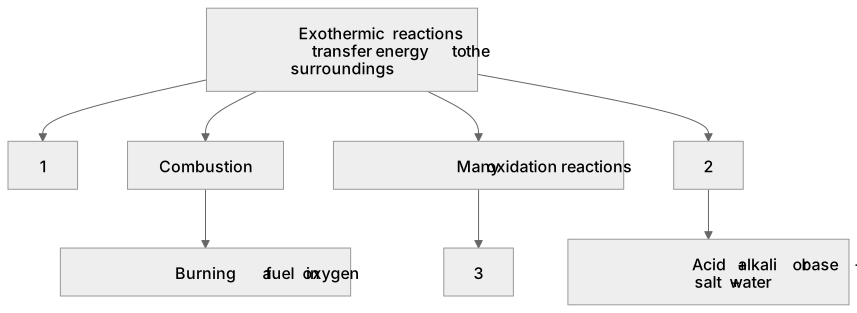
Label the diagram
Some boxes have lost their names. Pick the right name for each number.
1Box 1
2Box 2
3Box 3
There is more to this lesson
The full lesson goes on to check your understanding and help you earn the marks. Create a free account to carry on, with your progress saved.
A week of Premium from your first lesson · Then the free plan continues · No card, no charge
Test your understanding of Energy transfer during exothermic and endothermic reactions: Exothermic reactions include combustion, many oxidation reactions and neutralisation.
Active recall beats re-reading. Take an instant quiz now to test what you’ve learned and lock it into long-term memory.
A week of Premium from your first lesson · Then the free plan continues · No card, no charge