AQA · GCSE · Combined Science
Course version: 8464 · Version from Sept 2018
Energy transfer during exothermic and endothermic reactions: Required practical activity 10: investigate the variables that affect temperature changes in reacting solutions such as, eg acid plus metals, acid plus carbonates, neutralisations, displacement of metals.
This practical explores how temperature changes when solutions react.
- 4 key terms
Study notes
From the checked teaching notes for this specification point.
The idea
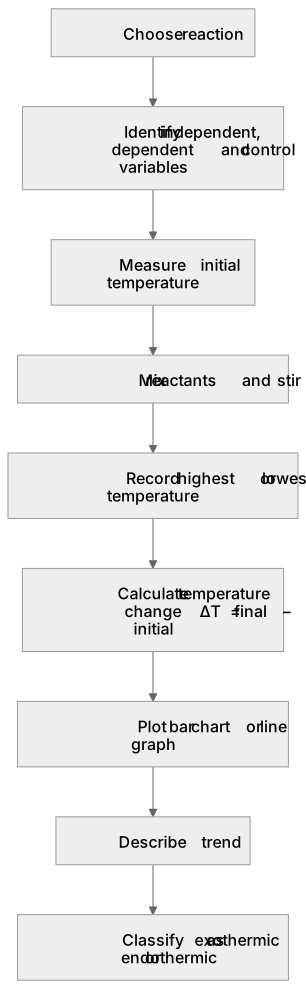
This practical explores how temperature changes when solutions react. You choose a reaction such as hydrochloric acid with magnesium, sodium carbonate or sodium hydroxide, or copper sulfate with zinc. Measure initial temperature, mix reactants, stir, and record the highest or lowest temperature. Calculate temperature change ΔT = final − initial. Variables include concentration, volume, particle size, metal identity and reaction type. Control variables to make comparisons valid. Exothermic reactions release energy, raising temperature; endothermic reactions absorb energy, lowering it. Plot bar charts or line graphs to identify trends. Assessed on planning, safe technique, accurate measurement, recording and interpreting results.
What earns the marks
- Selects a suitable reaction and identifies independent, dependent and control variables.
- Uses a thermometer or temperature probe correctly, reading to the nearest appropriate precision and allowing equilibration.
- Measures initial temperature before mixing and records maximum or minimum temperature after reaction.
- Controls variables such as volume, concentration, starting temperature and particle size to ensure valid comparison.
- Calculates temperature change ΔT = final temperature − initial temperature, including sign.
- Plots appropriate graph (bar chart for categoric data, line graph for continuous data) and describes trend.
- Evaluates risks and suggests improvements, such as insulation or repeated trials.
Common mistakes and how to put them right
Reading the thermometer immediately after mixing.
Put it right: Wait until the temperature stabilises or reaches its highest/lowest value.
Using different volumes or concentrations when comparing reactions.
Put it right: Keep all variables except the independent variable constant.
Confusing exothermic and endothermic temperature changes.
Put it right: Exothermic increases temperature; endothermic decreases temperature.
Ignoring heat loss to surroundings.
Put it right: Use a polystyrene cup or lid, or note this as a source of error.
Exam tips
- State the independent variable, dependent variable and at least two control variables for your chosen reaction.
- Describe how you ensure accurate temperature measurement, such as stirring and reading at eye level.
- When calculating temperature change, show the subtraction clearly and include the unit °C.
- Link your conclusion to exothermic or endothermic behaviour using the sign of ΔT.
Try the lesson
The start of the Energy transfer during exothermic and endothermic reactions: Required practical activity 10: investigate the variables that affect temperature changes in reacting solutions such as, eg acid plus metals, acid plus carbonates, neutralisations, displacement of metals. lesson, made from checked teaching notes for this specification point.
Have a go first
In the required practical, a student adds magnesium to dilute hydrochloric acid in a polystyrene cup and stirs the mixture. The temperature of the solution rises. What does this temperature rise show about the reaction?
Listen
This practical explores how temperature changes when solutions react. You choose a reaction such as hydrochloric acid with magnesium, sodium carbonate or sodium hydroxide, or copper sulfate with zinc. Measure initial temperature, mix reactants, stir, and record the highest or lowest temperature. Calculate temperature change ΔT = final − initial. Variables include concentration, volume, particle size, metal identity and reaction type. Control variables to make comparisons valid. Exothermic reactions release energy, raising temperature; endothermic reactions absorb energy, lowering it. Plot bar charts or line graphs to identify trends. Assessed on planning, safe technique, accurate measurement, recording and interpreting results. A strong answer earns marks for these points. Selects a suitable reaction and identifies independent, dependent and control variables. Uses a thermometer or temperature probe correctly, reading to the nearest appropriate precision and allowing equilibration. Measures initial temperature before mixing and records maximum or minimum temperature after reaction. Controls variables such as volume, concentration, starting temperature and particle size to ensure valid comparison. A common slip: reading the thermometer immediately after mixing. Instead, wait until the temperature stabilises or reaches its highest/lowest value. Exam tip: State the independent variable, dependent variable and at least two control variables for your chosen reaction.
See it
Key words
Say what each word means before you turn the card.
Exothermic reactions
Try answering aloud or in your head before turning the card.
Endothermic reactions
Try answering aloud or in your head before turning the card.
Control variables
Try answering aloud or in your head before turning the card.
Temperature change ΔT
Try answering aloud or in your head before turning the card.
See every definition
- Exothermic reactions
- Reactions that release energy, raising temperature.
- Endothermic reactions
- Reactions that absorb energy, lowering temperature.
- Control variables
- Variables kept constant to make comparisons valid.
- Temperature change ΔT
- Calculated as final temperature minus initial temperature, including sign.
Label the diagram
Some boxes have lost their names. Pick the right name for each number.
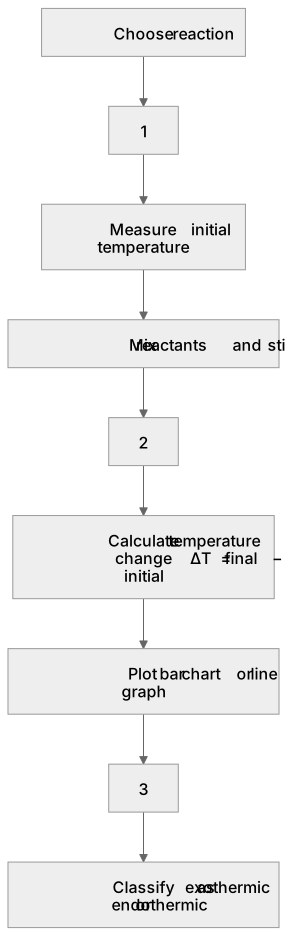
1Box 1
2Box 2
3Box 3
There is more to this lesson
The full lesson goes on to check your understanding and help you earn the marks. Create a free account to carry on, with your progress saved.
A week of Premium from your first lesson · Then the free plan continues · No card, no charge
Test your understanding of Energy transfer during exothermic and endothermic reactions: Required practical activity 10: investigate the variables that affect temperature changes in reacting solutions such as, eg acid plus metals, acid plus carbonates, neutralisations, displacement of metals.
Active recall beats re-reading. Take an instant quiz now to test what you’ve learned and lock it into long-term memory.
A week of Premium from your first lesson · Then the free plan continues · No card, no charge