AQA · GCSE · Combined Science
Course version: 8464 · Version from Sept 2018
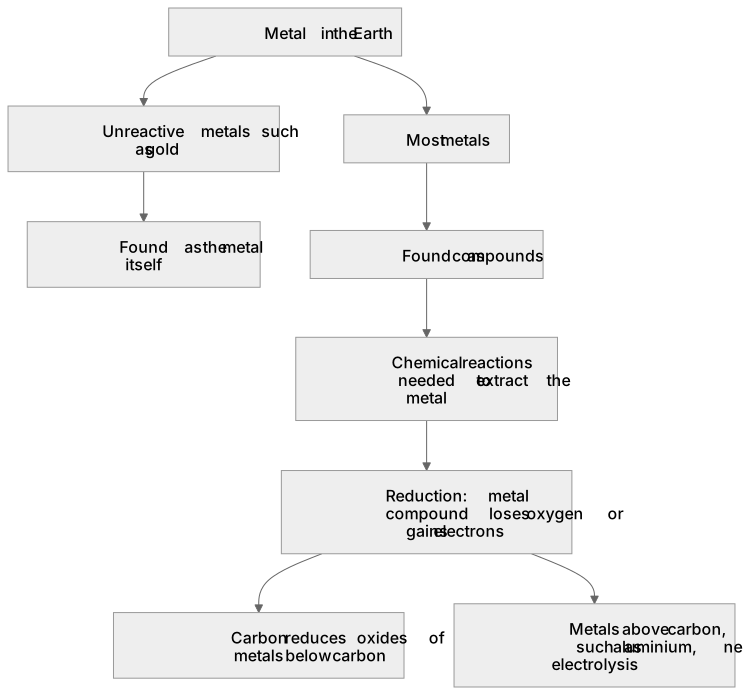
Extraction of metals and reduction: Unreactive metals such as gold are found in the Earth as the metal itself but most metals are found as compounds that require chemical reactions to extract the metal.
This statement links a metal's position in the reactivity series to how it occurs and how it is extracted.
- 4 key terms
Study notes
From the checked teaching notes for this specification point.
The idea
This statement links a metal's position in the reactivity series to how it occurs and how it is extracted. Unreactive metals such as gold occur native, meaning they are found in the Earth as the uncombined metal, because they do not readily react to form compounds. Most metals, including iron, aluminium and zinc, occur as compounds in ores and need chemical reactions to release the metal. Extraction is a reduction process: the metal compound loses oxygen or gains electrons. Carbon can reduce oxides of metals below carbon in the series, as in 2Fe₂O₃ + 3C → 4Fe + 3CO₂. Metals above carbon, such as aluminium, need electrolysis instead. The more reactive the metal, the more stable its compound and the more energy needed to extract it.
What earns the marks
- Gold and other unreactive metals occur native, found as the uncombined metal in the Earth, because they resist forming compounds.
- Most metals occur as compounds in ores, so chemical reactions are needed to extract the metal from its compound.
- Reduction removes oxygen from a metal oxide or adds electrons to a metal ion, producing the metal.
- Carbon reduces oxides of metals below carbon in the reactivity series, for example 2Fe₂O₃ + 3C → 4Fe + 3CO₂.
- Metals more reactive than carbon, such as aluminium, are extracted by electrolysis rather than by carbon reduction.
- The more reactive a metal, the more stable its compound and the more energy its extraction requires.
Common mistakes and how to put them right
Saying gold is extracted by reduction with carbon.
Put it right by stating gold is found native as the uncombined metal.
Confusing reduction with oxidation.
Put it right by defining reduction as loss of oxygen or gain of electrons.
Claiming carbon can extract any metal.
Put it right by limiting carbon reduction to metals below carbon in the series.
Exam tips
- State whether a named metal is found native or as a compound before describing its extraction method.
- Write a balanced symbol equation for a reduction you describe, and check that oxygen is removed from the metal oxide.
- Use reactivity series position to justify the extraction method rather than quoting it without reasoning.
Try the lesson
The start of the Extraction of metals and reduction: Unreactive metals such as gold are found in the Earth as the metal itself but most metals are found as compounds that require chemical reactions to extract the metal. lesson, made from checked teaching notes for this specification point.
Have a go first
Which metal is found in the Earth as the metal itself because it is unreactive?
Listen
This statement links a metal's position in the reactivity series to how it occurs and how it is extracted. Unreactive metals such as gold occur native, meaning they are found in the Earth as the uncombined metal, because they do not readily react to form compounds. Most metals, including iron, aluminium and zinc, occur as compounds in ores and need chemical reactions to release the metal. Extraction is a reduction process: the metal compound loses oxygen or gains electrons. Carbon can reduce oxides of metals below carbon in the series, as in 2Fe₂O₃ + 3C → 4Fe + 3CO₂. Metals above carbon, such as aluminium, need electrolysis instead. The more reactive the metal, the more stable its compound and the more energy needed to extract it. A strong answer earns marks for these points. Gold and other unreactive metals occur native, found as the uncombined metal in the Earth, because they resist forming compounds. Most metals occur as compounds in ores, so chemical reactions are needed to extract the metal from its compound. Reduction removes oxygen from a metal oxide or adds electrons to a metal ion, producing the metal. Carbon reduces oxides of metals below carbon in the reactivity series, for example 2Fe₂O₃ + 3C → 4Fe + 3CO₂. A common slip: Saying gold is extracted by reduction with carbon. Instead, stating gold is found native as the uncombined metal. Exam tip: State whether a named metal is found native or as a compound before describing its extraction method.
See it
Key words
Say what each word means before you turn the card.
Native metals
Try answering aloud or in your head before turning the card.
Ores and compounds
Try answering aloud or in your head before turning the card.
Reduction
Try answering aloud or in your head before turning the card.
Reactivity and extraction method
Try answering aloud or in your head before turning the card.
See every definition
- Native metals
- Unreactive metals such as gold are found in the Earth as the metal itself, as the uncombined metal, because they do not readily react to form compounds.
- Ores and compounds
- Most metals are found as compounds in ores and need chemical reactions to release the metal.
- Reduction
- Extraction is a reduction process in which the metal compound loses oxygen or gains electrons, producing the metal.
- Reactivity and extraction method
- Carbon can reduce oxides of metals below carbon in the series, while metals above carbon need electrolysis instead, and the more reactive the metal the more energy its extraction requires.
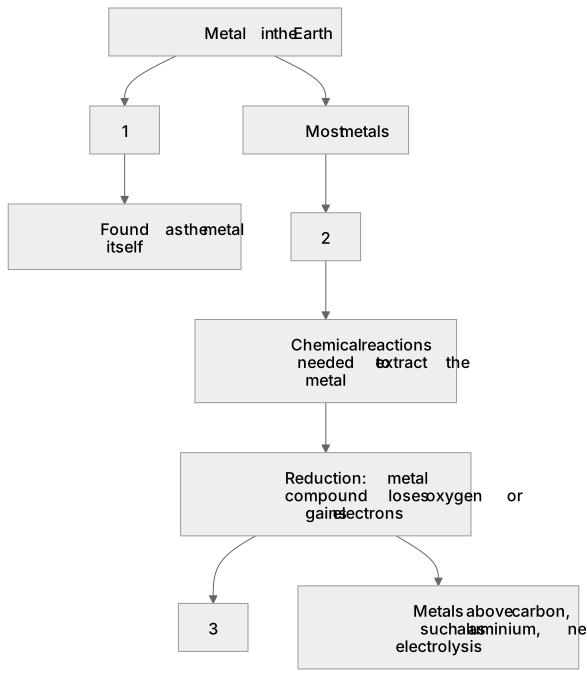
Label the diagram
Some boxes have lost their names. Pick the right name for each number.
1Box 1
2Box 2
3Box 3
There is more to this lesson
The full lesson goes on to check your understanding and help you earn the marks. Create a free account to carry on, with your progress saved.
A week of Premium from your first lesson · Then the free plan continues · No card, no charge
Test your understanding of Extraction of metals and reduction: Unreactive metals such as gold are found in the Earth as the metal itself but most metals are found as compounds that require chemical reactions to extract the metal.
Active recall beats re-reading. Take an instant quiz now to test what you’ve learned and lock it into long-term memory.
A week of Premium from your first lesson · Then the free plan continues · No card, no charge