AQA · GCSE · Combined Science
Course version: 8464 · Version from Sept 2018
Factors which affect the rates of chemical reactions: Required practical activity 11: investigate how changes in concentration affect the rates of reactions by a method involving measuring the volume of a gas produced and a method involving a change in colour or turbidity.
This required practical uses two complementary methods.
- 3 key terms
Study notes
From the checked teaching notes for this specification point.
The idea
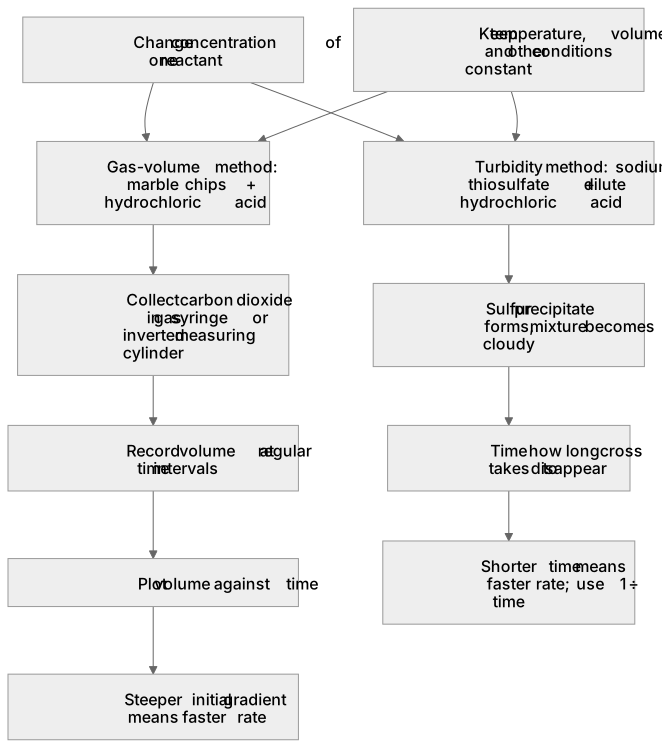
This required practical uses two complementary methods. In the gas-volume method, a known mass of marble chips (calcium carbonate) reacts with hydrochloric acid of different concentrations; the gas syringe or inverted measuring cylinder collects carbon dioxide, and you record the volume at regular time intervals, such as every 10 s. A steeper initial gradient on a volume–time graph means a faster rate. In the turbidity method, sodium thiosulfate solution reacts with dilute hydrochloric acid to form a pale yellow precipitate of sulfur; the mixture becomes cloudy. You place the flask over a printed cross and time how long the cross takes to disappear. A shorter time means a faster rate. For both methods, change only the concentration of one reactant, keep temperature, volume and other conditions constant, and repeat to improve reliability.
What earns the marks
- Describe measuring gas volume at regular time intervals using a gas syringe or inverted measuring cylinder, and plotting volume against time.
- Describe measuring the time for a cross to disappear as sulfur precipitate forms, and using 1 ÷ time as a measure of rate.
- Identify the independent variable as concentration of one reactant and the dependent variable as gas volume or time.
- State control variables such as temperature, volume of solution, mass or size of solid, and same cross or light intensity.
- Explain that a steeper initial gradient on a volume–time graph indicates a faster rate.
- Explain that a shorter time for the cross to disappear indicates a faster rate.
Common mistakes and how to put them right
Using the total volume of gas collected as the rate.
Put it right: Rate is related to the initial gradient or to 1 ÷ time, not the final total volume.
Changing temperature or volume of acid while changing concentration.
Put it right: Keep all variables except concentration constant.
Reading the cross through the side of the flask or using different lighting.
Put it right: View from directly above and keep lighting and cross identical.
Exam tips
- State clearly what is measured and how it is used to compare rates, for example initial gradient or 1 ÷ time.
- Name the control variables explicitly; examiners look for temperature, volume and solid mass or particle size.
- For the turbidity method, explain that the cross disappears when enough sulfur precipitate has formed to block the view.
Try the lesson
The start of the Factors which affect the rates of chemical reactions: Required practical activity 11: investigate how changes in concentration affect the rates of reactions by a method involving measuring the volume of a gas produced and a method involving a change in colour or turbidity. lesson, made from checked teaching notes for this specification point.
Have a go first
In the gas-volume method of Required practical activity 11, magnesium ribbon is added to dilute hydrochloric acid and the gas produced is collected in a syringe. Which gas is collected?
Listen
This required practical uses two complementary methods. In the gas-volume method, a known mass of marble chips (calcium carbonate) reacts with hydrochloric acid of different concentrations; the gas syringe or inverted measuring cylinder collects carbon dioxide, and you record the volume at regular time intervals, such as every 10 s. A steeper initial gradient on a volume–time graph means a faster rate. In the turbidity method, sodium thiosulfate solution reacts with dilute hydrochloric acid to form a pale yellow precipitate of sulfur; the mixture becomes cloudy. You place the flask over a printed cross and time how long the cross takes to disappear. A shorter time means a faster rate. For both methods, change only the concentration of one reactant, keep temperature, volume and other conditions constant, and repeat to improve reliability. A strong answer earns marks for these points. Describe measuring gas volume at regular time intervals using a gas syringe or inverted measuring cylinder, and plotting volume against time. Describe measuring the time for a cross to disappear as sulfur precipitate forms, and using 1 ÷ time as a measure of rate. Identify the independent variable as concentration of one reactant and the dependent variable as gas volume or time. State control variables such as temperature, volume of solution, mass or size of solid, and same cross or light intensity. A common slip: Using the total volume of gas collected as the rate. Instead, rate is related to the initial gradient or to 1 ÷ time, not the final total volume. Exam tip: State clearly what is measured and how it is used to compare rates, for example initial gradient or 1 ÷ time.
See it
Key words
Say what each word means before you turn the card.
Required practical skills
Try answering aloud or in your head before turning the card.
Rate graphs and gradients
Try answering aloud or in your head before turning the card.
Control variables and reliability
Try answering aloud or in your head before turning the card.
See every definition
- Required practical skills
- Investigating how changes in concentration affect the rates of reactions by measuring the volume of a gas produced and by a change in colour or turbidity.
- Rate graphs and gradients
- Plotting volume against time, where a steeper initial gradient on a volume–time graph means a faster rate.
- Control variables and reliability
- Keeping temperature, volume and other conditions constant, and repeating to improve reliability.
Label the diagram
Some boxes have lost their names. Pick the right name for each number.
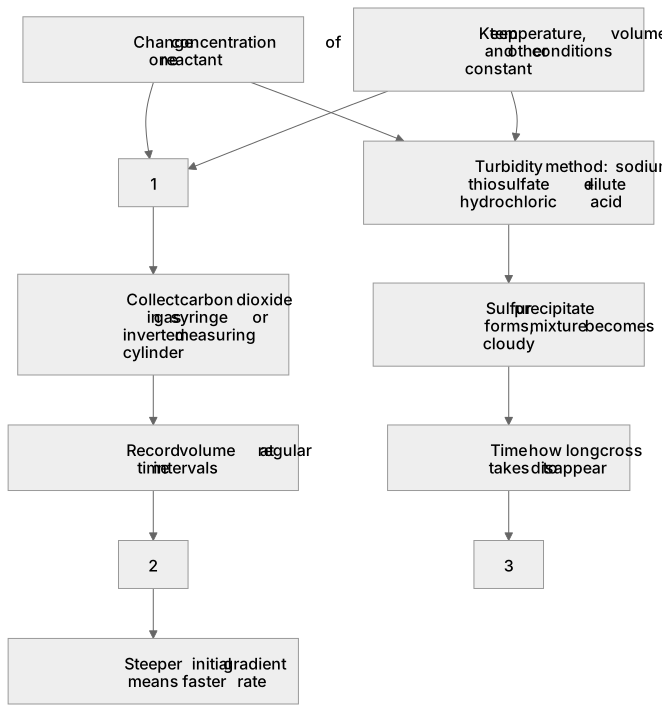
1Box 1
2Box 2
3Box 3
There is more to this lesson
The full lesson goes on to check your understanding and help you earn the marks. Create a free account to carry on, with your progress saved.
A week of Premium from your first lesson · Then the free plan continues · No card, no charge
Test your understanding of Factors which affect the rates of chemical reactions: Required practical activity 11: investigate how changes in concentration affect the rates of reactions by a method involving measuring the volume of a gas produced and a method involving a change in colour or turbidity.
Active recall beats re-reading. Take an instant quiz now to test what you’ve learned and lock it into long-term memory.
A week of Premium from your first lesson · Then the free plan continues · No card, no charge