AQA · GCSE · Combined Science
Course version: 8464 · Version from Sept 2018
Factors which affect the rates of chemical reactions: Students should be able to recall how changing these factors affects the rate of chemical reactions.
The rate of a chemical reaction is the speed at which reactants are used up or products are formed.
Study notes
From the checked teaching notes for this specification point.
The idea
The rate of a chemical reaction is the speed at which reactants are used up or products are formed. It increases when particles collide more frequently or with greater energy. Raising temperature makes particles move faster, so collisions are more frequent and more energetic; this increases rate. Increasing concentration of a solution, or pressure of a gas, packs particles closer, increasing collision frequency. Increasing surface area of a solid exposes more particles to collision. A catalyst provides an alternative pathway with lower activation energy, increasing rate without being used up. For example, magnesium ribbon reacts faster with 2 mol/dm³ hydrochloric acid than with 1 mol/dm³ acid, and faster still if the acid is warmed. Powdered calcium carbonate fizzes faster than the same mass of lumps in acid.
What earns the marks
- State that increasing temperature increases rate because particles gain kinetic energy, move faster and collide more frequently and with greater energy.
- State that increasing concentration or pressure increases rate because particles are closer together, so collision frequency increases.
- State that increasing surface area of a solid increases rate because more reactant particles are exposed and available to collide.
- State that a catalyst increases rate by providing an alternative reaction pathway of lower activation energy, and is not used up.
- Link each factor to collision frequency or collision energy, not merely to 'more reactions happening'.
- Use correct units where relevant, such as mol/dm³ for concentration and °C or K for temperature.
Common mistakes and how to put them right
Saying a catalyst increases the rate by increasing collision frequency.
Put it right: A catalyst lowers activation energy by providing an alternative pathway, so more collisions are successful.
Confusing surface area with concentration.
Put it right: Surface area applies to solids, while concentration applies to solutions and pressure to gases.
Stating that increasing temperature makes particles bigger or increases their volume.
Put it right: It increases their kinetic energy and speed, so collisions are more frequent and energetic.
Exam tips
- For each factor, write a cause-and-effect chain: change → particle behaviour → collision frequency or energy → rate.
- Use comparative language such as 'faster', 'more frequent' and 'greater energy' rather than vague words like 'better'.
- When asked to explain, refer to particles and collisions; when asked to state, a short accurate sentence is enough.
Try the lesson
The start of the Factors which affect the rates of chemical reactions: Students should be able to recall how changing these factors affects the rate of chemical reactions. lesson, made from checked teaching notes for this specification point.
Have a go first
A student adds marble chips to dilute hydrochloric acid. The reaction produces carbon dioxide gas. Which change would increase the rate of this reaction?
Listen
The rate of a chemical reaction is the speed at which reactants are used up or products are formed. It increases when particles collide more frequently or with greater energy. Raising temperature makes particles move faster, so collisions are more frequent and more energetic; this increases rate. Increasing concentration of a solution, or pressure of a gas, packs particles closer, increasing collision frequency. Increasing surface area of a solid exposes more particles to collision. A catalyst provides an alternative pathway with lower activation energy, increasing rate without being used up. For example, magnesium ribbon reacts faster with 2 mol/dm³ hydrochloric acid than with 1 mol/dm³ acid, and faster still if the acid is warmed. Powdered calcium carbonate fizzes faster than the same mass of lumps in acid. A strong answer earns marks for these points. State that increasing temperature increases rate because particles gain kinetic energy, move faster and collide more frequently and with greater energy. State that increasing concentration or pressure increases rate because particles are closer together, so collision frequency increases. State that increasing surface area of a solid increases rate because more reactant particles are exposed and available to collide. State that a catalyst increases rate by providing an alternative reaction pathway of lower activation energy, and is not used up. A common slip: Saying a catalyst increases the rate by increasing collision frequency. Instead, a catalyst lowers activation energy by providing an alternative pathway, so more collisions are successful. Exam tip: For each factor, write a cause-and-effect chain: change → particle behaviour → collision frequency or energy → rate.
See it
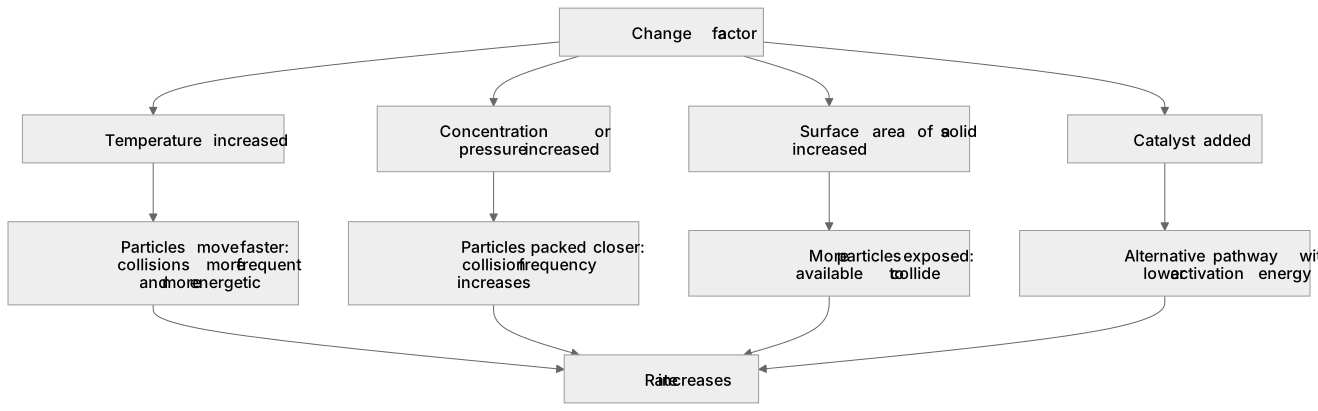
Label the diagram
Some boxes have lost their names. Pick the right name for each number.
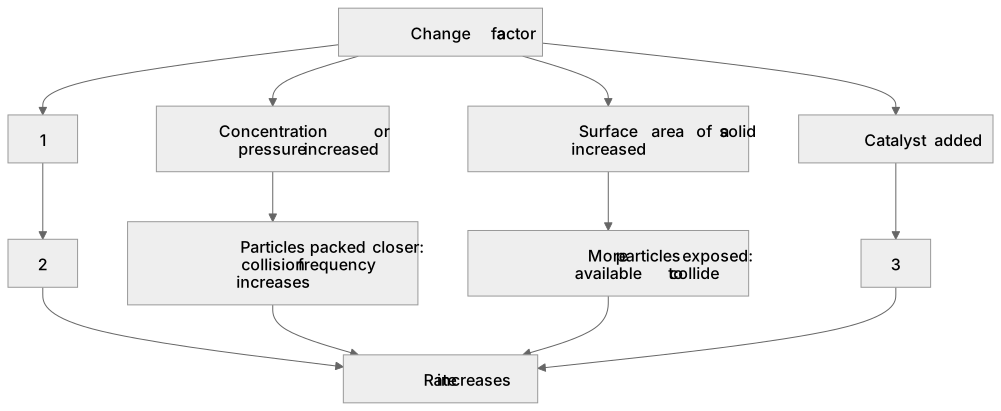
1Box 1
2Box 2
3Box 3
There is more to this lesson
The full lesson goes on to check your understanding and help you earn the marks. Create a free account to carry on, with your progress saved.
A week of Premium from your first lesson · Then the free plan continues · No card, no charge
Test your understanding of Factors which affect the rates of chemical reactions: Students should be able to recall how changing these factors affects the rate of chemical reactions.
Active recall beats re-reading. Take an instant quiz now to test what you’ve learned and lock it into long-term memory.
A week of Premium from your first lesson · Then the free plan continues · No card, no charge