AQA · GCSE · Combined Science
Course version: 8464 · Version from Sept 2018
Factors which affect the rates of chemical reactions: This should be an investigation involving developing a hypothesis.
Rates investigations begin with a testable hypothesis, not a guess.
- 4 key terms
Study notes
From the checked teaching notes for this specification point.
The idea
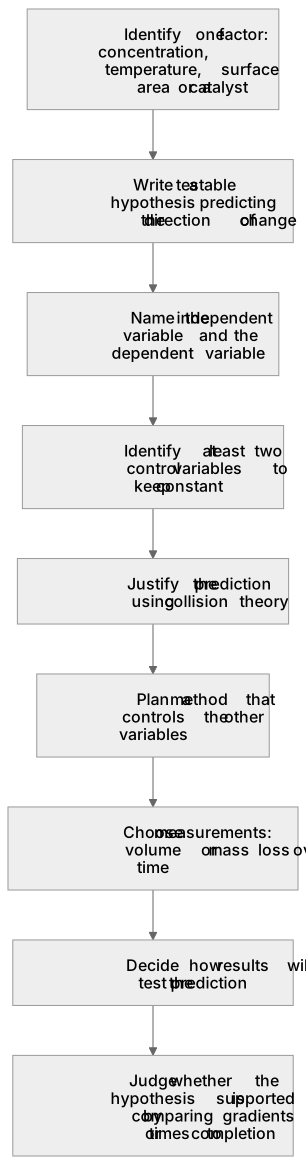
Rates investigations begin with a testable hypothesis, not a guess. You identify one factor, such as concentration, temperature, surface area or a catalyst, and predict its effect using collision theory. For example: 'Increasing the concentration of hydrochloric acid increases the rate of reaction with marble chips because there are more acid particles per unit volume, so more frequent successful collisions occur.' A good hypothesis names the independent variable, the dependent variable and the direction of change, and links to scientific reasoning. You then plan a method that controls other variables, choose measurements such as gas volume or mass loss over time, and decide how results will test the prediction.
What earns the marks
- State a clear hypothesis that links the chosen factor to the rate of reaction and predicts the direction of change.
- Identify the independent variable, dependent variable and at least two control variables in the investigation.
- Justify the hypothesis using collision theory, referring to frequency or energy of collisions between reacting particles.
- Describe a suitable method for measuring rate, such as volume of gas collected at timed intervals or loss in mass over time.
- Explain how the results will be used to judge whether the hypothesis is supported, for example by comparing gradients or times to completion.
Common mistakes and how to put them right
Writing a hypothesis as a question or a vague statement such as 'I think it will be faster'.
Put it right by making a precise prediction that names the factor and the expected effect on rate.
Changing several variables at once.
Put it right by keeping all variables except the independent variable constant so the test is fair.
Failing to link the prediction to collision theory.
Put it right by explaining that the factor changes either the frequency of collisions or the proportion of particles with energy greater than or equal to the activation energy.
Exam tips
- Write the hypothesis as a single sentence containing the independent variable, the dependent variable and the predicted direction of change.
- When describing the method, state exactly what is measured and how often, for example gas volume every 10 seconds.
- Use collision theory vocabulary such as frequency of collisions and activation energy to justify your prediction.
Try the lesson
The start of the Factors which affect the rates of chemical reactions: This should be an investigation involving developing a hypothesis. lesson, made from checked teaching notes for this specification point.
Have a go first
A student investigates how the concentration of hydrochloric acid affects the rate of its reaction with magnesium. Which statement is the most suitable hypothesis for this investigation?
Listen
Rates investigations begin with a testable hypothesis, not a guess. You identify one factor, such as concentration, temperature, surface area or a catalyst, and predict its effect using collision theory. For example: 'Increasing the concentration of hydrochloric acid increases the rate of reaction with marble chips because there are more acid particles per unit volume, so more frequent successful collisions occur. A good hypothesis names the independent variable, the dependent variable and the direction of change, and links to scientific reasoning. You then plan a method that controls other variables, choose measurements such as gas volume or mass loss over time, and decide how results will test the prediction. A strong answer earns marks for these points. State a clear hypothesis that links the chosen factor to the rate of reaction and predicts the direction of change. Identify the independent variable, dependent variable and at least two control variables in the investigation. Justify the hypothesis using collision theory, referring to frequency or energy of collisions between reacting particles. Describe a suitable method for measuring rate, such as volume of gas collected at timed intervals or loss in mass over time. A common slip: Writing a hypothesis as a question or a vague statement such as 'I think it will be faster'. Instead, making a precise prediction that names the factor and the expected effect on rate. Exam tip: Write the hypothesis as a single sentence containing the independent variable, the dependent variable and the predicted direction of change.
See it
Key words
Say what each word means before you turn the card.
Hypothesis development
Try answering aloud or in your head before turning the card.
Collision theory
Try answering aloud or in your head before turning the card.
Variables and fair testing
Try answering aloud or in your head before turning the card.
Measuring rate of reaction
Try answering aloud or in your head before turning the card.
See every definition
- Hypothesis development
- An investigation begins with a testable hypothesis that names the independent variable, the dependent variable and the direction of change, and links to scientific reasoning.
- Collision theory
- A hypothesis is justified by referring to the frequency or energy of collisions between reacting particles, including the proportion of particles with energy greater than or equal to the activation energy.
- Variables and fair testing
- The independent variable, dependent variable and at least two control variables are identified, keeping all variables except the independent variable constant so the test is fair.
- Measuring rate of reaction
- A suitable method measures rate, such as volume of gas collected at timed intervals or loss in mass over time, and results are used to judge whether the hypothesis is supported.
Label the diagram
Some boxes have lost their names. Pick the right name for each number.
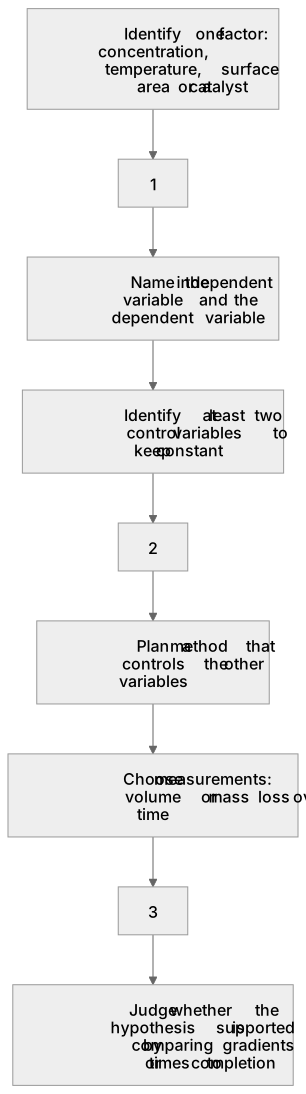
1Box 1
2Box 2
3Box 3
There is more to this lesson
The full lesson goes on to check your understanding and help you earn the marks. Create a free account to carry on, with your progress saved.
A week of Premium from your first lesson · Then the free plan continues · No card, no charge
Test your understanding of Factors which affect the rates of chemical reactions: This should be an investigation involving developing a hypothesis.
Active recall beats re-reading. Take an instant quiz now to test what you’ve learned and lock it into long-term memory.
A week of Premium from your first lesson · Then the free plan continues · No card, no charge