AQA · GCSE · Combined Science
Course version: 8464 · Version from Sept 2018
Fractional distillation and petrochemicals: Many of the fuels on which we depend for our modern lifestyle, such as petrol, diesel oil, kerosene, heavy fuel oil and liquefied petroleum gases, are produced from crude oil.
Crude oil is a finite mixture of hydrocarbons.
- 2 key terms
Study notes
From the checked teaching notes for this specification point.
The idea
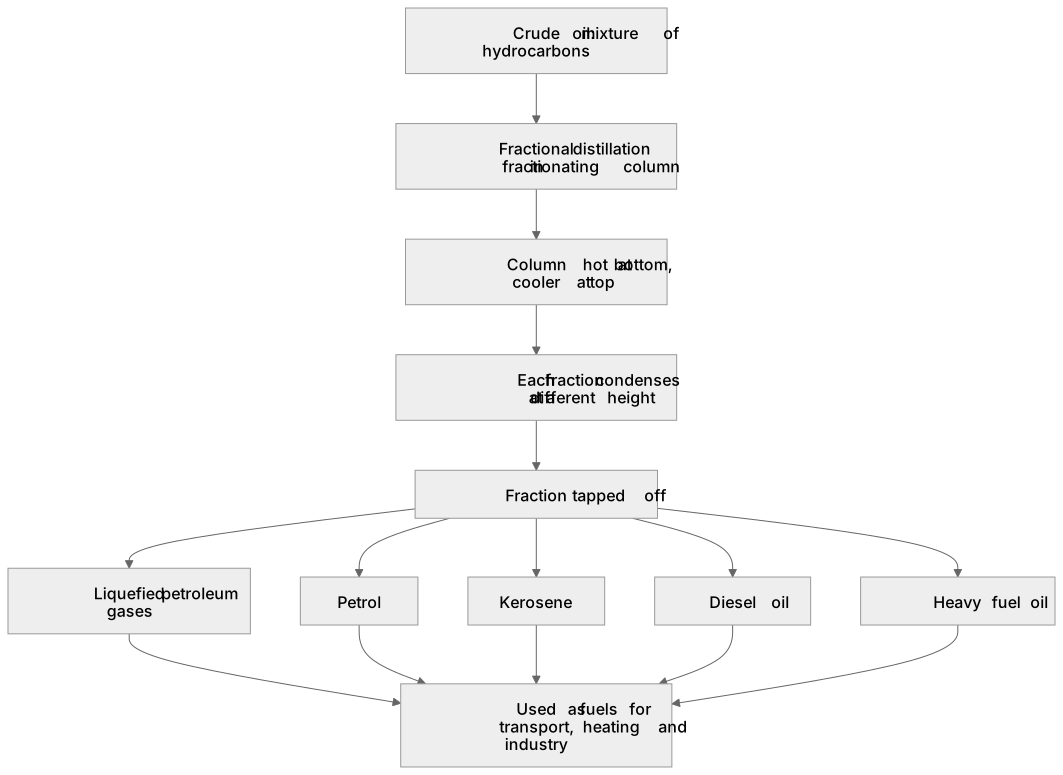
Crude oil is a finite mixture of hydrocarbons. It is separated by fractional distillation because the fractions have different boiling points. The column is hot at the bottom and cooler at the top. Each fraction condenses at a different height and is tapped off. Petrol, diesel oil, kerosene, heavy fuel oil and liquefied petroleum gases are examples of these fractions. They are fuels for cars, lorries, aircraft, ships and heating. Smaller molecules have lower boiling points, are more volatile, flow more easily and burn more cleanly. Larger molecules have higher boiling points, are more viscous and burn with a smoky flame. This explains why different fractions suit different uses.
What earns the marks
- Crude oil is a mixture of hydrocarbons that must be separated into fractions with different boiling point ranges.
- Fractional distillation uses a fractionating column with a temperature gradient: hot at the bottom, cooler at the top.
- Each fraction condenses at a different height because the hydrocarbons in it have a specific boiling point range.
- Petrol, diesel oil, kerosene, heavy fuel oil and liquefied petroleum gases are named fractions obtained from crude oil.
- The fractions are used as fuels because they release energy when burned, supporting transport, heating and industry.
- Smaller hydrocarbon molecules have lower boiling points, are more volatile and ignite more easily than larger molecules.
Common mistakes and how to put them right
Thinking crude oil is a single compound rather than a mixture.
Put it right: Crude oil is a mixture of many hydrocarbons with different boiling points.
Believing fractional distillation chemically changes the hydrocarbons.
Put it right: It is a physical separation process; the molecules themselves are unchanged.
Confusing the order of fractions in the column.
Put it right: Smaller molecules with lower boiling points leave near the top, while larger molecules with higher boiling points leave near the bottom.
Exam tips
- Link each named fuel to its use, for example kerosene for aircraft fuel and heavy fuel oil for ships, to show understanding of why the fraction is suitable.
- When describing the column, state clearly that it is hot at the bottom and cooler at the top, and that fractions condense at different heights.
- Use comparative language such as lower boiling point, more volatile and more viscous to explain trends rather than simply listing fractions.
Try the lesson
The start of the Fractional distillation and petrochemicals: Many of the fuels on which we depend for our modern lifestyle, such as petrol, diesel oil, kerosene, heavy fuel oil and liquefied petroleum gases, are produced from crude oil. lesson, made from checked teaching notes for this specification point.
Have a go first
Which raw material is the source of petrol, diesel oil and kerosene?
Listen
Crude oil is a finite mixture of hydrocarbons. It is separated by fractional distillation because the fractions have different boiling points. The column is hot at the bottom and cooler at the top. Each fraction condenses at a different height and is tapped off. Petrol, diesel oil, kerosene, heavy fuel oil and liquefied petroleum gases are examples of these fractions. They are fuels for cars, lorries, aircraft, ships and heating. Smaller molecules have lower boiling points, are more volatile, flow more easily and burn more cleanly. Larger molecules have higher boiling points, are more viscous and burn with a smoky flame. This explains why different fractions suit different uses. A strong answer earns marks for these points. Crude oil is a mixture of hydrocarbons that must be separated into fractions with different boiling point ranges. Fractional distillation uses a fractionating column with a temperature gradient: hot at the bottom, cooler at the top. Each fraction condenses at a different height because the hydrocarbons in it have a specific boiling point range. Petrol, diesel oil, kerosene, heavy fuel oil and liquefied petroleum gases are named fractions obtained from crude oil. A common slip: Thinking crude oil is a single compound rather than a mixture. Instead, crude oil is a mixture of many hydrocarbons with different boiling points. Exam tip: Link each named fuel to its use, for example kerosene for aircraft fuel and heavy fuel oil for ships, to show understanding of why the fraction is suitable.
See it
Key words
Say what each word means before you turn the card.
Crude oil
Try answering aloud or in your head before turning the card.
Fractional distillation
Try answering aloud or in your head before turning the card.
See every definition
- Crude oil
- A finite mixture of hydrocarbons that must be separated into fractions with different boiling point ranges.
- Fractional distillation
- A separation process using a fractionating column with a temperature gradient, hot at the bottom and cooler at the top, where each fraction condenses at a different height.
Label the diagram
Some boxes have lost their names. Pick the right name for each number.
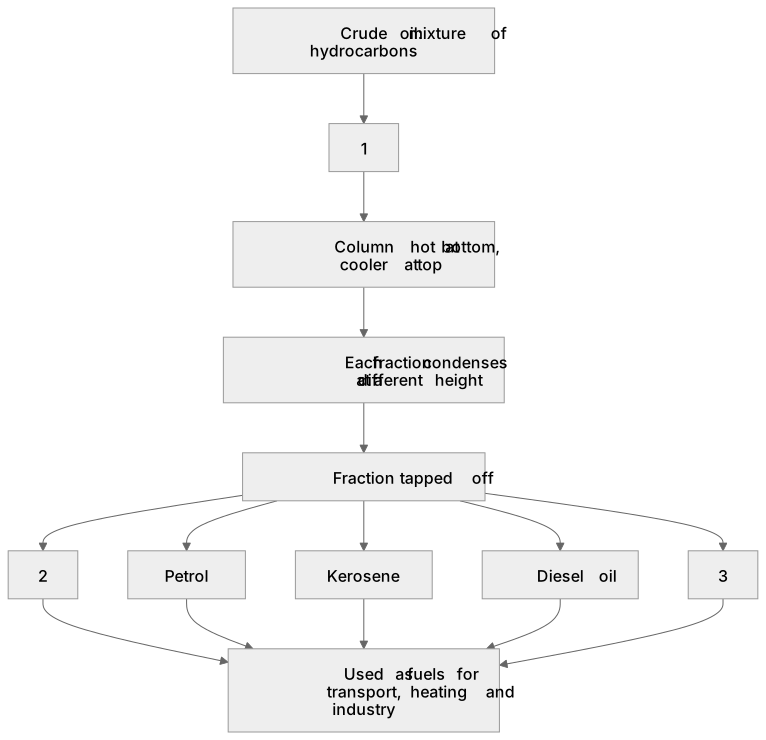
1Box 1
2Box 2
3Box 3
There is more to this lesson
The full lesson goes on to check your understanding and help you earn the marks. Create a free account to carry on, with your progress saved.
A week of Premium from your first lesson · Then the free plan continues · No card, no charge
Test your understanding of Fractional distillation and petrochemicals: Many of the fuels on which we depend for our modern lifestyle, such as petrol, diesel oil, kerosene, heavy fuel oil and liquefied petroleum gases, are produced from crude oil.
Active recall beats re-reading. Take an instant quiz now to test what you’ve learned and lock it into long-term memory.
A week of Premium from your first lesson · Then the free plan continues · No card, no charge